

Adding and subtracting integers on the number line
A frog hops past zero into the negatives. Thermometers and bank balances show why minus 3 plus 5 makes exactly 2.
Grade 7 (nine-year Gymnasium): topic fields of the curriculum; the order is binding only where the subject requires it. The numbers are those of the curriculum.
Negative fractions on the number line, opposite and absolute value, the four operations with rational numbers.
A frog hops past zero into the negatives. Thermometers and bank balances show why minus 3 plus 5 makes exactly 2.
Statements and open sentences, domain and solution set, equivalent transformations of equations and inequalities.

An expression drawn as a tree: whatever hangs lowest is calculated first. The order of operations stops being a rule and becomes visible.

Solve linear equations on a balance: whatever you do to both sides keeps the scale balanced.
Relationships in tables and graphs, proportional and inversely proportional relationships with line through the origin and hyperbola, the rule of three.

Twice as many apples cost twice as much. Picture, table and graph show together when a relation is proportional, with the rule of three.

Exactly one y for every x? The arrow diagram, table and graph tell you straight away whether a relation is a function.

The hyperbola gets ever closer to its asymptotes and yet never touches them. Shifting and stretching show what the parameters do.
Perpendiculars, perpendicular bisectors and angle bisectors, circumcircle and incircle of triangles.

A point equally far from A and B never lies there by chance: the perpendicular bisector appears before you draw it with compasses.
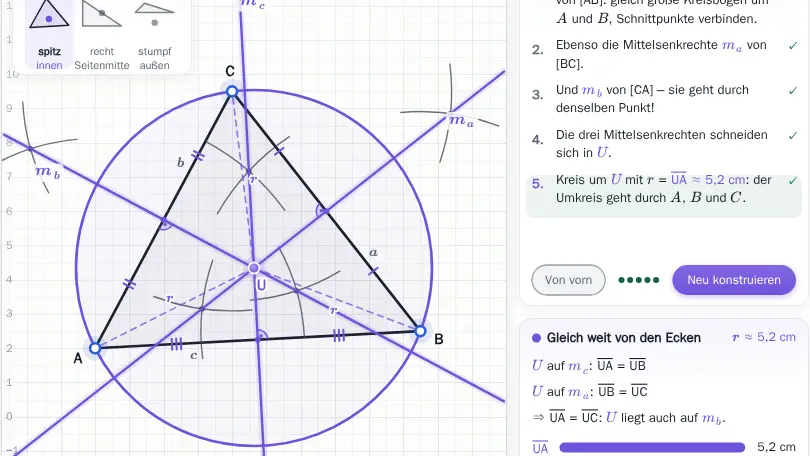

Construct the special lines in a triangle. Each set of three always meets in one point, for example at the centre of the circumcircle or the incircle.
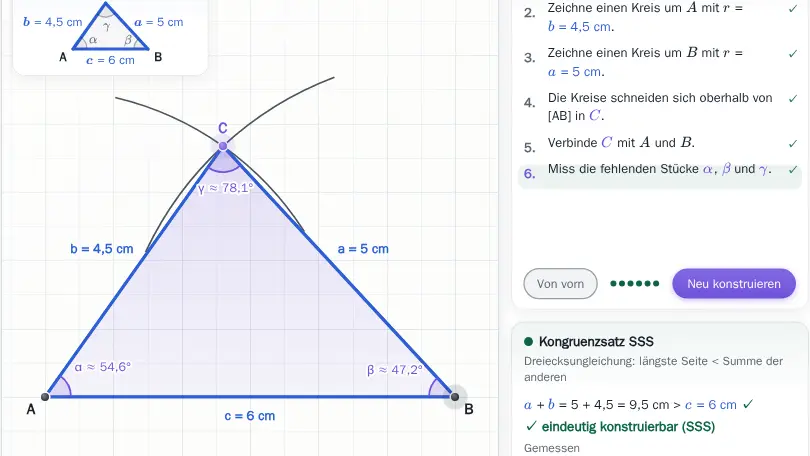
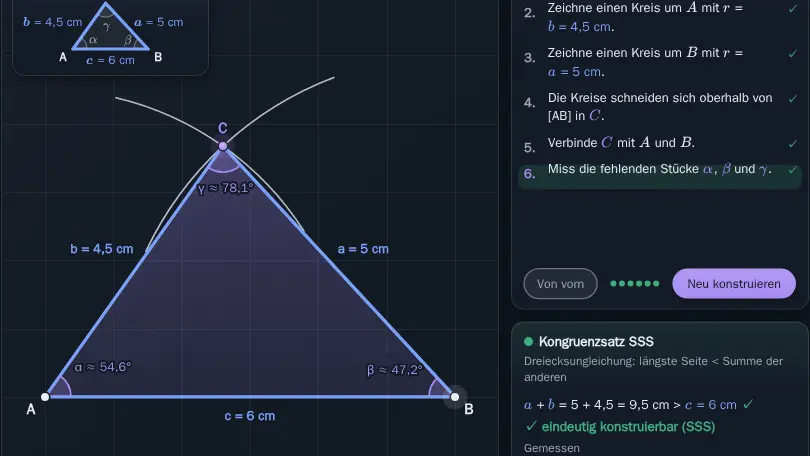
Construct triangles from three given parts with ruler and compass, step by step as in your exercise book. Sometimes there are no, one or two solutions.
Base value, percentage value and rate, increase and decrease, discount and VAT, simple and compound interest.

Discounts, VAT, surveys: one single bar holds the base value, the percentage and the part, one above the other.
Random experiments with outcomes and events, Laplace probability, simulations.

How many outfits or ice cream combinations are there? A tree diagram grows step by step and shows why you multiply the options.

Toss a coin, a die or a drawing pin a thousand times: the more often you throw, the closer the relative frequency gets to the probability.
Adjacent, vertical, corresponding and alternate angles, angle sums, secant and tangent, Thales’ theorem, converse.

Two lines cross and one of them turns. Which angles stay equal? At parallel lines they are called corresponding and alternate angles.

Tear off three corners, put them side by side, and you get a straight line: 180°, for every triangle. A quadrilateral gives 360°.

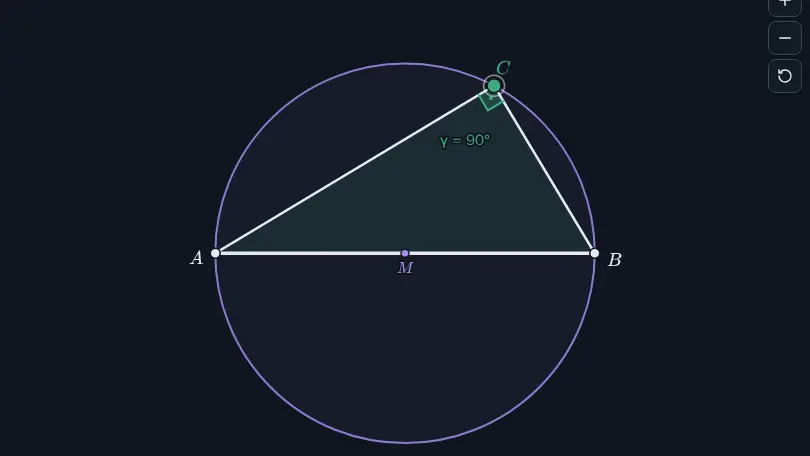
Drag a point along the semicircle: the angle there is always a right angle.
The summaries describe the curriculum in our own words. The original text is authoritative. Original text (German): Lehrplan, Gymnasium, Mathematics, grade 7