

Place value and rounding
Ten counters make a ten, ten tens make a hundred. Once you have seen the bundling, reading millions and rounding them is no longer a mystery.
Grades 5 and 6 (nine-year Gymnasium): the curriculum covers both grades together, so the units are the same for grades 5 and 6 and are shown as one stage. The order of the topic fields is binding only where the subject requires it. The numbers are those of the curriculum.
Data and charts, the decimal system with place value table and rounding, the binary system and Roman numerals, sets, the number line and order.
Ten counters make a ten, ten tens make a hundred. Once you have seen the bundling, reading millions and rounding them is no longer a mystery.

A frog hops past zero into the negatives. Thermometers and bank balances show why minus 3 plus 5 makes exactly 2.

Show the same data as bar, line and pie charts and more, and discover how charts can mislead.
The four operations and their terms, laws of arithmetic, terms with brackets, powers, figurate numbers.

An expression drawn as a tree: whatever hangs lowest is calculated first. The order of operations stops being a rule and becomes visible.

From a grain of sand to the Earth in steps of ten. Along the way it becomes clear why 10⁶ is a million and how to write tiny numbers.
Quantities with value and unit, converting between units, points in time and time spans.

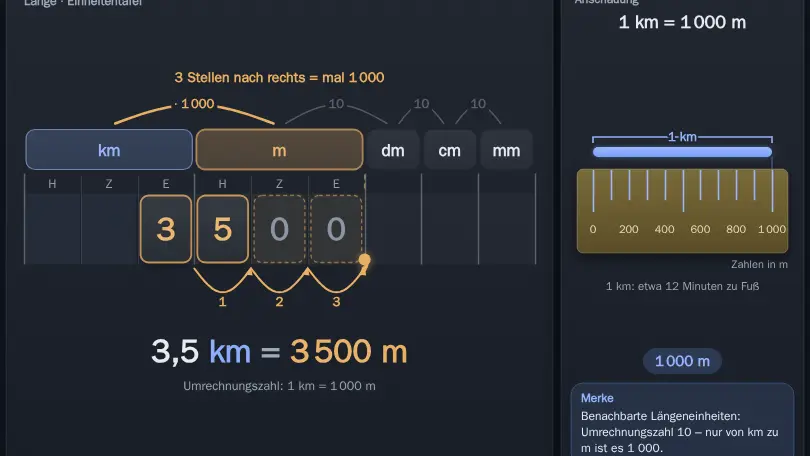
3.5 km is 3500 m, but 3.5 m² is 35,000 cm². The unit table shows why the decimal point jumps twice as far for areas.
Point, segment, ray and line, parallel and perpendicular, the coordinate system, quadrilaterals, solids with nets and oblique drawings.
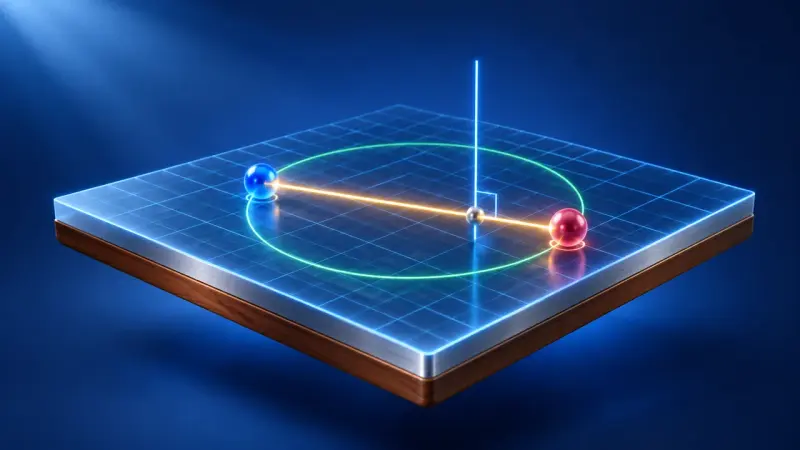
Place and read points in a coordinate system, draw segments and lines and check whether they are parallel or perpendicular.

Move one corner and the square becomes a kite. When does a quadrilateral get which name?

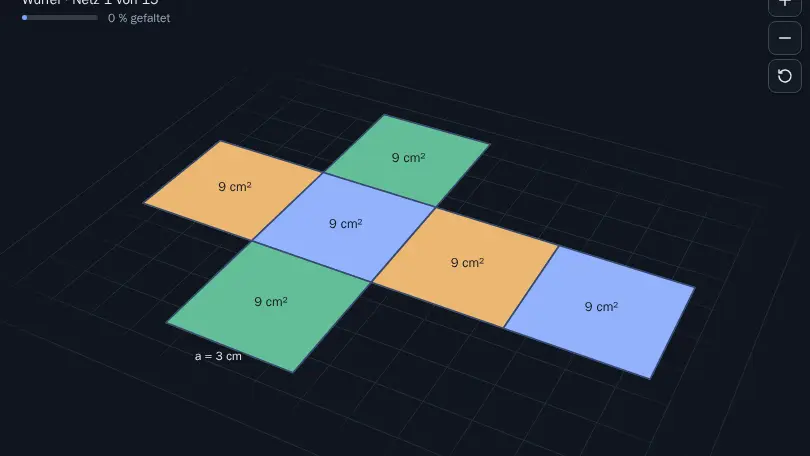
Fold nets of a cube, cuboid, prism, pyramid and cylinder into a solid in 3D and calculate the surface area.
Perimeter and area of rectangle and square, units of area and volume, volume and surface area of cuboid and cube.
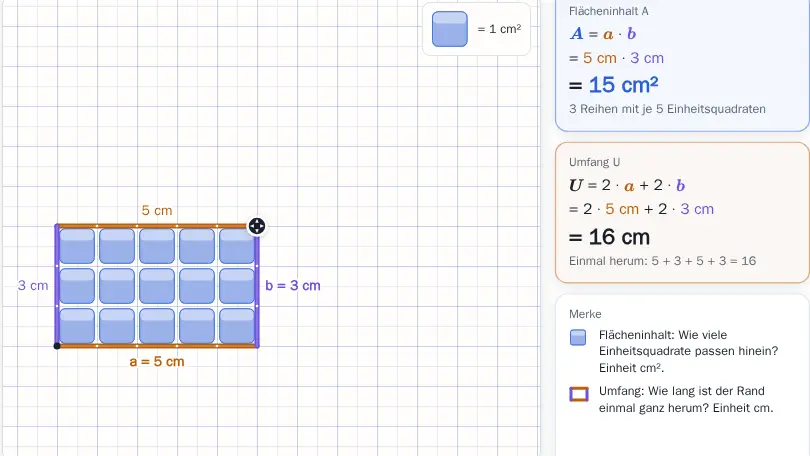

Count the squares or walk once around? An ant makes the difference between area and perimeter tangible.
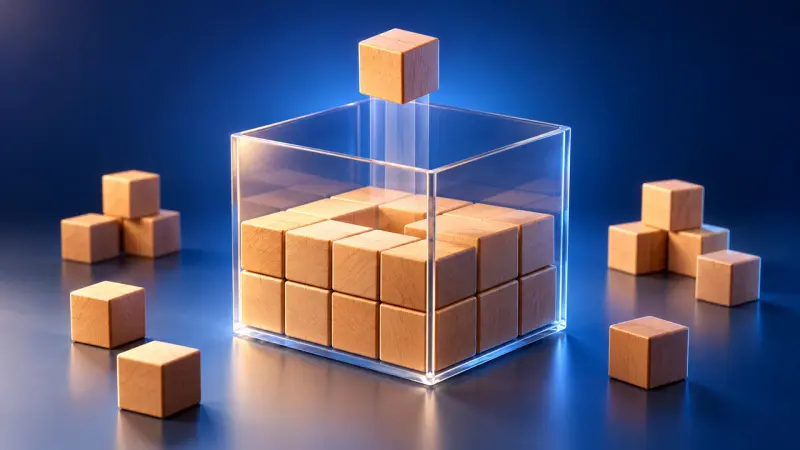
First a row of cubes, then a layer, then the whole cuboid. Length times width times height follows naturally from filling it.
Divisors and multiples, divisibility rules, prime numbers and prime factorisation, gcd and lcm.

Break numbers down into prime factors, check divisibility rules and find primes with a sieve. This also gives you the gcd and the lcm.
Fractions as parts, fractions on the number line, simplifying and expanding, comparing, decimals and recurring decimals.
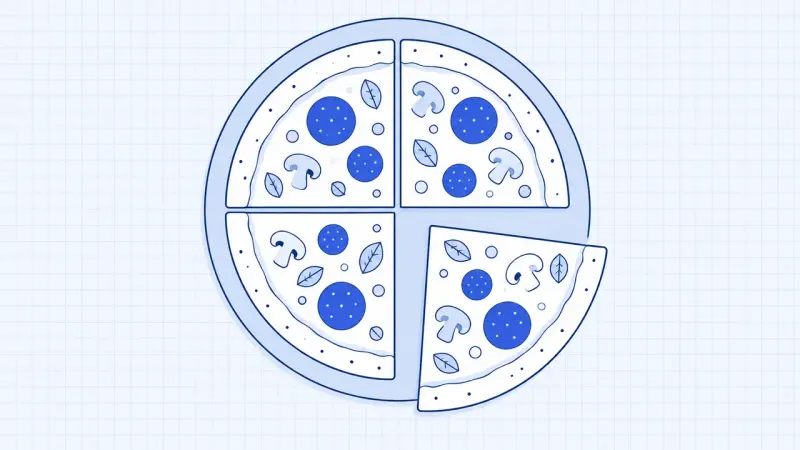
Pizza, cake or a line: share it out fairly first, then colour some pieces. That is exactly what a fraction means.

Compare two fractions as bars or circles. When you expand a fraction, the pieces get smaller but the amount stays the same.

Why does 1/4 end as a decimal but 1/3 never does? Long division gives it away as soon as a remainder repeats.
The four operations with fractions and decimals, reciprocals and complex fractions, moving the decimal point.

Two strips overlap in a rectangle: the shared area is the product of the fractions. Dividing by a fraction is shown visually as well.
Why does 1/4 end as a decimal but 1/3 never does? Long division gives it away as soon as a remainder repeats.
The circle with radius and diameter, measuring and drawing angles, line, point and rotational symmetry, reflection, rotation and translation, the base angle theorem.

Line up the protractor, hit the zero point, read the right scale. The estimation game then shows how well your eye already measures.

In a line or in a point: the shape flips over, and every construction step with the set square stays visible.
Absolute and relative frequency, pie charts, minimum, maximum, range, median and quartiles, box plots.
Show the same data as bar, line and pie charts and more, and discover how charts can mislead.

One outlier pulls the mean away while the median barely moves. Dragging single data points shows which value is how robust.
Negative numbers in everyday life, the number line and signs, the coordinate system with four quadrants, calculating with integers.
A frog hops past zero into the negatives. Thermometers and bank balances show why minus 3 plus 5 makes exactly 2.
Place and read points in a coordinate system, draw segments and lines and check whether they are parallel or perpendicular.
The summaries describe the curriculum in our own words. The original text is authoritative. Original text (German): Lehrplan, Gymnasium, Mathematics, grade 5/6