

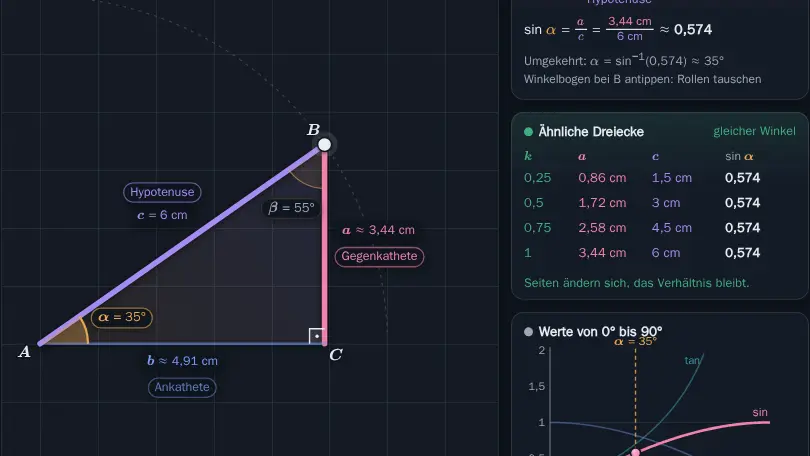
Sine, cosine and tangent in right triangles
In a right triangle, the ratio of two sides depends only on the angle. This gives sine, cosine and tangent, with examples such as ramps and ladders.
Grade 10 (nine-year Gymnasium): topic fields of the curriculum; the order is binding only where the subject requires it. The numbers are those of the curriculum.
Sine, cosine and tangent in right triangles and on the unit circle, angle of slope, the sine and cosine rules.
In a right triangle, the ratio of two sides depends only on the angle. This gives sine, cosine and tangent, with examples such as ramps and ladders.

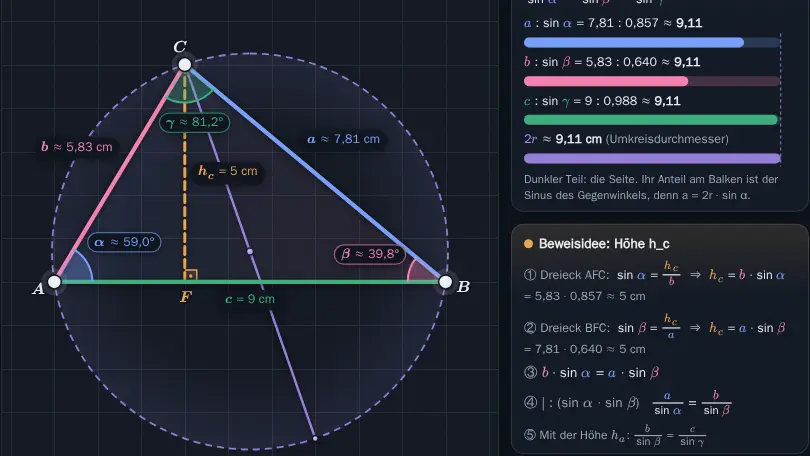
Calculate sides and angles in any triangle with the law of sines and the law of cosines. A helper shows which law fits your problem.

Sine, cosine and tangent on the unit circle, and how the sine curve grows out of it.
Powers and nth roots, scientific notation, power functions with symmetry, monotonicity and asymptotic behaviour.

Even or odd, positive or negative: y = a · xⁿ changes with every exponent, and only a few points always stay the same.
Tree diagrams and path rules, urn models and tuples, events with Venn diagrams and two-way tables, conditional probability.

Draw balls from an urn, with or without replacement. The tree diagram and the path rules show how to calculate probabilities.

How likely is it that two people in a class share a birthday? From just 23 people on, it is more likely than not.

Random points fall on a square with a circle inside. From the share inside the circle you can estimate π.

A two-way table, a Venn diagram and a tree diagram show the same data and are linked. Change one and the others follow.

A medical test is positive, but how likely is it that you are really ill? 1000 people show why the answer is often surprising.

Play yourself or simulate thousands of games: is it worth switching doors?
Linear and exponential growth, percentage growth rate, half-life and doubling time, exponential equations.

Water lilies on a pond, compound interest and decay: exponential growth compared with linear growth.
Pyramids, cones and their frustums, spheres, Cavalieri’s principle, surface area and volume.

Pour three times and the prism is full: a pyramid holds exactly one third. Cones and spheres can be turned and measured in 3D.

Push a stack of coins sideways: the shape changes, but the volume stays the same. This is Cavalieri's principle.
Radians, the sine function as a periodic function with period and amplitude.
Sine, cosine and tangent on the unit circle, and how the sine curve grows out of it.

Change the amplitude, period and shift of a sine curve with sliders or by dragging.
The summaries describe the curriculum in our own words. The original text is authoritative. Original text (German): Lehrplan, Gymnasium, Mathematics, grade 10