

General sine function
Change the amplitude, period and shift of a sine curve with sliders or by dragging.
Introductory phase of upper secondary (here grade 11): curriculum from 2014 (trial phase), written for the eight-year Gymnasium. Some content (sine function, solids, exponential functions) is already covered in grade 10 of the nine-year Gymnasium. The numbers are those of the curriculum.
Periodicity, the sine function and operations on it: translating, stretching and compressing.
Change the amplitude, period and shift of a sine curve with sliders or by dragging.

Shift, stretch, reflect: every move of the graph leaves its mark in the function's equation.
Prism and cylinder, pyramid and cone, Cavalieri’s principle, hemisphere and sphere.
No separate simulation is planned for this.
Exponential growth, exponential functions of the form x ↦ a · bˣ, logarithms and the laws of logarithms.
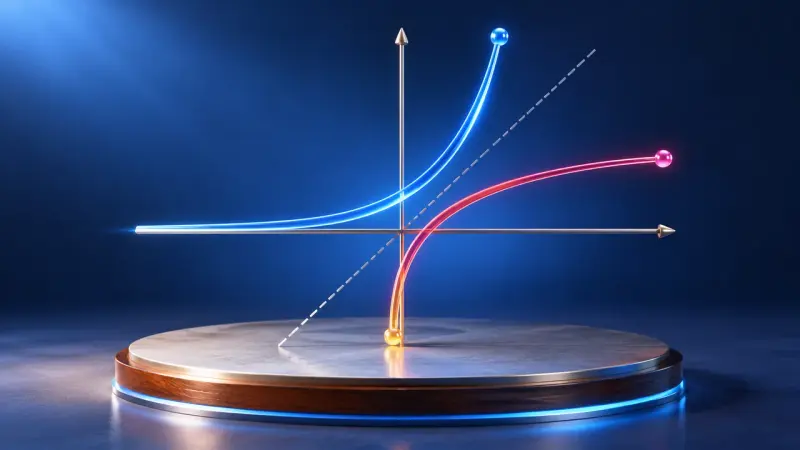
The logarithm answers the question: to what power do I raise the base to get this number? With graphs, rules and exponential equations.
Limits, local and global continuity, monotonicity, properties of continuous functions.

What happens to a graph when x gets very large? A point runs outwards and a magnifier shows how close it gets to the asymptote.
Average and local rate of change, differentiability and the derivative; optionally Newton’s method.

Let a point Q move towards P: the secant becomes the tangent, and the average slope becomes the derivative.

A tangent slides along the graph and draws its slope as a new graph: the derivative function.

Approximate a zero with tangent lines. Each step gets you closer, but sometimes it goes wrong.
Polynomial functions and their zeros, analysis with the first and second derivative, applications.
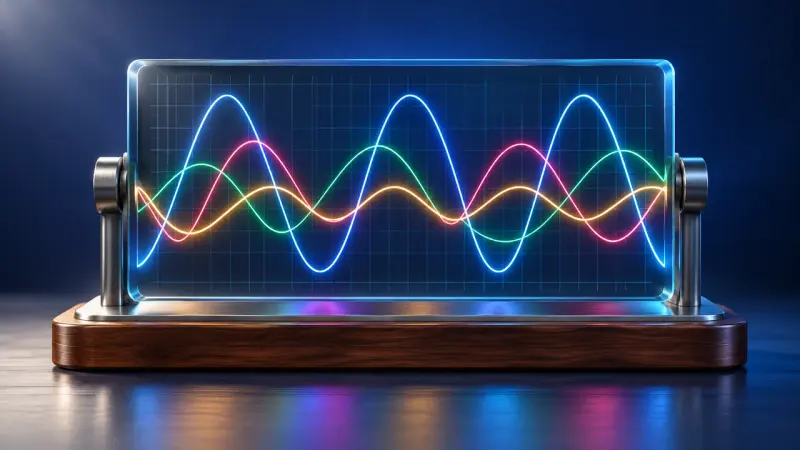
Up to three of your own functions at once, with a table of values, zeros and intersections. The tool for anything that can be a graph.
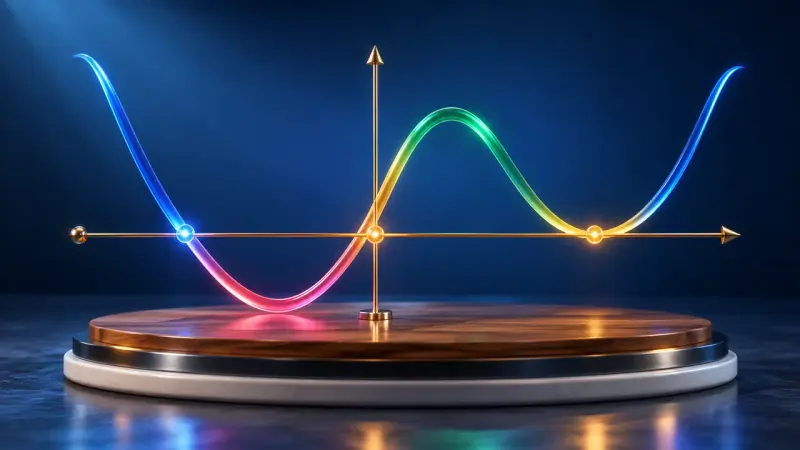
Does the graph cross the x-axis or only touch it? The multiplicity of the zero decides, the highest power decides what happens far out.

Analyse a graph step by step: zeros, maximum and minimum points, inflection points and where it rises or falls.

Which box holds the most, which can uses the least metal? Five everyday problems show how to find the best solution with the derivative.
The summaries describe the curriculum in our own words. The original text is authoritative. Original text (German): Lehrplan, Gymnasium, Mathematics, grade 11