

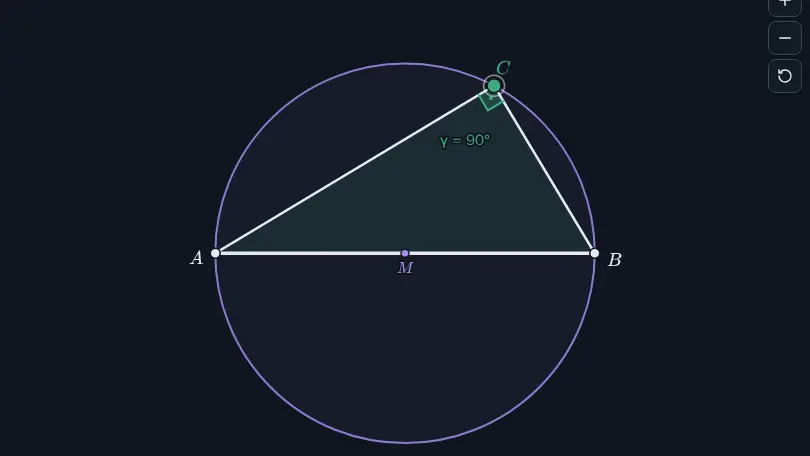
Thales’s theorem
Drag a point along the semicircle: the angle there is always a right angle.
The curriculum assigns these units to exactly this grade (Saxony, Gymnasium up to grade 12). The unit numbers are the curriculum’s; optional areas (“Wahlbereiche”) are labelled W1–W3 here.
Circles and lines, incircle and circumcircle, angle theorems in circles and Thales’ theorem; solving construction and proof problems.
Drag a point along the semicircle: the angle there is always a right angle.

A point equally far from A and B never lies there by chance: the perpendicular bisector appears before you draw it with compasses.
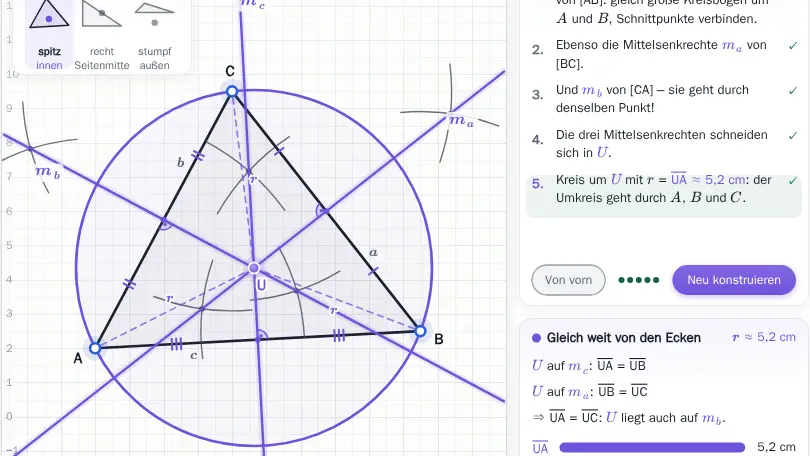

Construct the special lines in a triangle. Each set of three always meets in one point, for example at the centre of the circumcircle or the incircle.
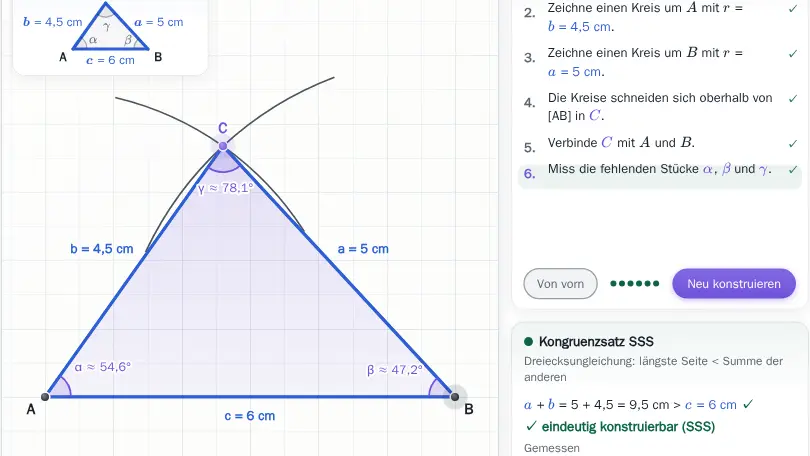
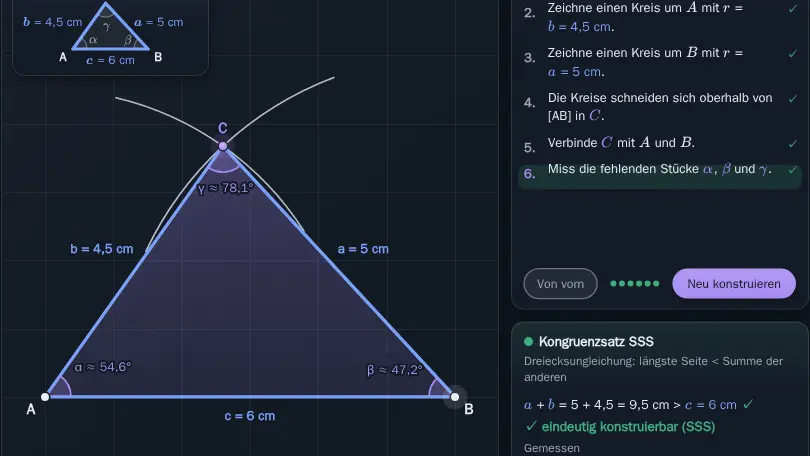
Construct triangles from three given parts with ruler and compass, step by step as in your exercise book. Sometimes there are no, one or two solutions.
Representing and ordering negative numbers, calculating with rational numbers, powers and square roots, solving linear equations and percentages.

A frog hops past zero into the negatives. Thermometers and bank balances show why minus 3 plus 5 makes exactly 2.

An expression drawn as a tree: whatever hangs lowest is calculated first. The order of operations stops being a rule and becomes visible.

Solve linear equations on a balance: whatever you do to both sides keeps the scale balanced.

Step by step, a rectangle turns into a square with the same area. The method is almost 2000 years old and reaches √2 surprisingly quickly.

Discounts, VAT, surveys: one single bar holds the base value, the percentage and the part, one above the other.
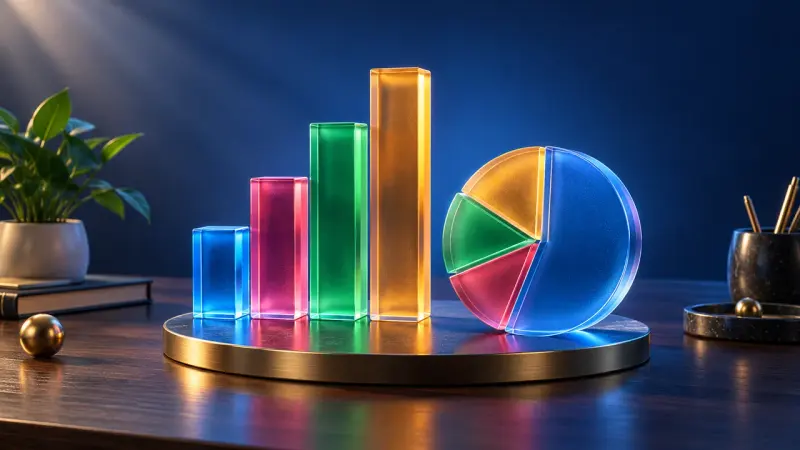
Show the same data as bar, line and pie charts and more, and discover how charts can mislead.
Prisms and pyramids in oblique and two-view drawings and as nets; surface area, volume and mass of pyramids and composite solids.

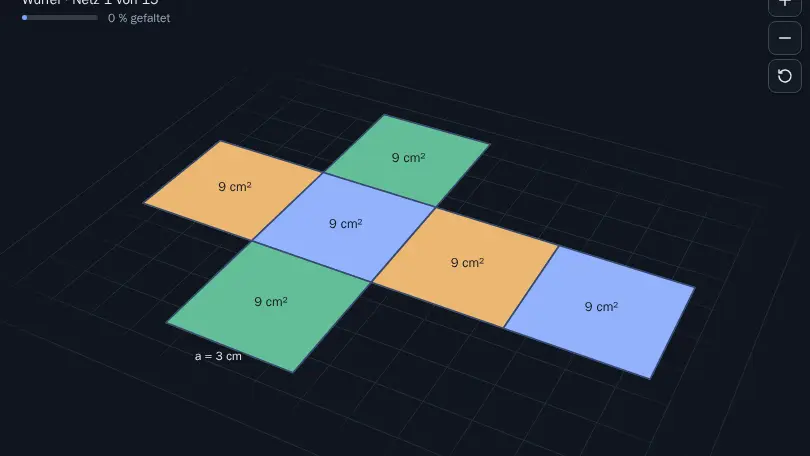
Fold nets of a cube, cuboid, prism, pyramid and cylinder into a solid in 3D and calculate the surface area.

Pour three times and the prism is full: a pyramid holds exactly one third. Cones and spheres can be turned and measured in 3D.
Presenting and evaluating statistical data in bar, line and pie charts.
Show the same data as bar, line and pie charts and more, and discover how charts can mislead.
Formulas, references and charts in spreadsheets.
No separate simulation is planned for this.
Enlarging and reducing, converting quantities with a scale, drawing to scale.
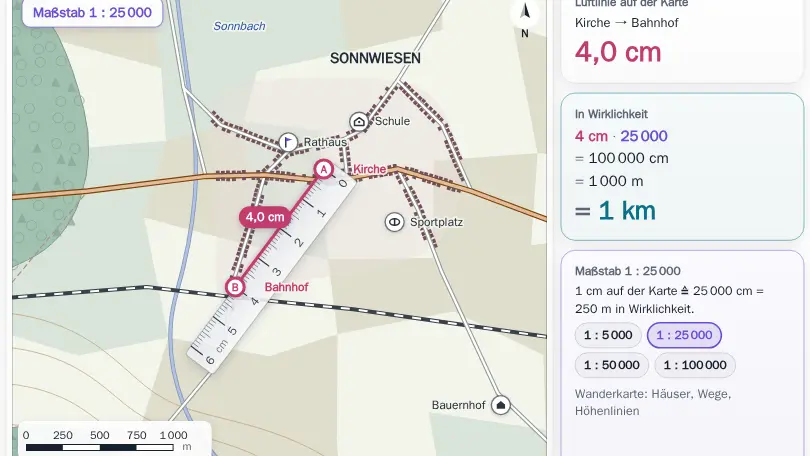

Measure on a map with a ruler and use the scale to work out the real distance.
Regular polyhedra and Euler’s polyhedron formula.
No separate simulation is planned for this.
The summaries describe the curriculum in our own words. The original text is authoritative. Original text (German): Lehrplan, Gymnasium, Mathematics, grade 7