

Terminating and repeating decimals
Why does 1/4 end as a decimal but 1/3 never does? Long division gives it away as soon as a remainder repeats.
The curriculum assigns these units to exactly this grade (Saxony, Gymnasium up to grade 12). The unit numbers are the curriculum’s; optional areas (“Wahlbereiche”) are labelled W1–W3 here.
Representing fractions and decimals, including recurring ones, calculating with them using the laws of arithmetic and solving word problems.
Why does 1/4 end as a decimal but 1/3 never does? Long division gives it away as soon as a remainder repeats.

Two strips overlap in a rectangle: the shared area is the product of the fractions. Dividing by a fraction is shown visually as well.

Compare two fractions as bars or circles. When you expand a fraction, the pieces get smaller but the amount stays the same.
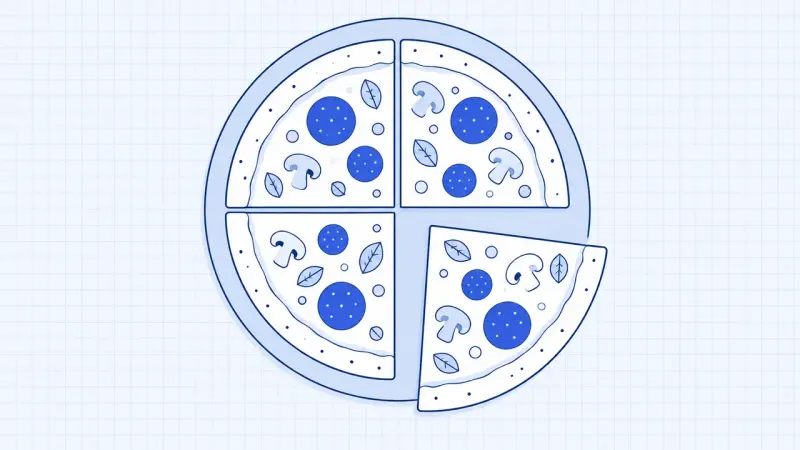
Pizza, cake or a line: share it out fairly first, then colour some pieces. That is exactly what a fraction means.

An expression drawn as a tree: whatever hangs lowest is calculated first. The order of operations stops being a rule and becomes visible.
Unique and non-unique relationships in tables, diagrams and arrow diagrams; direct and inverse proportionality with the rule of three.
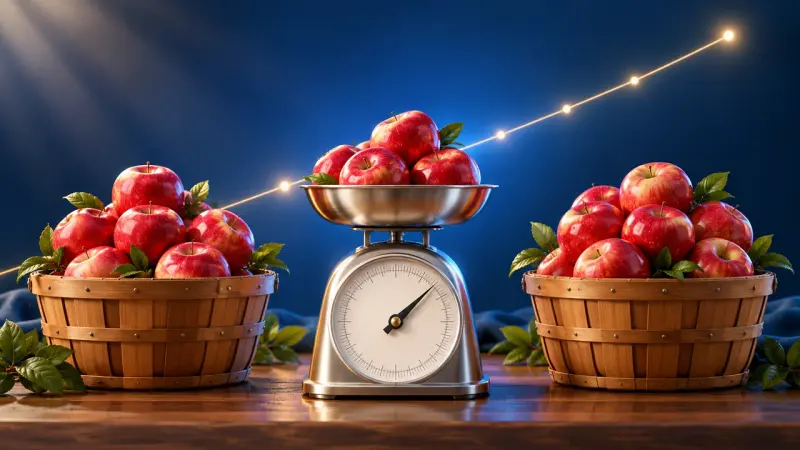
Twice as many apples cost twice as much. Picture, table and graph show together when a relation is proportional, with the rule of three.

Exactly one y for every x? The arrow diagram, table and graph tell you straight away whether a relation is a function.
Proving the angle sum theorem, congruence theorems for constructions, special lines in a triangle, perimeter and area of triangles and quadrilaterals, and classifying quadrilaterals.
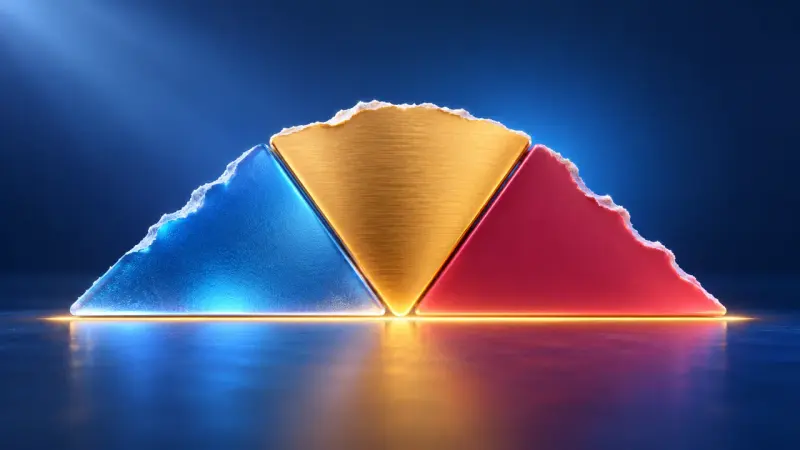
Tear off three corners, put them side by side, and you get a straight line: 180°, for every triangle. A quadrilateral gives 360°.
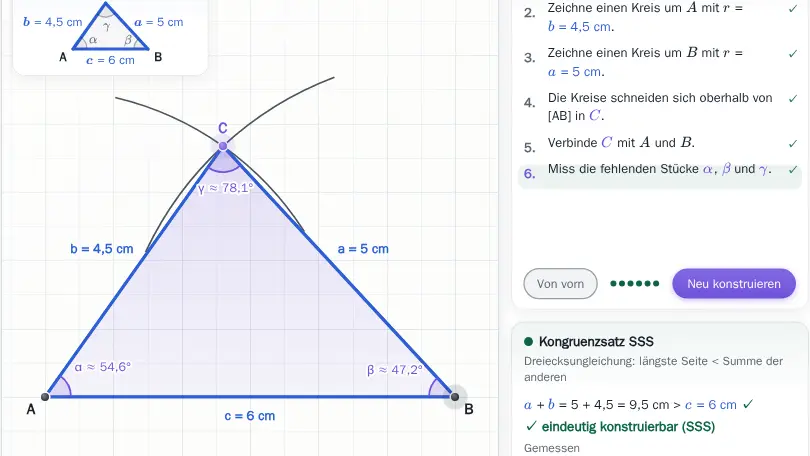
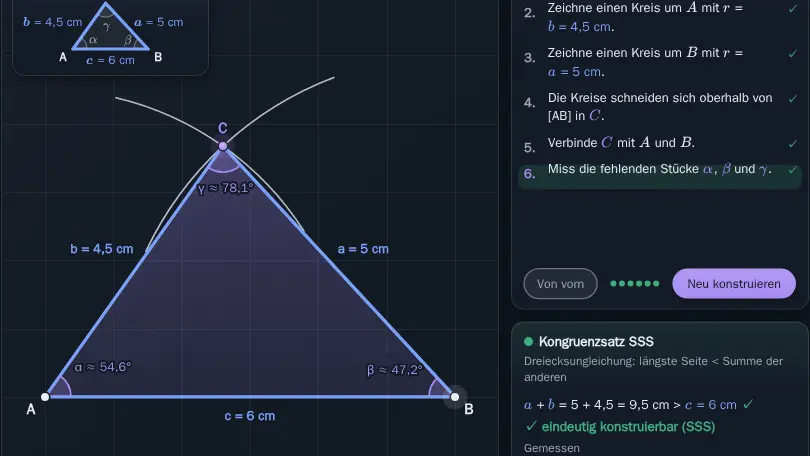
Construct triangles from three given parts with ruler and compass, step by step as in your exercise book. Sometimes there are no, one or two solutions.
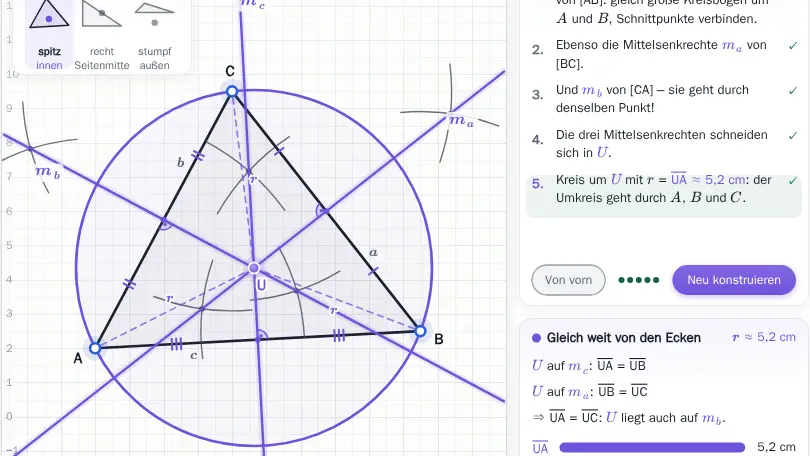

Construct the special lines in a triangle. Each set of three always meets in one point, for example at the centre of the circumcircle or the incircle.

A point equally far from A and B never lies there by chance: the perpendicular bisector appears before you draw it with compasses.
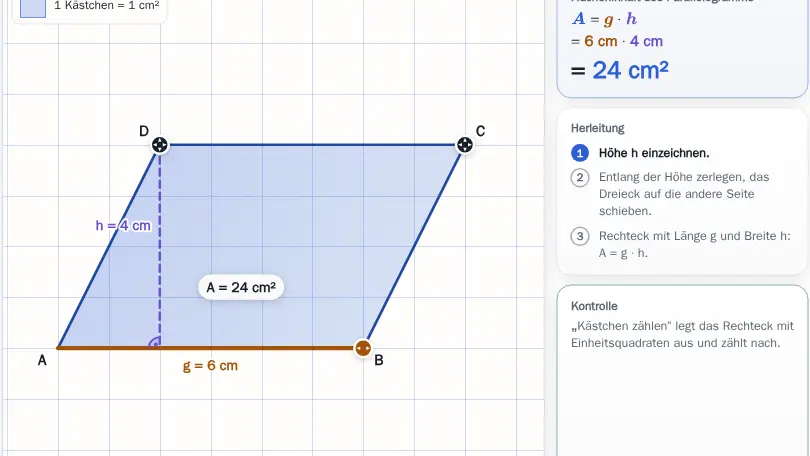
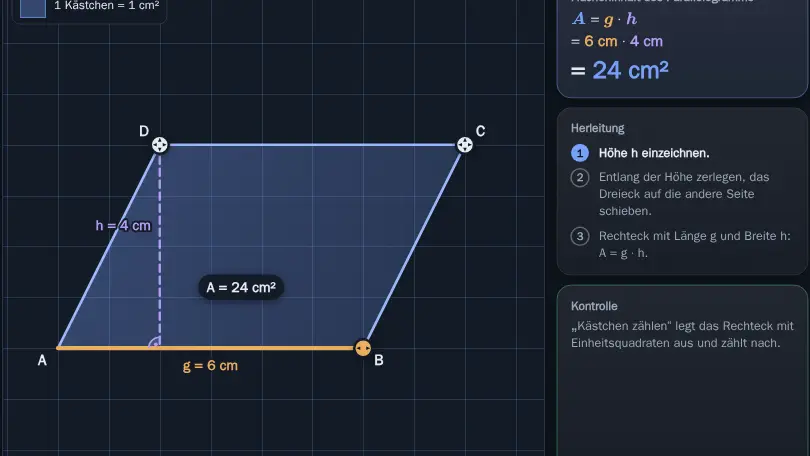
Cut off a triangle and put it on the other side: the parallelogram becomes a rectangle. Triangles and trapeziums work the same way.
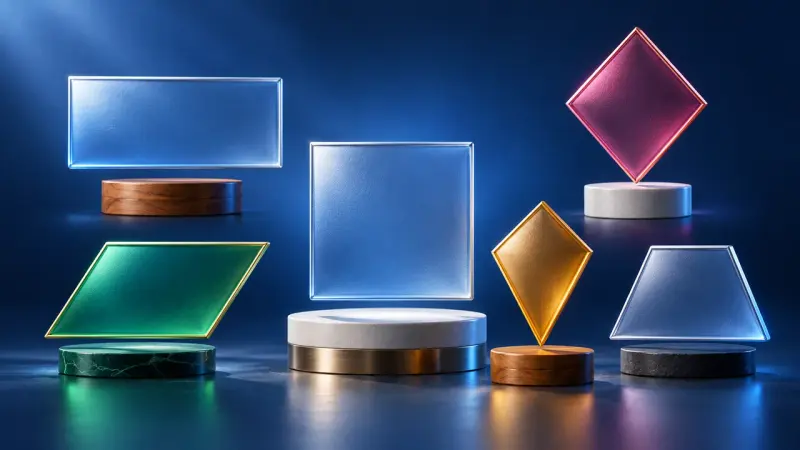
Move one corner and the square becomes a kite. When does a quadrilateral get which name?
Drawing prisms in cavalier perspective and as nets, calculating surface area and volume of right prisms.

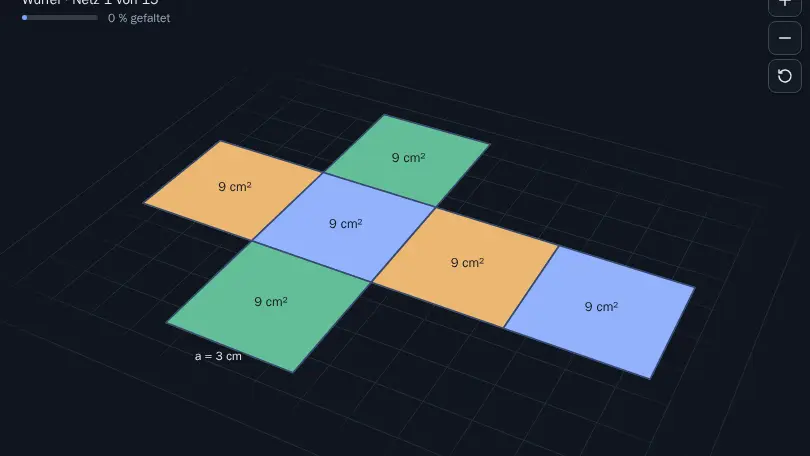
Fold nets of a cube, cuboid, prism, pyramid and cylinder into a solid in 3D and calculate the surface area.
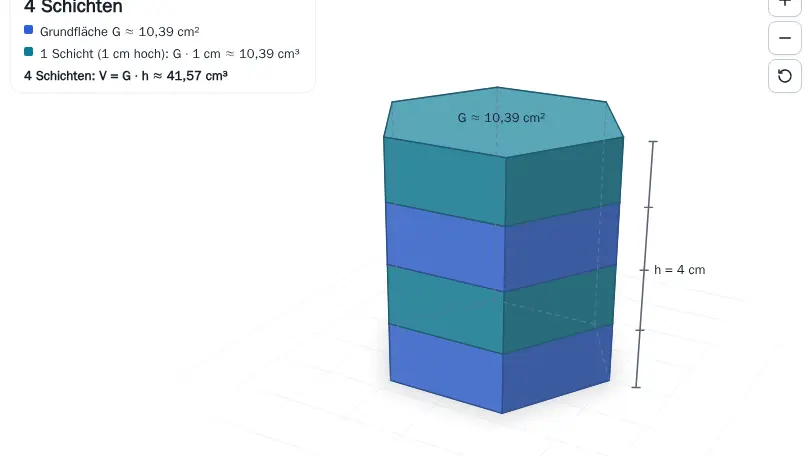
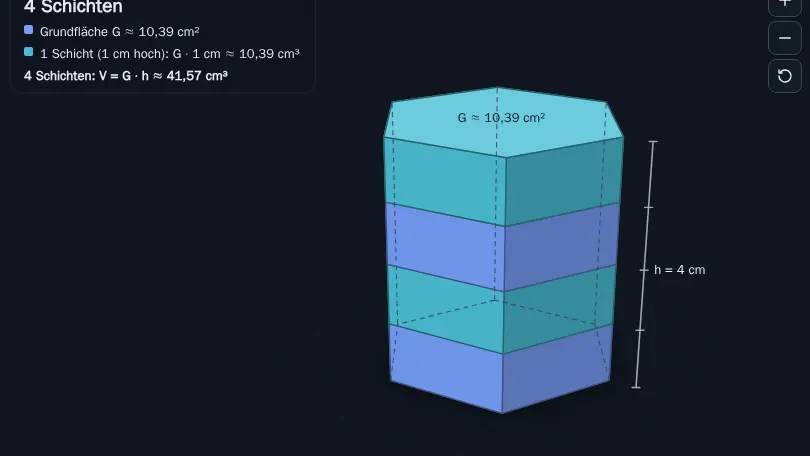
Layer by layer a prism grows upwards, and the curved surface of a cylinder unrolls into a rectangle.
Stating parts as fractions and percentages, showing them in pie charts and finding them for areas and solids.
Pizza, cake or a line: share it out fairly first, then colour some pieces. That is exactly what a fraction means.

Discounts, VAT, surveys: one single bar holds the base value, the percentage and the part, one above the other.

Show the same data as bar, line and pie charts and more, and discover how charts can mislead.
Measuring with geometry software and conjecturing relationships.
No separate simulation is planned for this.
Optical illusions, “impossible figures” and tiling puzzles.
No separate simulation is planned for this.
Prime factorisation, the sieve of Eratosthenes and the infinitude of primes.

Break numbers down into prime factors, check divisibility rules and find primes with a sieve. This also gives you the gcd and the lcm.
The summaries describe the curriculum in our own words. The original text is authoritative. Original text (German): Lehrplan, Gymnasium, Mathematics, grade 6