

Binomial formulas with squares
The three binomial formulas as areas: a square splits into smaller squares and rectangles.
The curriculum assigns these units to exactly this grade (Saxony, Gymnasium up to grade 12). The unit numbers are the curriculum’s; optional areas (“Wahlbereiche”) are labelled W1–W3 here.
Recognising the structure of terms, transforming terms and linear equations by hand, binomial formulas and an introduction to inequalities.
The three binomial formulas as areas: a square splits into smaller squares and rectangles.
Outcomes, events and relative frequencies, Laplace probability, multi-stage experiments with urn models, tree diagrams and path rules, and the product rule for counting.

Toss a coin, a die or a drawing pin a thousand times: the more often you throw, the closer the relative frequency gets to the probability.

Draw balls from an urn, with or without replacement. The tree diagram and the path rules show how to calculate probabilities.

How many outfits or ice cream combinations are there? A tree diagram grows step by step and shows why you multiply the options.

How likely is it that two people in a class share a birthday? From just 23 people on, it is more likely than not.
The concept and properties of functions, linear functions with slope and zero, linear regression, and solving systems with two unknowns graphically and algebraically.

Exactly one y for every x? The arrow diagram, table and graph tell you straight away whether a relation is a function.

Change the slope and the y-intercept of a line and read off the slope triangle and the zero.

Up to three of your own functions at once, with a table of values, zeros and intersections. The tool for anything that can be a graph.

Two equations are two lines. Their point of intersection is the solution, which you can read off and check.
Enlargement, the main similarity theorem and calculating lengths, areas and volumes of similar figures.
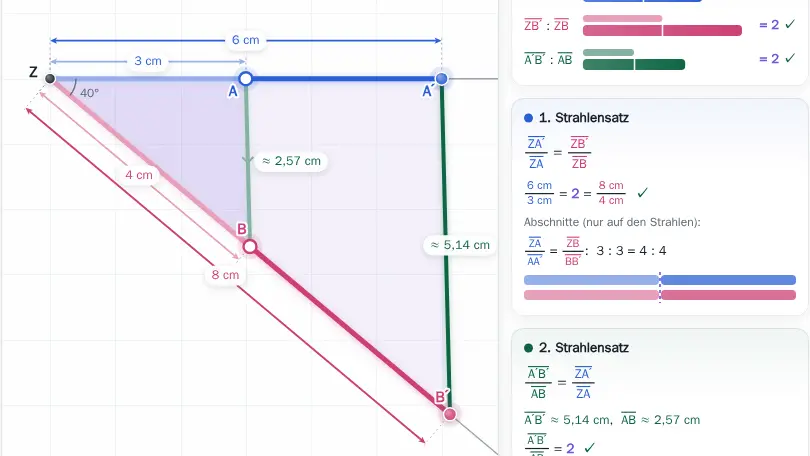
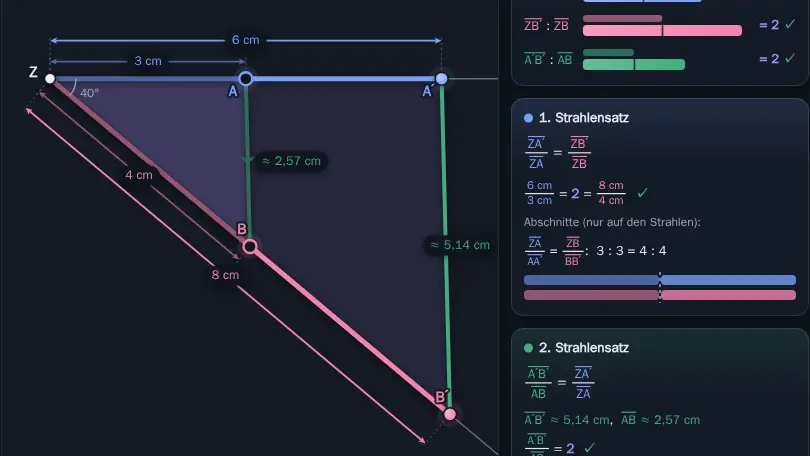
How tall is the tree without climbing it? Two rays and a parallel line are enough, because the ratios stay the same.

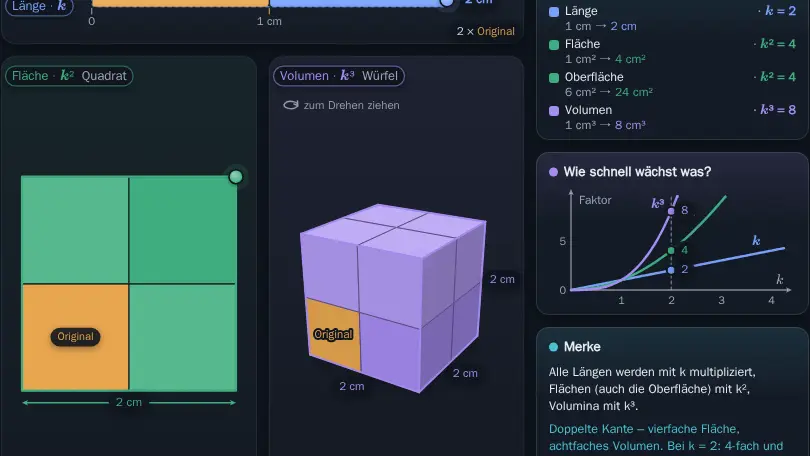
Enlarge lengths, areas and solids. Doubling the length makes the area four times and the volume eight times as large.
Working forwards and backwards, making solution plans and presenting solutions.
No separate simulation is planned for this.
Describing algorithms and implementing them with sequence, branching and loops.
No separate simulation is planned for this.
Solving optimisation problems graphically with an objective function.
No separate simulation is planned for this.
The Monte Carlo method: generating random numbers and simulating random experiments on the computer.

Random points fall on a square with a circle inside. From the share inside the circle you can estimate π.
Toss a coin, a die or a drawing pin a thousand times: the more often you throw, the closer the relative frequency gets to the probability.
The summaries describe the curriculum in our own words. The original text is authoritative. Original text (German): Lehrplan, Gymnasium, Mathematics, grade 8