

Exponential growth and decay
Water lilies on a pond, compound interest and decay: exponential growth compared with linear growth.
The curriculum assigns these units to exactly this grade (Saxony, Gymnasium up to grade 12). The unit numbers are the curriculum’s; optional areas (“Wahlbereiche”) are labelled W1–W3 here.
Describing growth and decay with exponential functions, parameters and regression; periodic processes with the sine function in degrees and radians.
Water lilies on a pond, compound interest and decay: exponential growth compared with linear growth.

Change the amplitude, period and shift of a sine curve with sliders or by dragging.

Sine, cosine and tangent on the unit circle, and how the sine curve grows out of it.

Shift, stretch, reflect: every move of the graph leaves its mark in the function's equation.
Probability distributions in bar charts and histograms, expected value, variance and standard deviation, and fair games.

Left or right at every pin, purely by chance. Yet every time the balls pile up into the same bell shape.
Deriving the laws of sines and cosines and applying them to triangles, pyramids and cones.

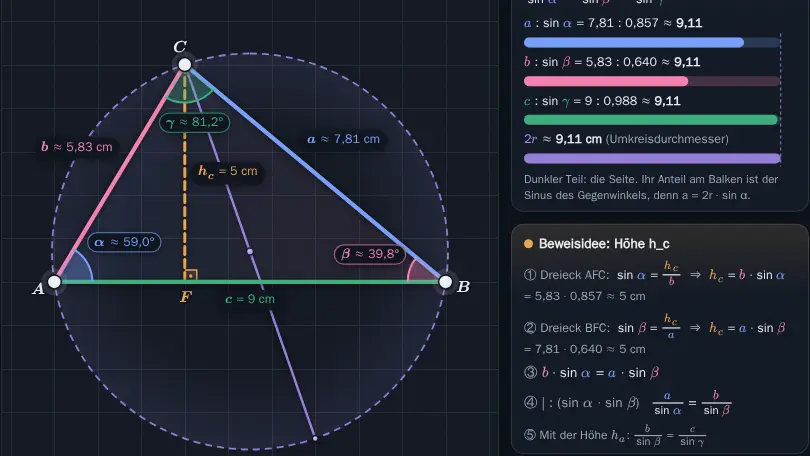
Calculate sides and angles in any triangle with the law of sines and the law of cosines. A helper shows which law fits your problem.

Pour three times and the prism is full: a pyramid holds exactly one third. Cones and spheres can be turned and measured in 3D.
Inverse functions and logarithms, exponential equations, combining and composing functions, key graphs by hand, and sequences with limits.
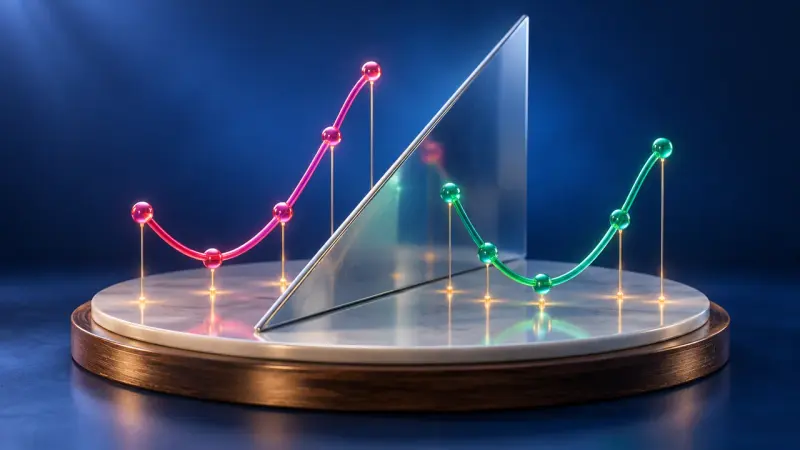
Reflect the graph in y = x and the inverse function appears. It only works if no function value occurs twice.
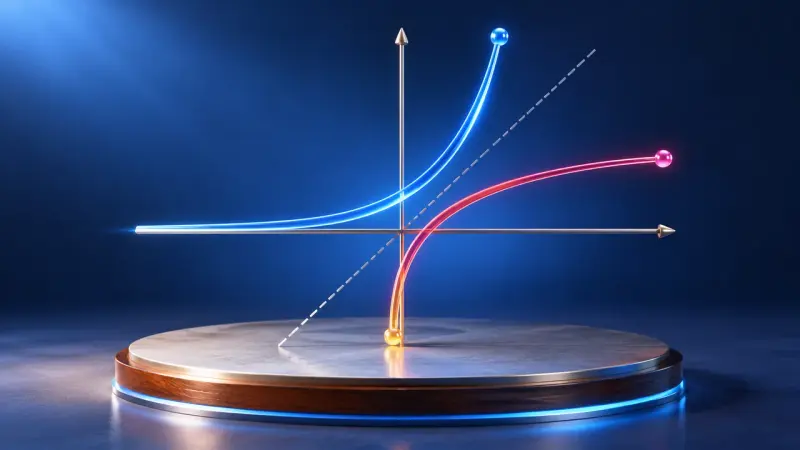
The logarithm answers the question: to what power do I raise the base to get this number? With graphs, rules and exponential equations.

What happens to a graph when x gets very large? A point runs outwards and a magnifier shows how close it gets to the asymptote.
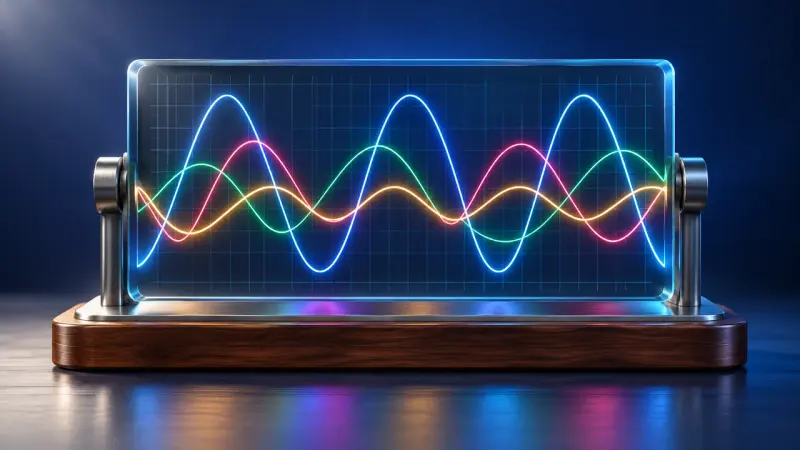
Up to three of your own functions at once, with a table of values, zeros and intersections. The tool for anything that can be a graph.
Simple and compound interest, loans and repayment.
Water lilies on a pond, compound interest and decay: exponential growth compared with linear growth.
The complex plane and calculating with complex numbers.
No separate simulation is planned for this.
The logistic growth model, explicit and recursive, and its limits.
No separate simulation is planned for this.
Describing curves with parameters and polar coordinates.
No separate simulation is planned for this.
The summaries describe the curriculum in our own words. The original text is authoritative. Original text (German): Lehrplan, Gymnasium, Mathematics, grade 10