
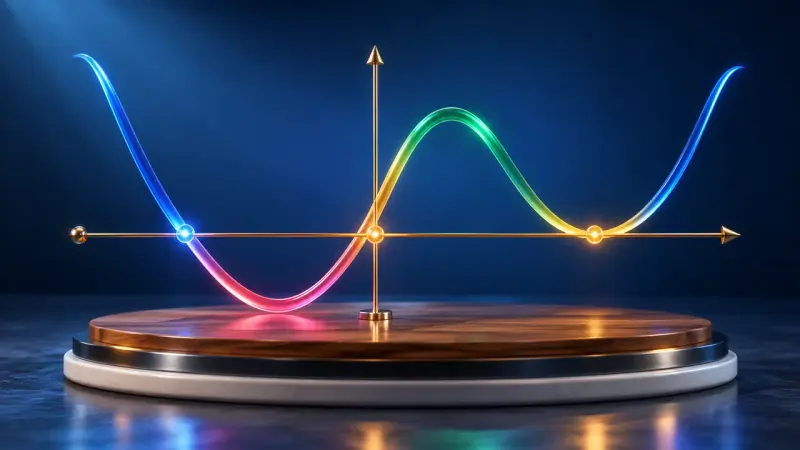
Polynomial functions: zeros, multiplicity and end behaviour
Does the graph cross the x-axis or only touch it? The multiplicity of the zero decides, the highest power decides what happens far out.
Introductory phase E1/E2 “Foundations of calculus”. Topic areas E.1–E.5 are mandatory. The core curriculum only names course half-years; assigning them to grade 11 is an assumption (G9).
Mandatory topic area. Revisiting and deepening the concept of function using polynomial functions: properties, special points and modelling with linear and quadratic functions.
Domain and range, symmetry, behaviour for large |x|, and shifting and stretching graphs.
Does the graph cross the x-axis or only touch it? The multiplicity of the zero decides, the highest power decides what happens far out.

Shift, stretch, reflect: every move of the graph leaves its mark in the function's equation.

What happens to a graph when x gets very large? A point runs outwards and a magnifier shows how close it gets to the asymptote.
Finding axis intercepts and intersections of two graphs graphically and algebraically.
No separate simulation is planned for this.
Describing real situations mainly with linear and quadratic functions.
No separate simulation is planned for this.
Mandatory topic area. From average to instantaneous rate of change: secant becomes tangent, derivative at a point and derivative function, first differentiation rules.
Interpreting rates of change in context, especially average and instantaneous velocity.

Let a point Q move towards P: the secant becomes the tangent, and the average slope becomes the derivative.
Limit from difference quotient to differential quotient using an intuitive notion of limit; tangent and normal.
Let a point Q move towards P: the secant becomes the tangent, and the average slope becomes the derivative.
Differentiating graphically, matching graphs of f and f′ with reasons; concept of an antiderivative.

A tangent slides along the graph and draws its slope as a new graph: the derivative function.
Justifying the power, constant-factor and sum rules and differentiating polynomials.
No separate simulation is planned for this.
Mandatory topic area. Curve sketching of polynomial functions, reconstructing functions from properties and solving optimisation problems.
Determining monotonicity, concavity, extrema and inflection points with necessary and sufficient conditions.

Analyse a graph step by step: zeros, maximum and minimum points, inflection points and where it rises or falls.
Does the graph cross the x-axis or only touch it? The multiplicity of the zero decides, the highest power decides what happens far out.
Finding a suitable function equation from conditions (e.g. extreme point, smooth join).
No separate simulation is planned for this.
Solving optimisation problems inside and outside mathematics with the derivative.

Which box holds the most, which can uses the least metal? Five everyday problems show how to find the best solution with the derivative.
Mandatory topic area. Exponential growth and decay, the natural exponential function and its derivative, product and chain rule, and solving exponential equations.
Interpreting parameters in f(x) = a·bˣ + c, half-life and doubling time, modelling with data.
No separate simulation is planned for this.
Deriving the number e and the derivative of eˣ intuitively; changing to base e.
No separate simulation is planned for this.
Differentiating products and compositions of polynomial and exponential functions.
No separate simulation is planned for this.
Solving exponential equations algebraically using logarithms.
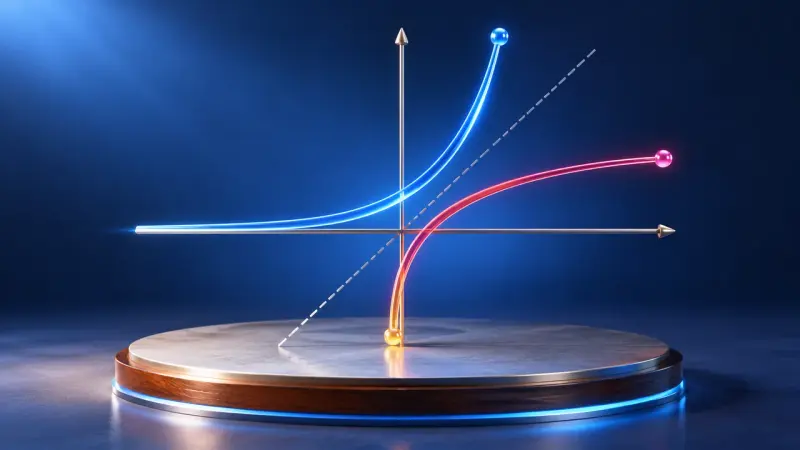
The logarithm answers the question: to what power do I raise the base to get this number? With graphs, rules and exponential equations.
Mandatory topic area. Describing periodic processes with sine and cosine functions, interpreting parameters and finding the derivatives of these functions.
Radians, meaning of the parameters in a·sin[b·(x − c)] + d, period, amplitude and modelling with data.

Change the amplitude, period and shift of a sine curve with sliders or by dragging.
Justifying the derivatives by graphical differentiation.
A tangent slides along the graph and draws its slope as a new graph: the derivative function.
Differentiating with the chain rule and interpreting derivative values in context; tangents and normals.
No separate simulation is planned for this.
Optional topic area. Polynomial division to find zeros and numerical approximation methods for equations.
Factorising polynomials to determine zeros.
No separate simulation is planned for this.
Comparing bisection, Newton's method and regula falsi, including convergence and limitations.

Approximate a zero with tangent lines. Each step gets you closer, but sometimes it goes wrong.
Optional topic area. Arithmetic and geometric sequences and series and their limits.
Justifying convergence and divergence and finding limits with limit laws.
No separate simulation is planned for this.
Investigating arithmetic and geometric series and their limits.
No separate simulation is planned for this.
The summaries describe the curriculum in our own words. The original text is authoritative. Original text (German): Kerncurriculum, Gymnasium, Mathematics, grade 11