

Two-way tables and Venn diagrams
A two-way table, a Venn diagram and a tree diagram show the same data and are linked. Change one and the others follow.
Qualification phase Q3 “Probability and statistics” and Q4 “Families of functions, problem solving and reasoning”. Q3.1–Q3.2 (in the advanced course also Q3.3) and Q4.1 are mandatory. Assigning them to grade 13 is an assumption (G9). “Advanced course only” marks the higher level.
Mandatory topic area. Concept of probability, multi-stage experiments, events and sets, conditional probability, independence and combinatorics.
Absolute and relative frequency and the empirical law of large numbers.
No separate simulation is planned for this.
Outcome, event, Laplace probability and comparison with experimental results.
No separate simulation is planned for this.
Using tree diagrams and path rules.
No separate simulation is planned for this.
And, or and complementary events, set notation, also with a two-way table.
A two-way table, a Venn diagram and a tree diagram show the same data and are linked. Change one and the others follow.
Conditional probabilities in tree diagrams and contingency tables; stochastic independence.

A medical test is positive, but how likely is it that you are really ill? 1000 people show why the answer is often surprising.
A two-way table, a Venn diagram and a tree diagram show the same data and are linked. Change one and the others follow.
Product rule, samples with/without replacement, factorial, binomial coefficient.
No separate simulation is planned for this.
Comparing urn models with and without replacement (e.g. lottery).

How likely is it that two people in a class share a birthday? From just 23 people on, it is more likely than not.
Mandatory topic area. Random variables with expected value and spread, Bernoulli chains and binomial distribution; in the advanced course also the normal distribution.
Random variable, distribution as histogram, expected value, variance, standard deviation; fair games.
No separate simulation is planned for this.
Justifying Bernoulli's formula and applying it in context; limits of the model.

The histogram of the binomial distribution: choose a range and read off the probability directly.
Parameters, histograms and cumulative probabilities, including inverse problems.
The histogram of the binomial distribution: choose a range and read off the probability directly.
Density function, bell shape, μ and σ, maximum and inflection points.

How many bottles are underfilled? Under the bell curve every probability is an area, with the sigma rules as a rule of thumb.
Cumulative distribution function, sigma rules and inverse problems.
How many bottles are underfilled? Under the bell curve every probability is an area, with the sigma rules as a rule of thumb.
[mandatory in the advanced course only (optional in the basic course)] Significance tests for binomially distributed random variables with decision rule and type I and II errors; in the advanced course also the operating characteristic.
Setting hypotheses, finding the rejection region, calculating type I and II errors.
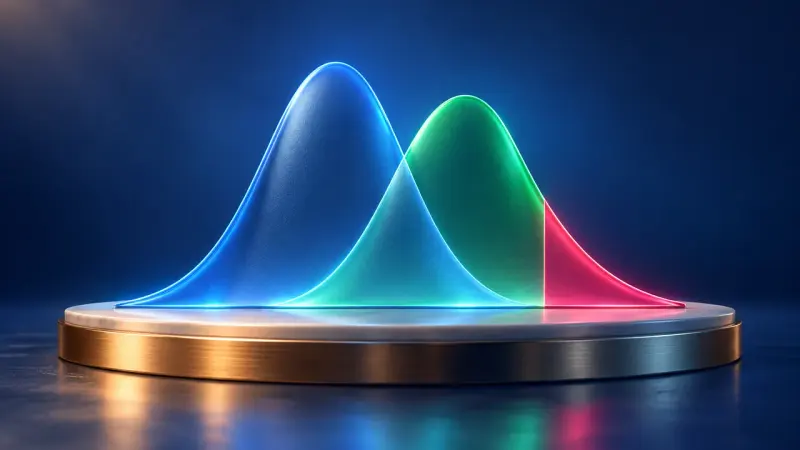
A test decides between two hypotheses. Coloured areas show how often it can be wrong.
Plotting and interpreting the operating characteristic or power function.
No separate simulation is planned for this.
Optional topic area. Using sigma rules to infer from population to sample and vice versa.
Determining expected ranges for sample results.
No separate simulation is planned for this.
Estimating a range for the unknown probability from a sample.
No separate simulation is planned for this.
Representing confidence regions graphically.
No separate simulation is planned for this.
Calculating the sample size needed for a confidence level.
No separate simulation is planned for this.
Optional topic area. Own data collection and simulations, empirical statistics, Poisson distribution; in the advanced course approximations and further continuous distributions.
Carrying out own random experiments and simulating them with software.
No separate simulation is planned for this.
Assessing own data with mean, empirical variance and standard deviation.
No separate simulation is planned for this.
Calculating rare events with the Poisson distribution.
No separate simulation is planned for this.
Approximating binomial histograms with large spread by the bell curve.
How many bottles are underfilled? Under the bell curve every probability is an area, with the sigma rules as a rule of thumb.
Proving the limit as n → ∞.
No separate simulation is planned for this.
E.g. the exponential distribution.
No separate simulation is planned for this.
Mandatory topic area. Investigating and integrating functions with a parameter, especially polynomial families and families combined with exponential functions; in the advanced course loci.
Influence of the parameter on zeros, extrema and areas.

One parameter, infinitely many graphs. Where do the maxima go as k grows? Along a curve of their own, the locus.
Investigating and integrating families built from exponential functions and polynomials.
One parameter, infinitely many graphs. Where do the maxima go as k grows? Along a curve of their own, the locus.
Interpreting the parameter as a shift or stretch of the graph.
One parameter, infinitely many graphs. Where do the maxima go as k grows? Along a curve of their own, the locus.
Determining the loci of extreme and inflection points.
No separate simulation is planned for this.
Optional topic area. Process-oriented topic area: recognising problems, using heuristic strategies and developing arguments, applied to freely chosen content from all areas.
Framing questions mathematically.
No separate simulation is planned for this.
E.g. working forwards/backwards, systematic trial, extremal and symmetry principles.
No separate simulation is planned for this.
Checking statements and evaluating them with reasons.
No separate simulation is planned for this.
Understanding chains of reasoning and building them oneself.
No separate simulation is planned for this.
Examples from calculus, analytic geometry, linear algebra and probability.
No separate simulation is planned for this.
Strategies for hypotheses and critical values; influence of n on the operating characteristic.
A test decides between two hypotheses. Coloured areas show how often it can be wrong.
Optional topic area. Calculating with complex numbers in algebraic and polar form and solving equations in ℂ.
Real and imaginary part, basic operations.
No separate simulation is planned for this.
Representation in the complex plane and geometric interpretation of the operations.
No separate simulation is planned for this.
Solving equations that have no solution in ℝ.
No separate simulation is planned for this.
Complex numbers as rotation-dilation matrices.
No separate simulation is planned for this.
The summaries describe the curriculum in our own words. The original text is authoritative. Original text (German): Kerncurriculum, Gymnasium, Mathematics, grade 13