
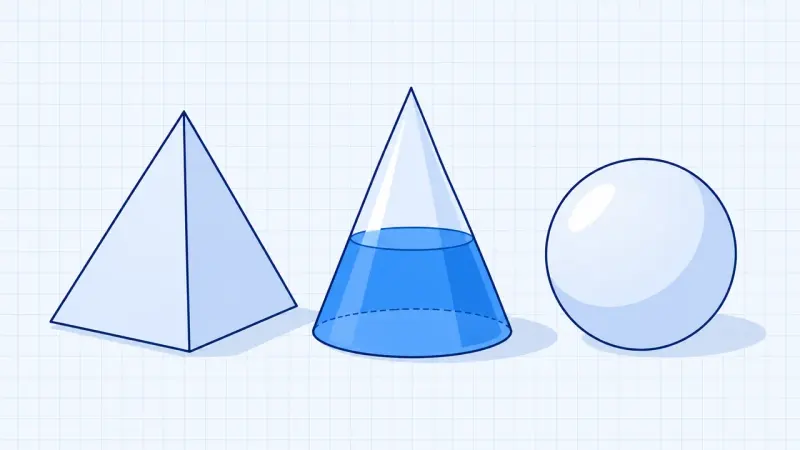
Pyramid, cone and sphere
Pour three times and the prism is full: a pyramid holds exactly one third. Cones and spheres can be turned and measured in 3D.
MathematicsHesse curriculum · Gymnasium
Double grade 9/10: the core curriculum describes what should be achieved by the end of grade 10, so the units are the same for grades 9 and 10. Both grades are therefore shown as one stage. The numbers (guiding idea.content area.focus) are our own.
Pyramid, cone and sphere as well as solids from technology and everyday life: representation and calculation of volume and surface area.
Getting to know pointed and round solids and their properties.
Pour three times and the prism is full: a pyramid holds exactly one third. Cones and spheres can be turned and measured in 3D.
Modelling real objects as combinations of basic solids.
No separate simulation is planned for this.
Justifying volume formulas (e.g. Cavalieri) and applying them.
Pour three times and the prism is full: a pyramid holds exactly one third. Cones and spheres can be turned and measured in 3D.

Push a stack of coins sideways: the shape changes, but the volume stays the same. This is Cavalieri's principle.
Representing pyramids and cones as nets and oblique drawings too.
No separate simulation is planned for this.
Trigonometry: sine, cosine and tangent in right-angled and general triangles.
Side ratios as sin, cos, tan; law of sines and law of cosines for any triangle.
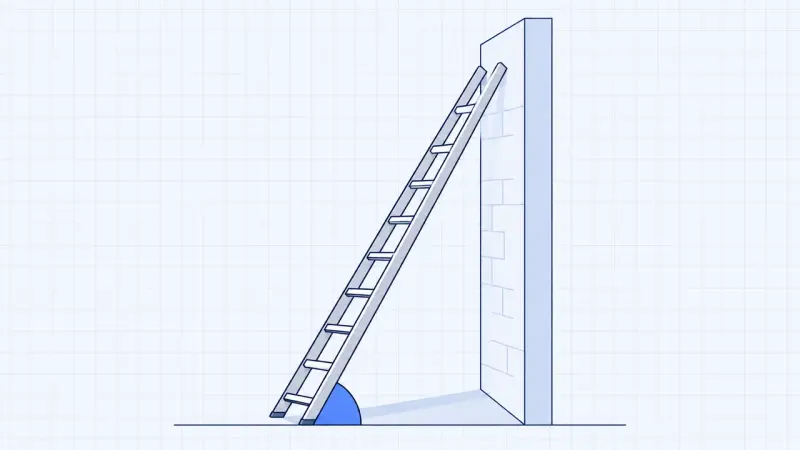
In a right triangle, the ratio of two sides depends only on the angle. This gives sine, cosine and tangent, with examples such as ramps and ladders.

Calculate sides and angles in any triangle with the law of sines and the law of cosines. A helper shows which law fits your problem.
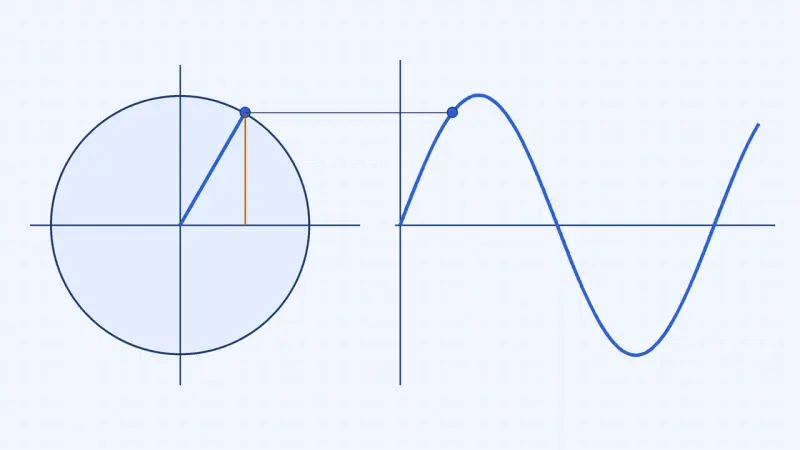
Sine, cosine and tangent on the unit circle, and how the sine curve grows out of it.
Calculations in triangles and polygons in applications, and volume and surface area of pyramid, cone, cylinder and sphere.
Calculating lengths and angles in applied problems with Pythagoras and trigonometry.

Squares on the sides of a right triangle and a puzzle proof show: a² + b² = c².
In a right triangle, the ratio of two sides depends only on the angle. This gives sine, cosine and tangent, with examples such as ramps and ladders.
Calculate sides and angles in any triangle with the law of sines and the law of cosines. A helper shows which law fits your problem.
Applying and comparing formulas for volume and surface area.

Layer by layer a prism grows upwards, and the curved surface of a cylinder unrolls into a rectangle.
Pour three times and the prism is full: a pyramid holds exactly one third. Cones and spheres can be turned and measured in 3D.
Understanding non-proportional functional relationships and representing them in words, tables and graphs.
Recognising when a relationship is a function and how it changes.
No separate simulation is planned for this.
Describing relationships flexibly in different representations.
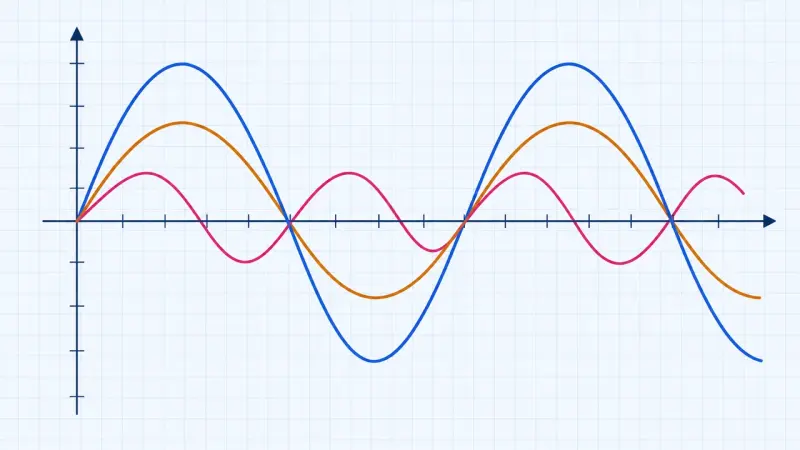
Up to three of your own functions at once, with a table of values, zeros and intersections. The tool for anything that can be a graph.
Solving quadratic equations and linear 2×2 systems; using power, exponential and sine functions (according to the content-area description also quadratic functions) for modelling.
Solving quadratic equations algebraically and graphically.

Stretch, reflect and shift parabolas and read off the vertex and the zeros.
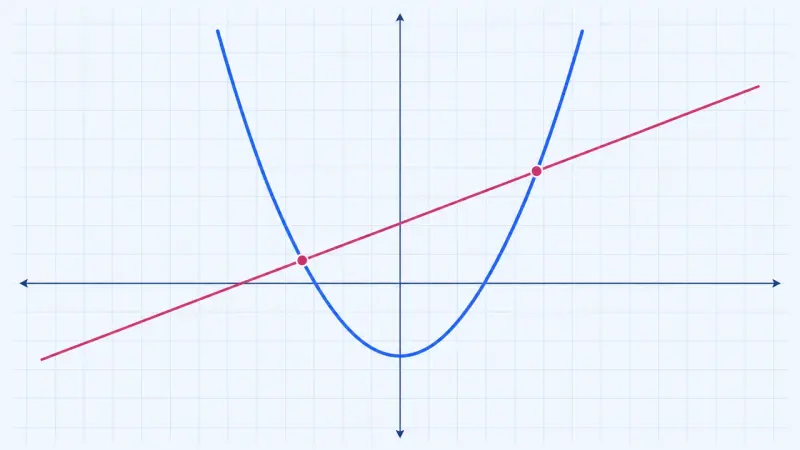
Draw both sides of an equation as graphs. The solutions are where the graphs cross.
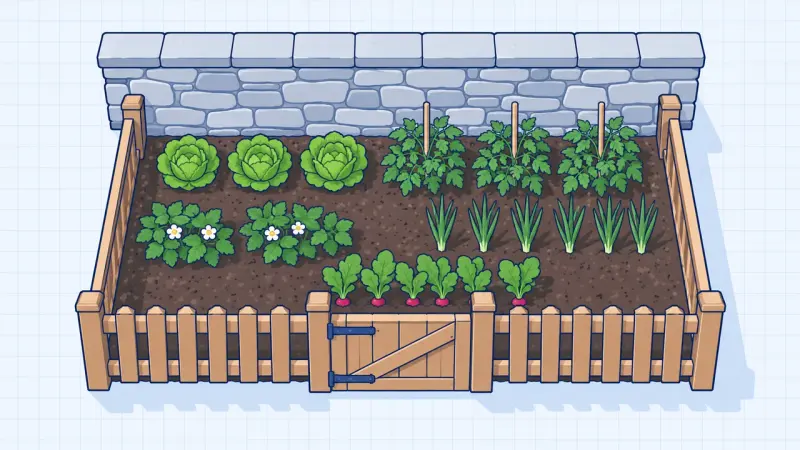
Which enclosure has the largest area? Picture and graph show the maximum, first by trying, then by exact calculation.
Solving systems of two equations algebraically and as intersecting lines.

Two equations are two lines. Their point of intersection is the solution, which you can read off and check.
Investigating graphs of y = a·xⁿ.
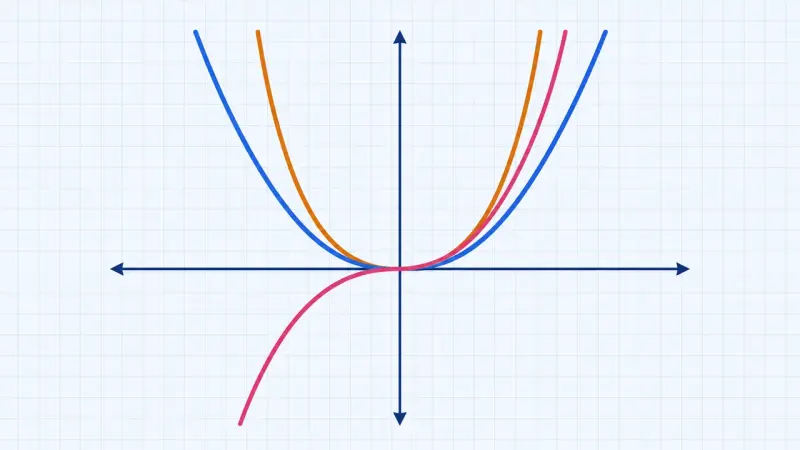
Even or odd, positive or negative: y = a · xⁿ changes with every exponent, and only a few points always stay the same.
Describing growth and decay processes with exponential functions.
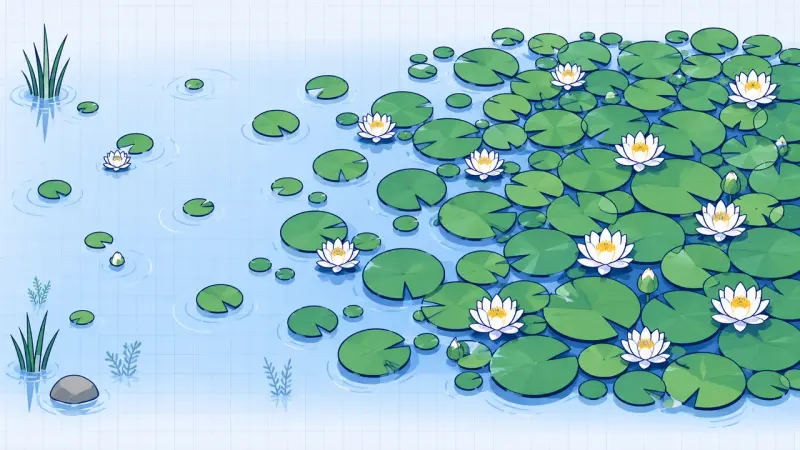
Water lilies on a pond, compound interest and decay: exponential growth compared with linear growth.
Developing the sine function on the unit circle; period and amplitude.
Sine, cosine and tangent on the unit circle, and how the sine curve grows out of it.

Change the amplitude, period and shift of a sine curve with sliders or by dragging.
Switching between term, table and graph, also with software.
Up to three of your own functions at once, with a table of values, zeros and intersections. The tool for anything that can be a graph.
Describing multi-stage random experiments and calculating probabilities.
Finding probabilities for more than two stages with tree diagrams and path rules.

Draw balls from an urn, with or without replacement. The tree diagram and the path rules show how to calculate probabilities.
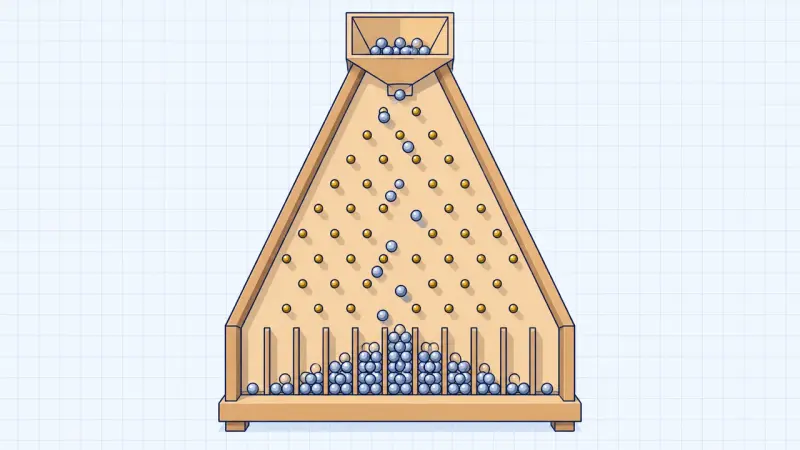
Left or right at every pin, purely by chance. Yet every time the balls pile up into the same bell shape.
The summaries describe the curriculum in our own words. The original text is authoritative. Original text (German): Kerncurriculum, Gymnasium, Mathematics, grade 9/10