

Spring pendulum
A mass bounces up and down on a spring. Graphs show position, speed and energy during the oscillation.
Qualification phase (G9: grades 12 and 13). The core curriculum lists content areas for the basic course (GK) and separate ones for the advanced course (LK), but does not distribute them over half-years; the units are therefore the same for grades 12 and 13. The codes are our own. Core curriculum for upper secondary of 2026 (phased in from 1 August 2027, starting with the introductory phase).
Spring pendulum, harmonic oscillations and waves with Huygens, interference and standing waves; electric and magnetic fields and the path of electrons in the fine-beam tube.
Spring pendulum, harmonic oscillations and waves, Huygens’ principle, reflection, refraction, diffraction, superposition, standing waves, polarisation, and double slit and grating with light.
A mass bounces up and down on a spring. Graphs show position, speed and energy during the oscillation.
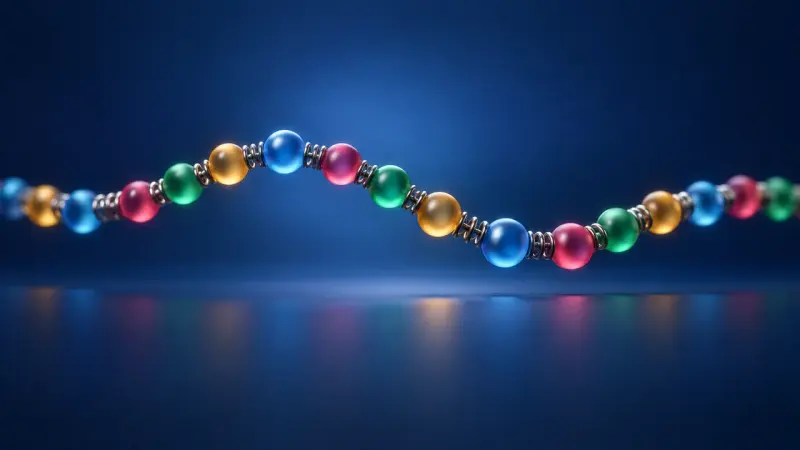
A wave travels through a chain of particles. Each particle only oscillates in place, across or along the direction of travel.
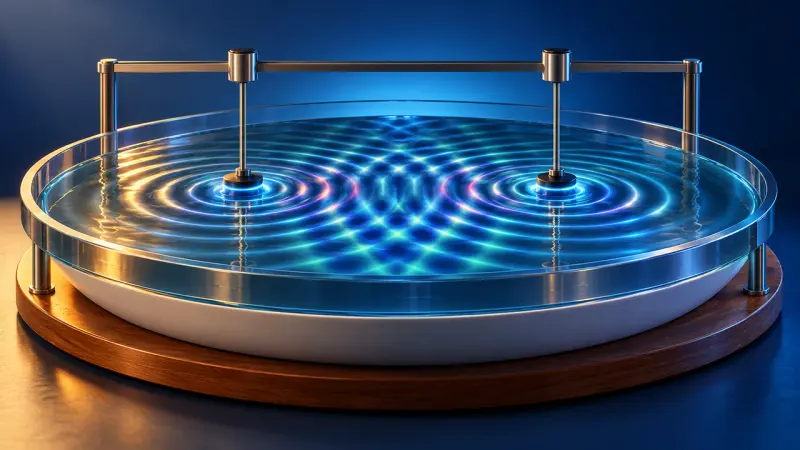
Two circular waves overlap: in some places they reinforce each other, in others they cancel out.
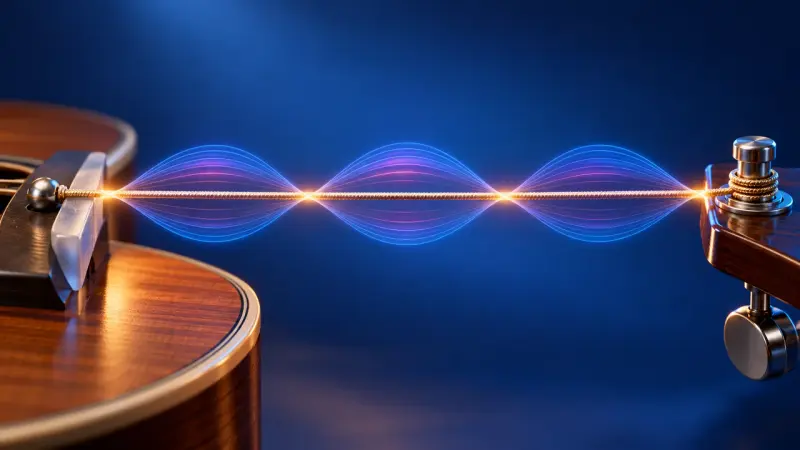
A wave is reflected at the end and a fixed pattern of nodes and antinodes appears, like on a guitar string.
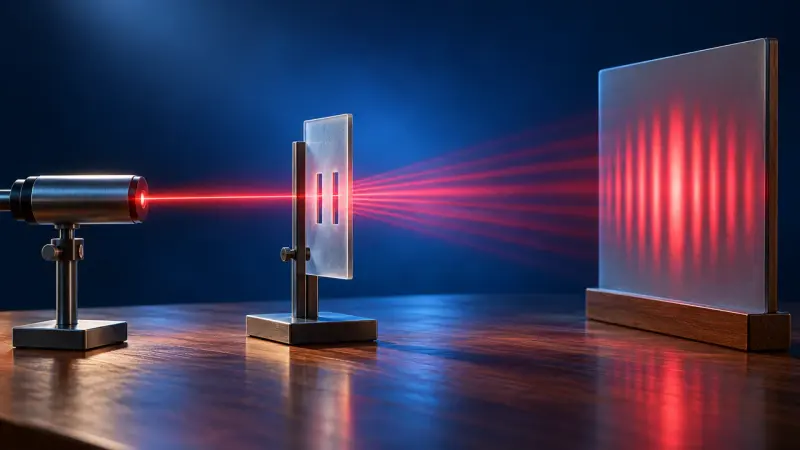
Laser light passes through a double slit or a grating. A pattern of bright and dark stripes appears on the screen.
Electric and magnetic fields, field strength, voltage and flux density, field-line patterns, the Millikan experiment and paths of charged particles in uniform fields.

Two charges and the field rearranges itself. A test charge measures where the force is strongest.
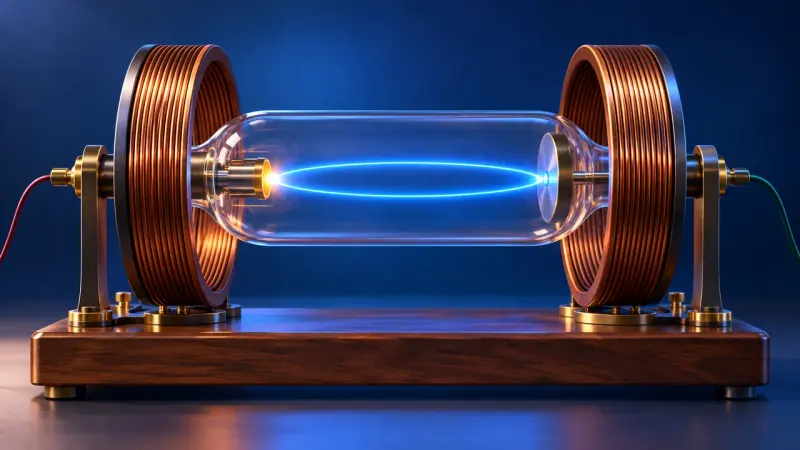
Electrons fly along a glowing circular path in a magnetic field. From the radius you determine a property of the electron.
Light has particle properties and electrons have wave properties: photoelectric effect, de Broglie wavelength, electron interference and the interpretation of quantum objects.
Quantisation of light energy and the photoelectric effect.
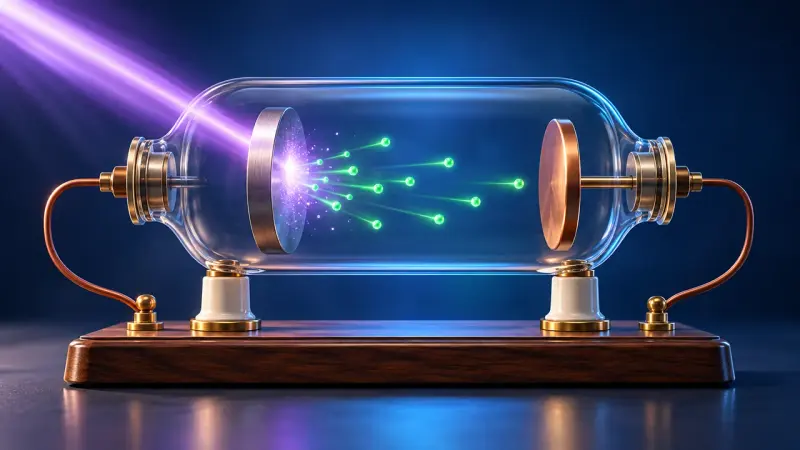
Red light can be as bright as you like, it frees not a single electron. Short-wave light does it at once. A puzzle for waves, not for photons.
De Broglie wavelength and interference of electrons.
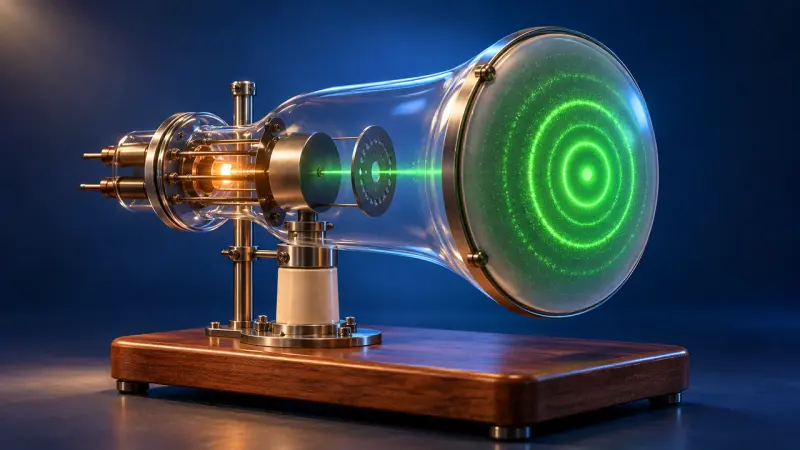
Electrons hit a thin layer of graphite and form rings on the screen, just like waves do.
Wave and particle models, probability interpretation, which-way information and the Copenhagen interpretation.
No separate simulation is planned for this.
Law of induction, generator and transformer, long-distance transmission of energy, charging and discharging a capacitor, and electromagnetic oscillation.
Magnetic flux, electromagnetic induction and the law of induction, alternating voltage, charging and discharging a capacitor.
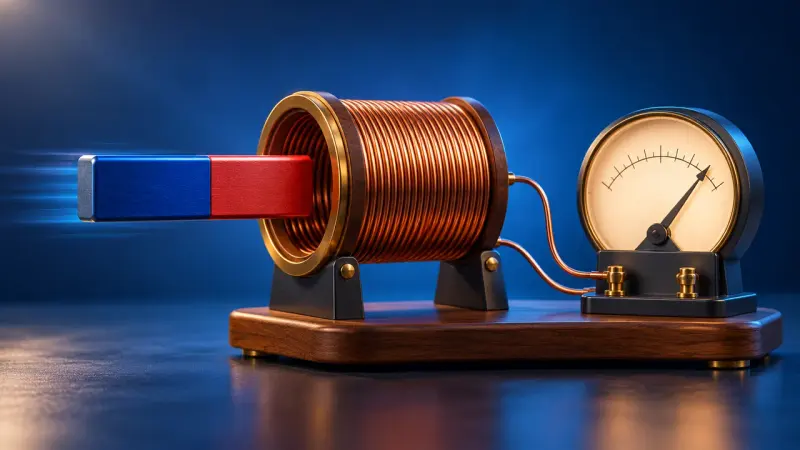
Magnet in, the needle swings. Magnet out, it swings the other way. Every generator works on the same principle.

A capacitor charges through a resistor and discharges again. The graphs show how voltage and current change over time.
Generator and transformer, overhead power lines and electromagnetic oscillation.
Magnet in, the needle swings. Magnet out, it swings the other way. Every generator works on the same principle.
Electromagnetic spectrum and ionising radiation, line spectra and energy levels of the atomic shell, as well as nuclear transformations, the decay law, fission and fusion.
Spectrum of electromagnetic radiation, ionising radiation, the Geiger–Müller counter and biological effects.
No separate simulation is planned for this.
Line spectra, energy level diagrams, the Franck–Hertz experiment, the nuclear model of the atom and X-rays.

Every element glows in its own colours. When an electron drops one level, exactly one line appears in the spectrum.
Nucleons, decay processes and nuclear transformations, the decay law and half-life, fission and fusion.
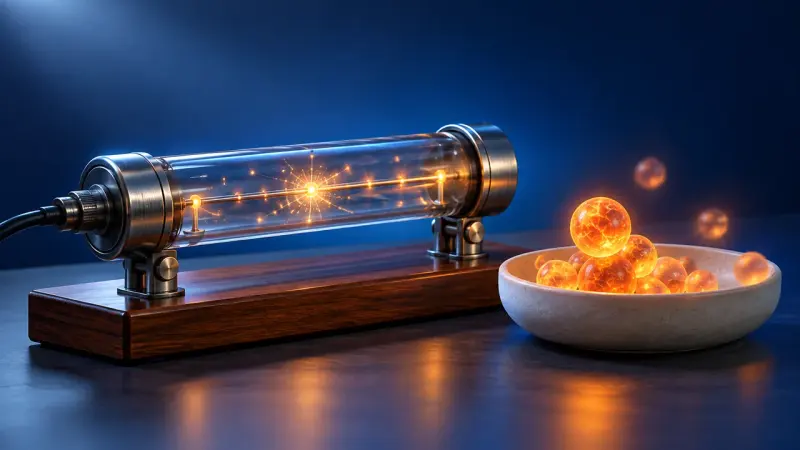
Many nuclei decay at random and a Geiger counter clicks. Even so, after each half-life almost exactly half are left.
Electric and magnetic fields with Coulomb’s law, potential and capacitors, paths of charged particles in fields, as well as induction and self-induction.
Charges, field strength, Coulomb’s law, potential and voltage, capacitor and capacitance with charging and discharging curves; magnetic flux density.
Two charges and the field rearranges itself. A test charge measures where the force is strongest.
A capacitor charges through a resistor and discharges again. The graphs show how voltage and current change over time.
Charged particles in longitudinal and transverse electric fields, the Lorentz force and crossed fields.
Electrons fly along a glowing circular path in a magnetic field. From the radius you determine a property of the electron.
Magnetic flux, the law of induction, Lenz’s law, self-induction and inductance.
Magnet in, the needle swings. Magnet out, it swings the other way. Every generator works on the same principle.
Mechanical and electromagnetic oscillations with differential equations, damping and resonance, wave phenomena, interference at slits and gratings, the Michelson interferometer and the Hertzian dipole.
Harmonic oscillations and their parameters, the wave equation, Huygens’ principle, reflection, refraction, diffraction, polarisation, superposition and the Michelson interferometer.
A wave travels through a chain of particles. Each particle only oscillates in place, across or along the direction of travel.
Two circular waves overlap: in some places they reinforce each other, in others they cancel out.
A wave is reflected at the end and a fixed pattern of nodes and antinodes appears, like on a guitar string.
Laser light passes through a double slit or a grating. A pattern of bright and dark stripes appears on the screen.
Spring and simple pendulum, damped and forced oscillations and resonance, the LC circuit and the Hertzian dipole.
A mass bounces up and down on a spring. Graphs show position, speed and energy during the oscillation.
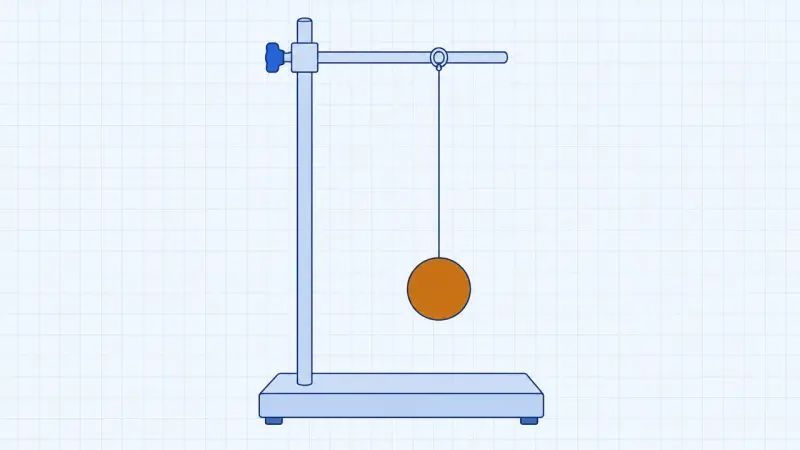
Pull a pendulum aside, let it go and measure how long one swing takes. What does it depend on? Also with large angles and damping.
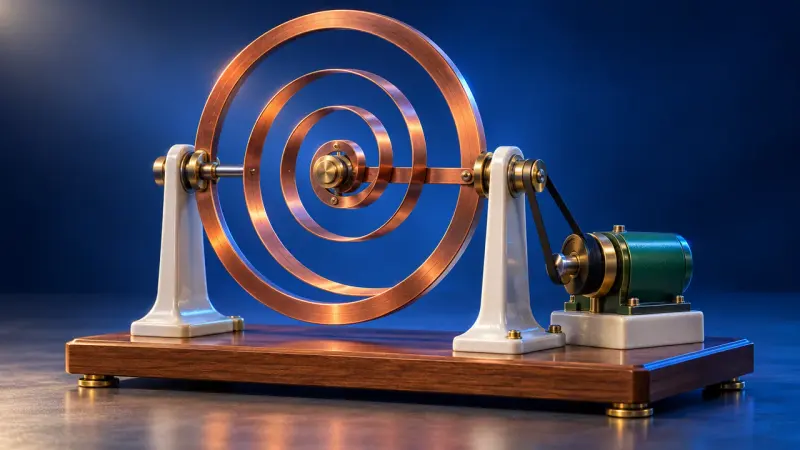
A motor drives an oscillating wheel. If the motor hits exactly the right rhythm, the wheel swings especially strongly: resonance.
Photoelectric effect and Planck’s constant, bremsstrahlung, Bragg reflection and electron diffraction, the wave function, the delayed-choice experiment and the uncertainty principle.
Quantisation of light energy, the photoelectric effect and bremsstrahlung.
Red light can be as bright as you like, it frees not a single electron. Short-wave light does it at once. A puzzle for waves, not for photons.
Double-slit experiment, Bragg reflection, electron diffraction, probability interpretation, the delayed-choice experiment and the Copenhagen interpretation.
Electrons hit a thin layer of graphite and form rings on the screen, just like waves do.
Atomic models up to the potential well, energy levels and X-rays, types and detection of ionising radiation, the decay law and dating, as well as nuclear fission and fusion.
Atomic models, the one-dimensional potential well, energy level diagrams, line spectra, the Franck–Hertz experiment and X-rays.
Every element glows in its own colours. When an electron drops one level, exactly one line appears in the spectrum.
Types of radiation, their detection, properties and absorption.
No separate simulation is planned for this.
Nuclear structure, decay series, the decay law, half-life and carbon-14 dating.
Many nuclei decay at random and a Geiger counter clicks. Even so, after each half-life almost exactly half are left.
Binding energies, mass defect and chain reaction.
No separate simulation is planned for this.
The summaries describe the curriculum in our own words. The original text is authoritative. Original text (German): Kernlehrplan, Gymnasium, Physics, grade 12/13