
Particle model and temperature
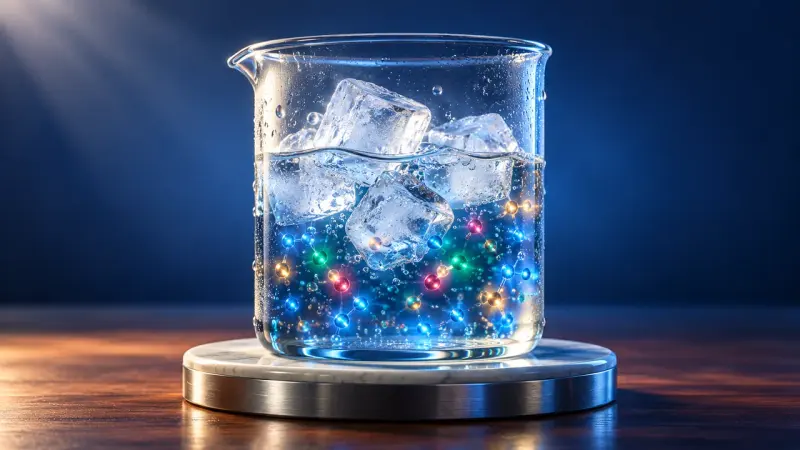
Ice melts, water boils, and the temperature stops rising meanwhile. The particles show where the energy goes in between.
Orientation stage (grades 5 and 6): the core curriculum states its expectations “by the end of the orientation stage”, so the units are the same for grades 5 and 6. Both grades are therefore shown as one stage. The content areas are numbered in the curriculum; the numbers of the focal points are our own.
Measuring temperature and telling it apart from heat, three ways heat travels, materials expand and change state – explained with a simple particle model.
Heat, temperature and measuring temperature, the Celsius scale.
No separate simulation is planned for this.
Convection, conduction and radiation, temperature equalisation and insulation.
No separate simulation is planned for this.
States of matter and changes of state as well as thermal expansion, interpreted with particles; the anomaly of water.
Ice melts, water boils, and the temperature stops rising meanwhile. The particles show where the energy goes in between.
Planning and building simple circuits and drawing circuit diagrams, effects of current and safety, as well as magnets, magnetic fields and the Earth’s magnetic field.
Voltage sources, conductors and insulators, series, parallel, AND and OR circuits, electrons as charge carriers in a conductor.
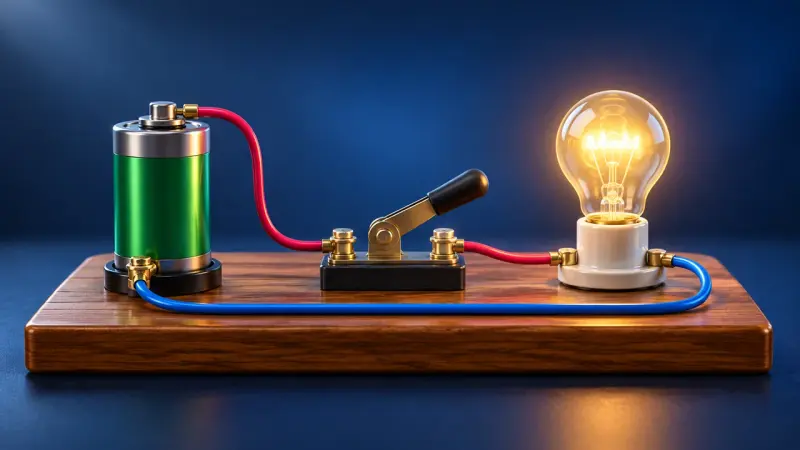
Build a circuit with a battery, a switch and a lamp, as a set-up and as a circuit diagram. When the circuit is closed, the lamp lights up.
Heating, lighting and magnetic effects, fuses and dangers of electricity.
No separate simulation is planned for this.
Attraction and repulsion, magnetic poles, field-line patterns, the Earth’s magnetic field and the compass.
No separate simulation is planned for this.
Magnetisable materials and the model of elementary magnets.
No separate simulation is planned for this.
Sound is produced by vibrations, travels through materials and is reflected or absorbed; pitch, loudness, ultrasound and noise protection.
Pitch and loudness, sound propagation in the particle model, absorption and reflection.
No separate simulation is planned for this.
Sender–receiver model, ultrasound in nature, medicine and technology, noise and noise protection.
No separate simulation is planned for this.
Light travels in straight lines; explaining vision, shadows and the pinhole camera with the ray model; how surfaces scatter, reflect or absorb light.
Light sources and receivers, the light-ray model and images formed by a pinhole camera.
No separate simulation is planned for this.
Scattering, reflection, transmission and absorption at surfaces, as well as umbra and penumbra.
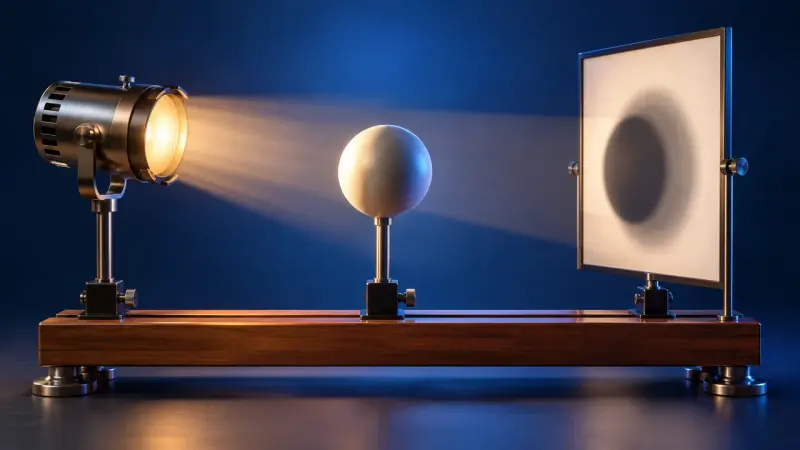
One lamp casts a sharp shadow, two lamps a penumbra. Solar and lunar eclipses form in just the same way.
The summaries describe the curriculum in our own words. The original text is authoritative. Original text (German): Kernlehrplan, Gymnasium, Physics, grade 5/6