With a federal state selected, simulations are ordered by its grades. Your choice is only stored in this browser.
Physics·Bavaria curriculum · Gymnasium
Physics – grade 13
Several syllabuses: no letter = basic level; “A” = astrophysics alternative; “E” = advanced level. The syllabus alternative replaces the standard syllabus.
Unit 1Basic ideas of quantum physics
1.1Properties of quantum objects
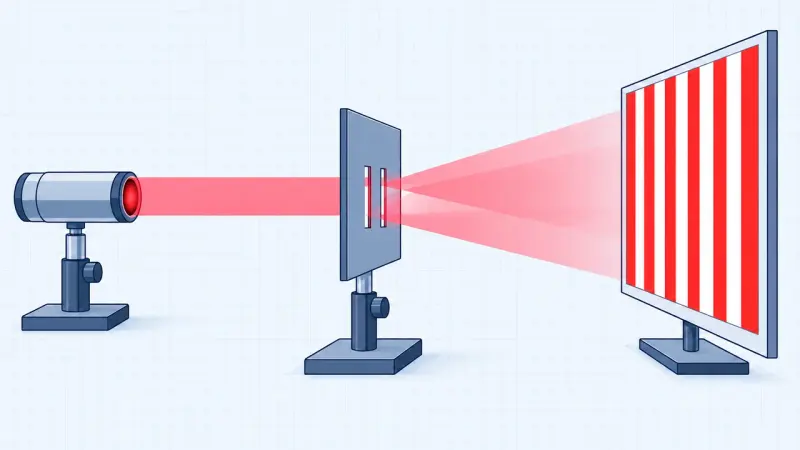
Electron diffraction and de Broglie wavelength, the double-slit experiment with electrons and photons in simulation, and energy and momentum of photons.
Wave function and detection probability, superposition, complementarity and the quantum measurement process.
No separate simulation is planned for this.
Unit 2An atomic model of quantum physics
The potential well with discrete energy levels, orbitals and energy values of the hydrogen atom, emission and absorption of light, and the Franck–Hertz experiment.
Binding energy per nucleon, the potential-well model of the nucleus, the origin of the types of radiation, and energy balances in decays and nuclear reactions.
No separate simulation is planned for this.
4.2Radioactivity and nuclear technology
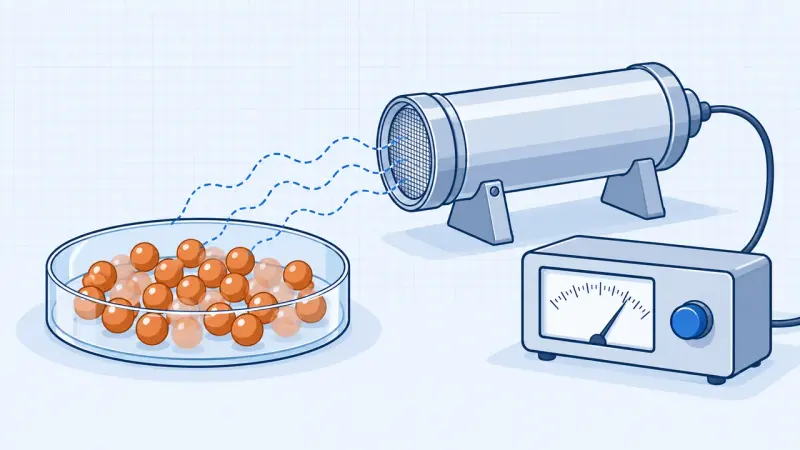
Geiger–Müller counter, decay law and half-life, carbon-14 dating, radiation protection, and nuclear fission and reactors.
Finding constellations and objects in the night sky with a star chart or software, judging visibility and explaining the retrograde loops of planets.
No separate simulation is planned for this.
Unit A2The solar system (astrophysics only)
The astronomical unit, the law of gravitation and elliptical orbits for determining masses, classifying celestial bodies, and satellites and escape velocity.
State quantities of the Sun, nuclear fusion and energy transport, sunspots, the solar spectrum with absorption lines, and radiation laws for estimating temperatures.
Parallax, brightness and luminosity, spectral classes, the Hertzsprung–Russell diagram and stellar evolution, binary stars, gravitational waves and exoplanets.
No separate simulation is planned for this.
Unit A5Large-scale structures in the universe (astrophysics only)
Structure and mass of the Milky Way, dark matter, distances of galaxies, the Hubble relation and the Big Bang model.
No separate simulation is planned for this.
Unit E1Basic ideas of quantum physics (advanced level)
E1.1Properties of quantum objects
Electron diffraction with Bragg reflection and the de Broglie relation, double slit and Mach–Zehnder interferometer with single quanta, and the photoelectric effect with the retarding-field method.
E1.2Insight into the world view of quantum physics
Wave function, uncertainty principle, measurement, the quantum eraser, non-locality and decoherence, and quantum technology and its misuse in texts.
No separate simulation is planned for this.
Unit E2An atomic model of quantum physics (advanced level)
The Schrödinger equation in a potential well, orbitals and energy values of hydrogen and hydrogen-like systems, the Pauli principle, X-ray spectra and the Franck–Hertz experiment.
Compulsory experiments with uncertainty analysis, e.g. polarisation, electron diffraction, the retarding-field method for the photoelectric effect, building a spectrometer and absorption of radiation.