

Circular motion and centripetal force
A ball swings round on a string, a car drives through a bend. Which force keeps them on a circular path?
PhysicsBavaria curriculum · Gymnasium
Quantities of circular motion, deriving and testing the centripetal force, cornering in road traffic, and celestial bodies with the law of gravitation.
A ball swings round on a string, a car drives through a bend. Which force keeps them on a circular path?

Too fast and the planet flies off, never to return. A little slower and it traces an ellipse around the Sun, exactly as Kepler's laws say.
Harmonic oscillations of spring and simple pendulums, mechanical waves, diffraction, interference and standing waves, and light at the double slit.

Pull a pendulum aside, let it go and measure how long one swing takes. What does it depend on? Also with large angles and damping.
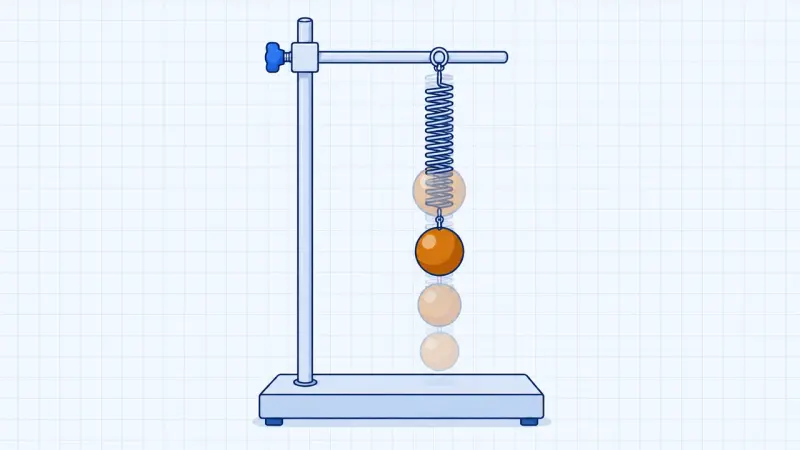
A mass bounces up and down on a spring. Graphs show position, speed and energy during the oscillation.
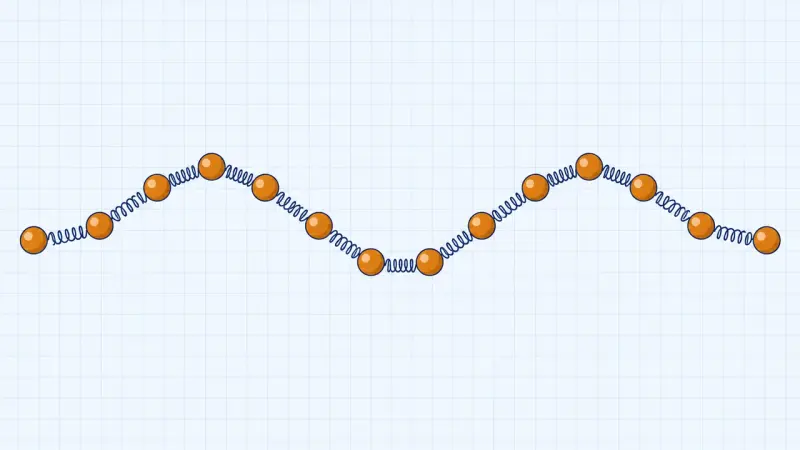
A wave travels through a chain of particles. Each particle only oscillates in place, across or along the direction of travel.

Two circular waves overlap: in some places they reinforce each other, in others they cancel out.
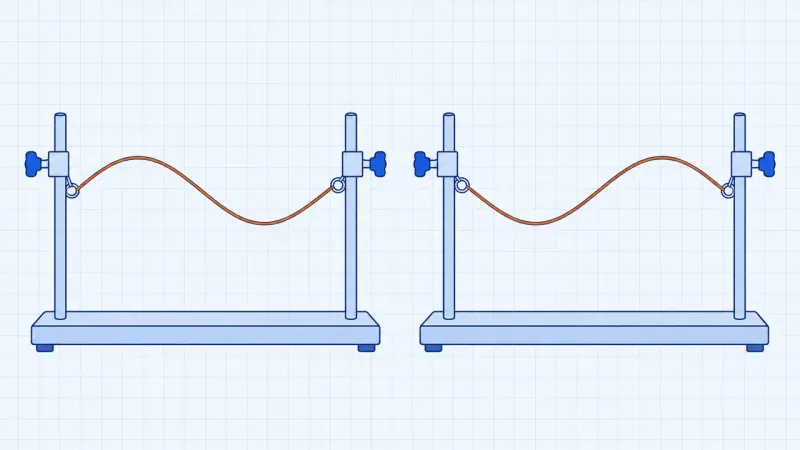
A wave is reflected at the end and a fixed pattern of nodes and antinodes appears, like on a guitar string.
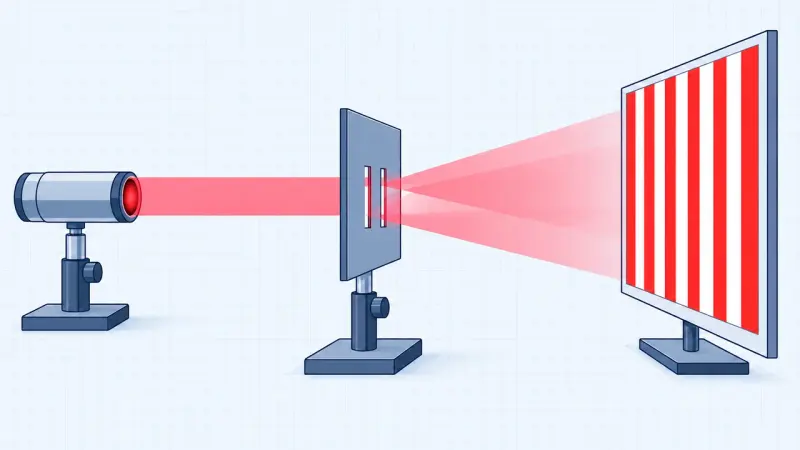
Laser light passes through a double slit or a grating. A pattern of bright and dark stripes appears on the screen.
From the geocentric to the heliocentric world view with Kepler’s laws, and a look at the modern picture of the universe.
Too fast and the planet flies off, never to return. A little slower and it traces an ellipse around the Sun, exactly as Kepler's laws say.
Einstein’s postulates, relativity of simultaneity, time dilation and length contraction, and science under social and political pressure.
No separate simulation is planned for this.
Reversible and irreversible processes, energy degradation and efficiency, and questions about today’s and future energy supply.
No separate simulation is planned for this.
Calculating motion under changing forces step by step on a computer, e.g. falling with air resistance and harmonic oscillation, and comparing with experiments.
No separate simulation is planned for this.
Determining the U–I curve of a solar cell and its maximum power point, knowing the components of photovoltaic systems and assessing their benefit.
No separate simulation is planned for this.
At least one activity outside lessons, such as a student lab, a museum, a company visit or an own research project.
No separate simulation is planned for this.
Optional topics such as physics at the fair, acoustics and resonance, light in technology, or computer models of throws with air resistance and planetary orbits.

Which launch angle goes furthest? On Earth it is 45°, and on the Moon the same ball flies six times as far.
Too fast and the planet flies off, never to return. A little slower and it traces an ellipse around the Sun, exactly as Kepler's laws say.
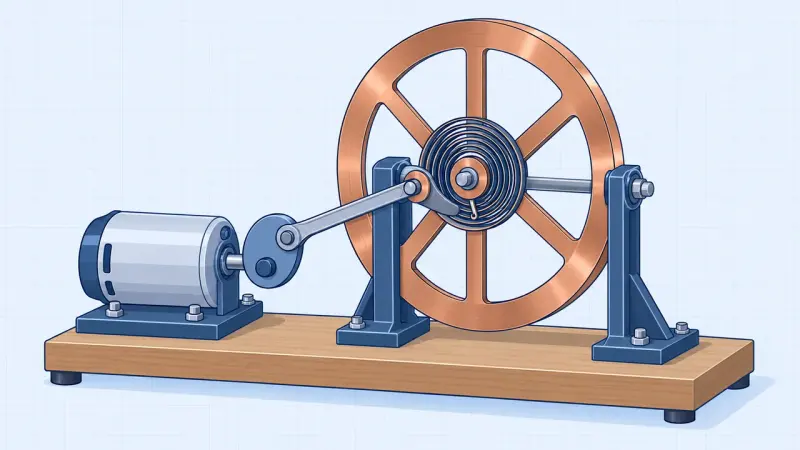
A motor drives an oscillating wheel. If the motor hits exactly the right rhythm, the wheel swings especially strongly: resonance.
The summaries describe the curriculum in our own words. The original text is authoritative. Original text (German): LehrplanPLUS, Gymnasium, Physics, grade 11