Home Mathematics Bremen curriculum · Gymnasium Grade 7–9 Mathematics Bremen curriculum · Gymnasium
Mathematics – grade 7–9 Grades 7 to 9 (Gymnasium with Abitur after grade 12): the curriculum describes requirements at the end of grade 9, so the units are the same for grades 7, 8 and 9 and are shown as one stage. The order of the modules is not fixed. The codes are the module numbers of the curriculum.
Unit A7 PercentagesPercentages with base value, percentage value and rate, interest.
Discounts, VAT, surveys: one single bar holds the base value, the percentage and the part, one above the other.
Grade 6–7 Baden-Württemberg: grade 7/8 Bavaria: grades 6, 7 Berlin: grade 7 Brandenburg: grade 7 Bremen: grade 7–9 Hamburg: grades 5/6, 7/8 Hesse: grades 5/6, 7/8 Lower Saxony: grades 5/6, 7/8 North Rhine-Westphalia: grades 5/6, 7/8 Rhineland-Palatinate: grades 5/6, 7/8 Saarland: grade 7 Saxony: grades 6, 7 Saxony-Anhalt: grade 7/8 Schleswig-Holstein: grade 7–9
Unit A8 Terms and linear equationsDescribing relationships with variables and terms, rearranging terms and binomial formulas, solving linear equations numerically, algebraically and graphically.
An expression drawn as a tree: whatever hangs lowest is calculated first. The order of operations stops being a rule and becomes visible.
Grade 5–7 Baden-Württemberg: grades 5/6, 7/8 Bavaria: grades 5, 6, 7 Berlin: grades 5, 6, 7 Brandenburg: grades 5/6, 7 Bremen: grades 5/6, 7–9 Hamburg: grades 5/6, 7/8 Hesse: grades 5/6, 7/8 Lower Saxony: grades 5/6, 7/8 North Rhine-Westphalia: grades 5/6, 7/8 Rhineland-Palatinate: grades 5/6, 7/8 Saarland: grades 5/6, 7 Saxony: grades 5, 6, 7 Saxony-Anhalt: grades 5/6, 7/8 Schleswig-Holstein: grades 5/6, 7–9
Solve linear equations on a balance: whatever you do to both sides keeps the scale balanced.
Grade 7 Baden-Württemberg: grade 7/8 Bavaria: grade 7 Berlin: grade 7 Brandenburg: grade 7 Bremen: grade 7–9 Hamburg: grade 7/8 Hesse: grade 7/8 Lower Saxony: grade 7/8 North Rhine-Westphalia: grade 7/8 Rhineland-Palatinate: grade 7/8 Saarland: grade 7 Saxony: grade 7 Saxony-Anhalt: grade 7/8 Schleswig-Holstein: grade 7–9
The three binomial formulas as areas: a square splits into smaller squares and rectangles.
Grade 7–9 Baden-Württemberg: grade 7/8 Bavaria: grade 7 Berlin: grades 8, 9 Brandenburg: grades 8, 9 Bremen: grade 7–9 Hamburg: grade 7/8 Hesse: grade 7/8 Lower Saxony: grade 7/8 North Rhine-Westphalia: grade 7/8 Rhineland-Palatinate: grade 7/8 Saarland: grade 8 Saxony: grade 8 Saxony-Anhalt: grade 7/8 Schleswig-Holstein: grade 7–9
Unit A9 Powers and rootsSquare roots, scientific notation, Heron’s method or nested intervals with digital tools, extending to the real numbers.
Step by step, a rectangle turns into a square with the same area. The method is almost 2000 years old and reaches √2 surprisingly quickly.
Grade 7–9 Baden-Württemberg: grade 7/8 Bavaria: grade 9 Berlin: grades 8, 9 Brandenburg: grades 8, 9 Bremen: grade 7–9 Hamburg: grades 7/8, 9/10 Hesse: grade 7/8 Lower Saxony: grade 9/10 North Rhine-Westphalia: grade 9/10 Rhineland-Palatinate: grade 9/10 Saarland: grade 9 Saxony: grades 7, 9 Saxony-Anhalt: grades 7/8, 9 Schleswig-Holstein: grade 7–9
From a grain of sand to the Earth in steps of ten. Along the way it becomes clear why 10⁶ is a million and how to write tiny numbers.
Grade 5–8 Baden-Württemberg: grade 5/6 Bavaria: grades 5, 6 Berlin: grade 8 Brandenburg: grade 8 Bremen: grades 5/6, 7–9 Hamburg: grade 5/6 Hesse: grade 5/6 Lower Saxony: grade 5/6 North Rhine-Westphalia: grade 5/6 Rhineland-Palatinate: grade 5/6 Saarland: grade 5/6 Saxony: grade 5 Saxony-Anhalt: grade 5/6 Schleswig-Holstein: grade 7–9
Unit A10 Systems of linear equationsSolving systems of linear equations numerically, graphically and by substitution, equating and elimination, examining solvability.
Two equations are two lines. Their point of intersection is the solution, which you can read off and check.
Grade 8–10 Baden-Württemberg: grade 7/8 Bavaria: grade 8 Berlin: grades 8, 9, 10 Brandenburg: grades 8, 9, 10 Bremen: grade 7–9 Hamburg: grade 7/8 Hesse: grade 9/10 Lower Saxony: grade 7/8 North Rhine-Westphalia: grade 7/8 Rhineland-Palatinate: grade 9/10 Saarland: grade 9 Saxony: grade 8 Saxony-Anhalt: grade 7/8 Schleswig-Holstein: grade 7–9
Unit A11 Quadratic equationsSolving quadratic equations numerically, algebraically and graphically, solvability and applications.
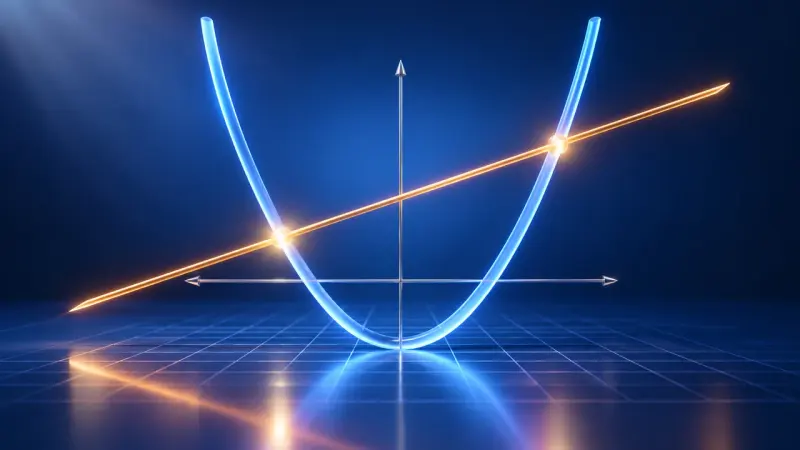
Draw both sides of an equation as graphs. The solutions are where the graphs cross.
Grade 8–9 Baden-Württemberg: grades 7/8, 9/10 Bavaria: grades 8, 9 Berlin: grades 8, 9 Brandenburg: grades 8, 9 Bremen: grade 7–9 Hamburg: grades 7/8, 9/10 Hesse: grades 7/8, 9/10 Lower Saxony: grades 7/8, 9/10 North Rhine-Westphalia: grades 7/8, 9/10 Rhineland-Palatinate: grades 7/8, 9/10 Saarland: grade 9 Saxony: grade 9 Saxony-Anhalt: grades 7/8, 9 Schleswig-Holstein: grade 7–9
Unit G7 Shapes in the plane and in space IISpecial triangles and regular polygons, oblique drawings and nets of prisms.
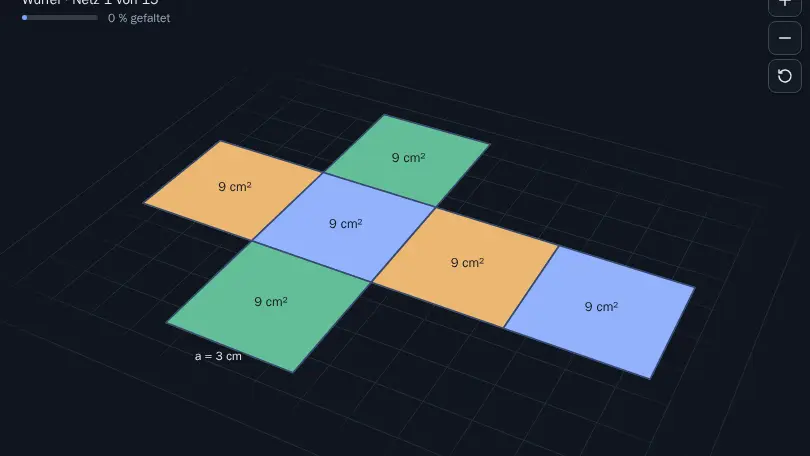
Fold nets of a cube, cuboid, prism, pyramid and cylinder into a solid in 3D and calculate the surface area.
Grade 5–8 Baden-Württemberg: grade 5/6 Bavaria: grades 5, 6, 8 Berlin: grades 5, 6, 7, 8 Brandenburg: grades 5/6, 7, 8 Bremen: grades 5/6, 7–9 Hamburg: grades 5/6, 7/8 Hesse: grades 5/6, 7/8 Lower Saxony: grades 5/6, 7/8 North Rhine-Westphalia: grade 5/6 Rhineland-Palatinate: grades 5/6, 7/8 Saarland: grades 5/6, 8 Saxony: grades 5, 6, 7 Saxony-Anhalt: grades 5/6, 7/8 Schleswig-Holstein: grades 5/6, 7–9
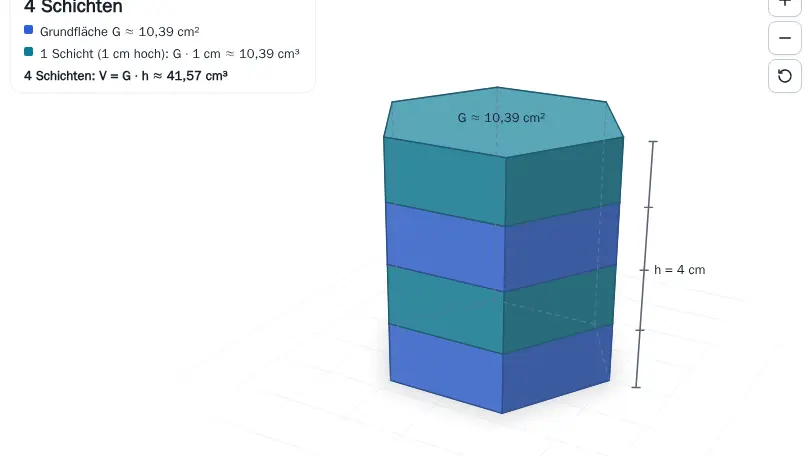
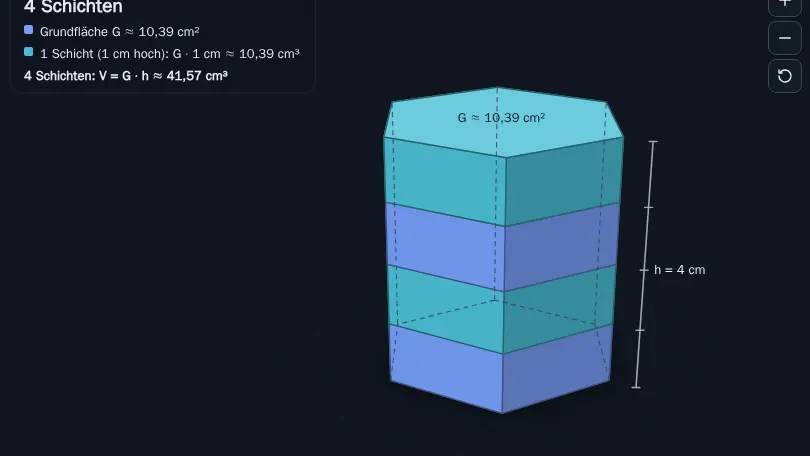
Layer by layer a prism grows upwards, and the curved surface of a cylinder unrolls into a rectangle.
Grade 6–9 Baden-Württemberg: grade 9/10 Bavaria: grade 8 Berlin: grades 7, 8 Brandenburg: grades 7, 8 Bremen: grade 7–9 Hamburg: grade 7/8 Hesse: grades 7/8, 9/10 Lower Saxony: grades 7/8, 9/10 North Rhine-Westphalia: grade 9/10 Rhineland-Palatinate: grade 7/8 Saarland: grade 8 Saxony: grades 6, 9 Saxony-Anhalt: grade 7/8 Schleswig-Holstein: grade 7–9
Unit G8 Geometric constructions, symmetry and congruenceConstructing triangles, perpendicular and angle bisectors, solvability of constructions, justifying congruence and symmetry.
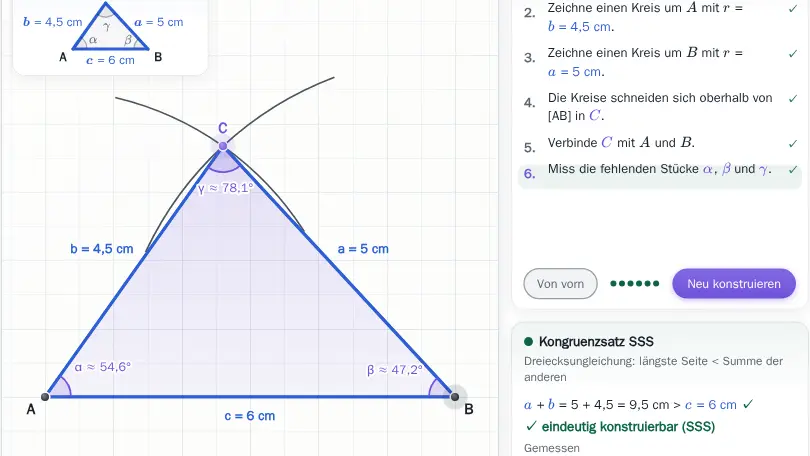
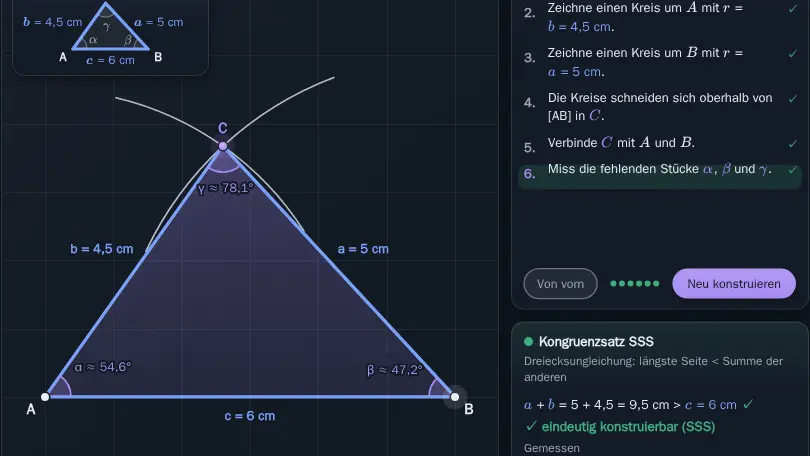
Construct triangles from three given parts with ruler and compass, step by step as in your exercise book. Sometimes there are no, one or two solutions.
Grade 6–8 Baden-Württemberg: grade 7/8 Bavaria: grade 7 Berlin: grade 7 Brandenburg: grade 7 Bremen: grade 7–9 Hamburg: grade 7/8 Hesse: grade 7/8 Lower Saxony: grade 7/8 North Rhine-Westphalia: grade 7/8 Rhineland-Palatinate: grade 7/8 Saarland: grades 7, 8 Saxony: grades 6, 7 Saxony-Anhalt: grade 5/6 Schleswig-Holstein: grade 7–9
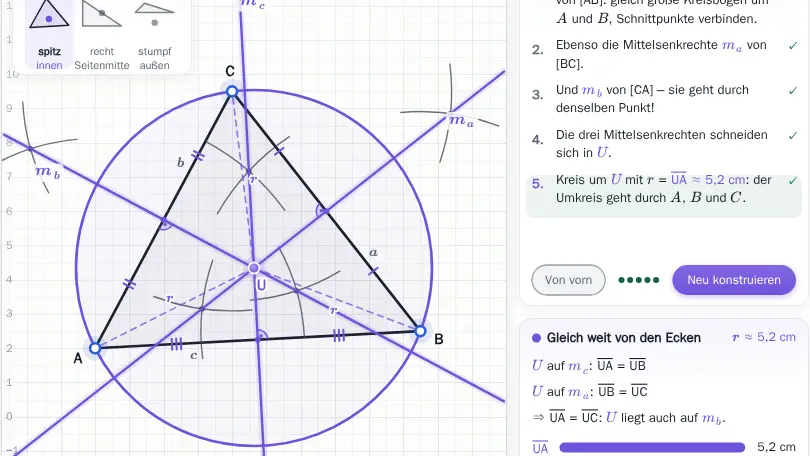
A point equally far from A and B never lies there by chance: the perpendicular bisector appears before you draw it with compasses.
Grade 6–7 Baden-Württemberg: grade 7/8 Bavaria: grade 7 Berlin: grade 7 Brandenburg: grade 7 Bremen: grade 7–9 Hamburg: grade 7/8 Hesse: grade 7/8 Lower Saxony: grades 5/6, 7/8 North Rhine-Westphalia: grade 7/8 Rhineland-Palatinate: grade 7/8 Saarland: grade 7 Saxony: grades 6, 7 Saxony-Anhalt: grade 5/6 Schleswig-Holstein: grades 5/6, 7–9
Construct the special lines in a triangle. Each set of three always meets in one point, for example at the centre of the circumcircle or the incircle.
Grade 6–8 Baden-Württemberg: grade 7/8 Bavaria: grade 7 Berlin: grade 7 Brandenburg: grade 7 Bremen: grade 7–9 Hamburg: grade 7/8 Hesse: grade 7/8 Lower Saxony: grade 7/8 North Rhine-Westphalia: grade 7/8 Rhineland-Palatinate: grade 7/8 Saarland: grades 7, 8 Saxony: grades 6, 7 Saxony-Anhalt: grade 5/6 Schleswig-Holstein: grade 7–9
Unit G9 Perimeter, area, volume and surface area IIPerimeter and area of triangles, parallelograms and trapeziums, surface area and volume of right prisms.
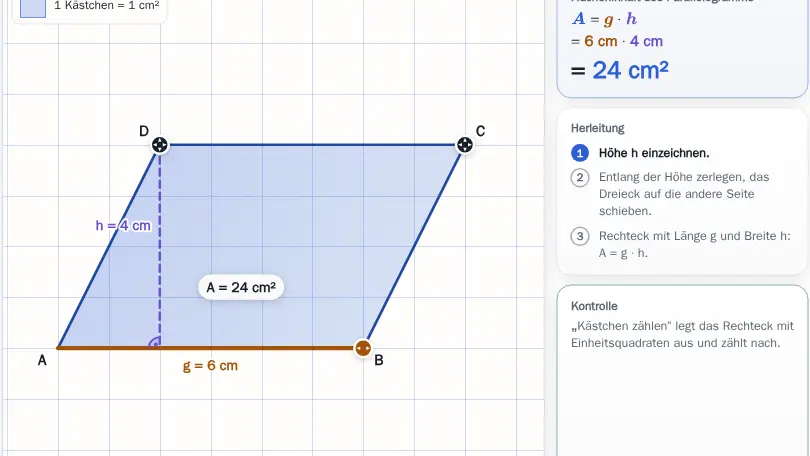
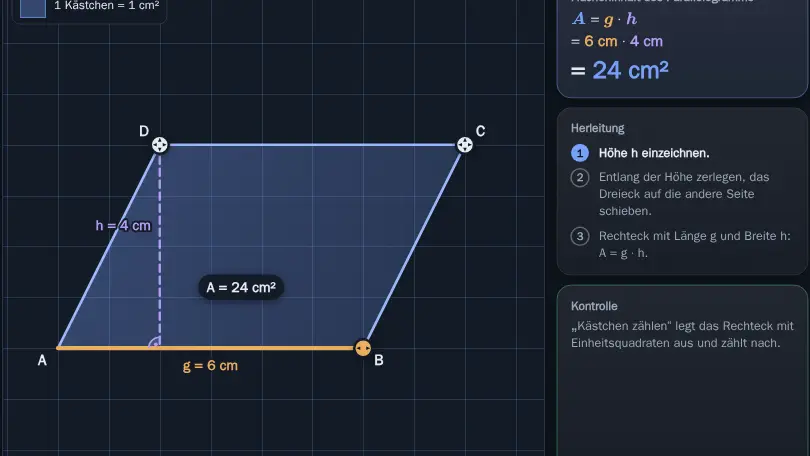
Cut off a triangle and put it on the other side: the parallelogram becomes a rectangle. Triangles and trapeziums work the same way.
Grade 6–8 Baden-Württemberg: grade 5/6 Bavaria: grade 6 Berlin: grades 7, 8 Brandenburg: grades 7, 8 Bremen: grade 7–9 Hamburg: grade 7/8 Hesse: grade 7/8 Lower Saxony: grade 7/8 North Rhine-Westphalia: grades 5/6, 7/8 Rhineland-Palatinate: grade 7/8 Saarland: grade 8 Saxony: grade 6 Saxony-Anhalt: grade 5/6 Schleswig-Holstein: grade 7–9
Layer by layer a prism grows upwards, and the curved surface of a cylinder unrolls into a rectangle.
Grade 6–9 Baden-Württemberg: grade 9/10 Bavaria: grade 8 Berlin: grades 7, 8 Brandenburg: grades 7, 8 Bremen: grade 7–9 Hamburg: grade 7/8 Hesse: grades 7/8, 9/10 Lower Saxony: grades 7/8, 9/10 North Rhine-Westphalia: grade 9/10 Rhineland-Palatinate: grade 7/8 Saarland: grade 8 Saxony: grades 6, 9 Saxony-Anhalt: grade 7/8 Schleswig-Holstein: grade 7–9
Unit G10 Shapes in the plane and in space IIIDescribing pyramids, cylinders, cones and spheres, oblique drawings and nets.
Pour three times and the prism is full: a pyramid holds exactly one third. Cones and spheres can be turned and measured in 3D.
Grade 7–10 Baden-Württemberg: grade 9/10 Bavaria: grade 10 Berlin: grades 8, 9, 10 Brandenburg: grades 8, 9, 10 Bremen: grade 7–9 Hamburg: grade 9/10 Hesse: grade 9/10 Lower Saxony: grade 9/10 North Rhine-Westphalia: grade 9/10 Rhineland-Palatinate: grade 9/10 Saarland: grade 10 Saxony: grades 7, 9, 10 Saxony-Anhalt: grade 7/8 Schleswig-Holstein: grades 7–9, 10
Unit G11 SimilarityEnlargements, justifying properties of figures with similarity.
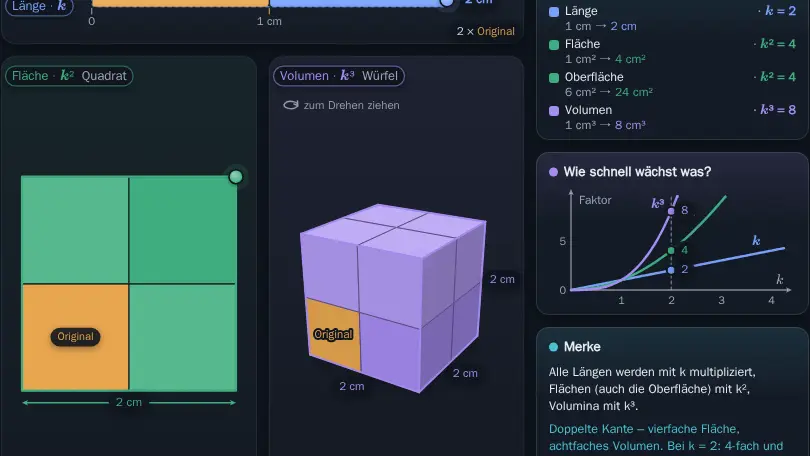
Enlarge lengths, areas and solids. Doubling the length makes the area four times and the volume eight times as large.
Grade 8–10 Baden-Württemberg: grade 7/8 Bavaria: grade 9 Berlin: grade 9 Brandenburg: grade 9 Bremen: grade 7–9 Hamburg: grade 9/10 Hesse: grade 7/8 Lower Saxony: grade 9/10 North Rhine-Westphalia: grade 9/10 Rhineland-Palatinate: grade 9/10 Saarland: grade 9 Saxony: grade 8 Saxony-Anhalt: grade 7/8 Schleswig-Holstein: grades 7–9, 10
Unit G12 Perimeter, area, volume and surface area IIICircumference and area of circles, surface area and volume of pyramids, cylinders, cones, spheres and composite solids.
A wheel rolls once and travels a bit more than three times its diameter. Cut into pieces, the circle becomes a rectangle and the area formula follows.
Grade 7–9 Baden-Württemberg: grade 9/10 Bavaria: grade 8 Berlin: grades 7, 8 Brandenburg: grades 7, 8 Bremen: grade 7–9 Hamburg: grade 7/8 Hesse: grade 7/8 Lower Saxony: grade 9/10 North Rhine-Westphalia: grade 9/10 Rhineland-Palatinate: grades 7/8, 9/10 Saarland: grade 8 Saxony: grade 9 Saxony-Anhalt: grade 7/8 Schleswig-Holstein: grade 7–9
Layer by layer a prism grows upwards, and the curved surface of a cylinder unrolls into a rectangle.
Grade 6–9 Baden-Württemberg: grade 9/10 Bavaria: grade 8 Berlin: grades 7, 8 Brandenburg: grades 7, 8 Bremen: grade 7–9 Hamburg: grade 7/8 Hesse: grades 7/8, 9/10 Lower Saxony: grades 7/8, 9/10 North Rhine-Westphalia: grade 9/10 Rhineland-Palatinate: grade 7/8 Saarland: grade 8 Saxony: grades 6, 9 Saxony-Anhalt: grade 7/8 Schleswig-Holstein: grade 7–9
Pour three times and the prism is full: a pyramid holds exactly one third. Cones and spheres can be turned and measured in 3D.
Grade 7–10 Baden-Württemberg: grade 9/10 Bavaria: grade 10 Berlin: grades 8, 9, 10 Brandenburg: grades 8, 9, 10 Bremen: grade 7–9 Hamburg: grade 9/10 Hesse: grade 9/10 Lower Saxony: grade 9/10 North Rhine-Westphalia: grade 9/10 Rhineland-Palatinate: grade 9/10 Saarland: grade 10 Saxony: grades 7, 9, 10 Saxony-Anhalt: grade 7/8 Schleswig-Holstein: grades 7–9, 10
Unit G13 Pythagoras’ theorem and Thales’ theoremJustifying and applying Pythagoras’ theorem, also in space, justifying right angles with Thales’ theorem.
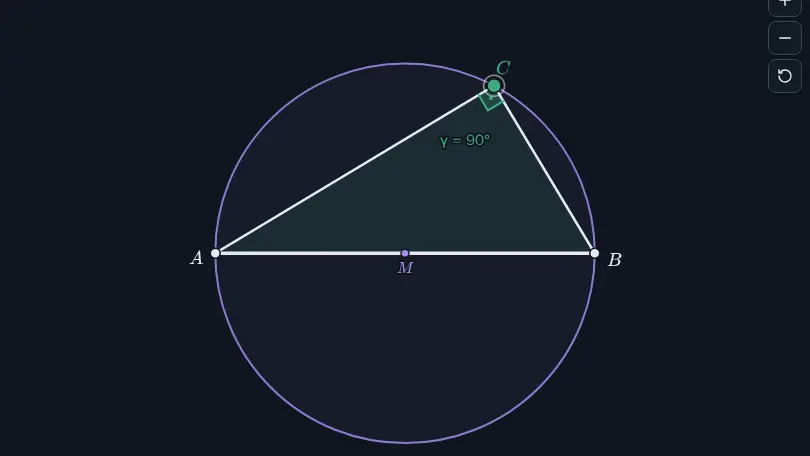
Drag a point along the semicircle: the angle there is always a right angle.
Grade 7 Baden-Württemberg: grade 7/8 Bavaria: grade 7 Berlin: grade 7 Brandenburg: grade 7 Bremen: grade 7–9 Hamburg: grade 7/8 Hesse: grade 7/8 Lower Saxony: grade 7/8 North Rhine-Westphalia: grade 7/8 Rhineland-Palatinate: grade 7/8 Saarland: grade 7 Saxony: grade 7 Saxony-Anhalt: grade 7/8 Schleswig-Holstein: grade 7–9
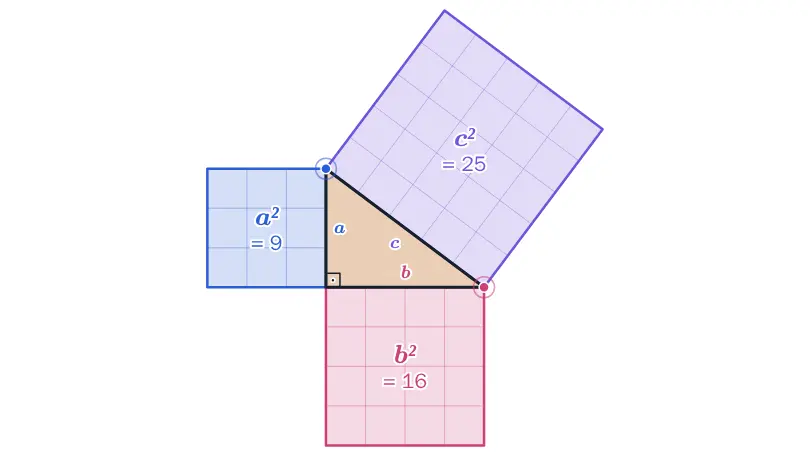
Squares on the sides of a right triangle and a puzzle proof show: a² + b² = c².
Grade 7–9 Baden-Württemberg: grade 9/10 Bavaria: grade 9 Berlin: grades 7, 9 Brandenburg: grades 7, 9 Bremen: grade 7–9 Hamburg: grade 9/10 Hesse: grades 7/8, 9/10 Lower Saxony: grade 9/10 North Rhine-Westphalia: grade 9/10 Rhineland-Palatinate: grade 9/10 Saarland: grade 9 Saxony: grade 9 Saxony-Anhalt: grade 7/8 Schleswig-Holstein: grade 7–9
Unit G14 Trigonometric relationshipsSine, cosine and tangent in right triangles.
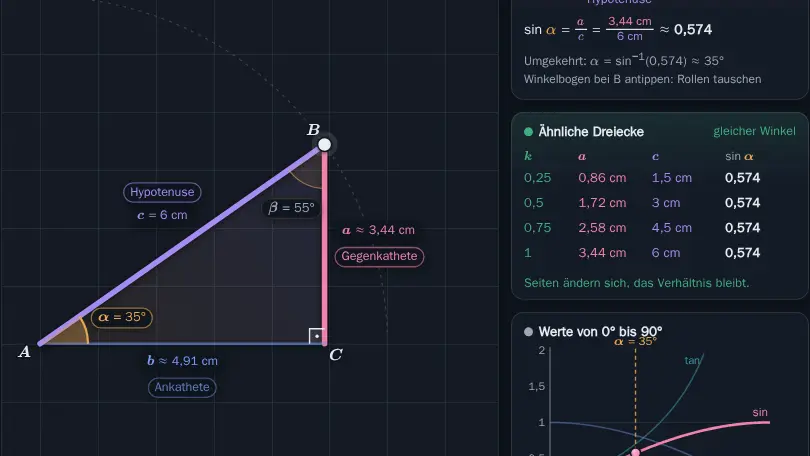
In a right triangle, the ratio of two sides depends only on the angle. This gives sine, cosine and tangent, with examples such as ramps and ladders.
Grade 9–10 Baden-Württemberg: grade 9/10 Bavaria: grade 9 Berlin: grades 9, 10 Brandenburg: grades 9, 10 Bremen: grades 7–9, 10 Hamburg: grade 9/10 Hesse: grade 9/10 Lower Saxony: grade 9/10 North Rhine-Westphalia: grade 9/10 Rhineland-Palatinate: grade 9/10 Saarland: grade 10 Saxony: grade 9 Saxony-Anhalt: grade 9 Schleswig-Holstein: grade 10
Unit F4 Proportional and inversely proportional relationshipsRelationships in words, tables and graphs, recognising patterns, everyday calculations.
Twice as many apples cost twice as much. Picture, table and graph show together when a relation is proportional, with the rule of three.
Grade 6–8 Baden-Württemberg: grades 5/6, 7/8 Bavaria: grade 8 Berlin: grades 6, 7 Brandenburg: grades 5/6, 7 Bremen: grade 7–9 Hamburg: grade 7/8 Hesse: grade 7/8 Lower Saxony: grade 7/8 North Rhine-Westphalia: grades 5/6, 7/8 Rhineland-Palatinate: grade 7/8 Saarland: grade 7 Saxony: grade 6 Saxony-Anhalt: grade 5/6 Schleswig-Holstein: grade 7–9
Exactly one y for every x? The arrow diagram, table and graph tell you straight away whether a relation is a function.
Grade 6–8 Baden-Württemberg: grade 7/8 Bavaria: grade 8 Berlin: grades 6, 7, 8 Brandenburg: grades 5/6, 7, 8 Bremen: grades 5/6, 7–9 Hamburg: grades 5/6, 7/8 Hesse: grade 7/8 Lower Saxony: grade 7/8 North Rhine-Westphalia: grade 7/8 Rhineland-Palatinate: grade 7/8 Saarland: grade 7 Saxony: grades 6, 8 Saxony-Anhalt: grade 7/8 Schleswig-Holstein: grades 5/6, 7–9
The hyperbola gets ever closer to its asymptotes and yet never touches them. Shifting and stretching show what the parameters do.
Grade 7–10 Baden-Württemberg: grade 9/10 Bavaria: grade 8 Berlin: grade 10 Brandenburg: grade 10 Bremen: grades 7–9, 10 Hamburg: grades 7/8, 9/10 Hesse: grade 7/8 Lower Saxony: grade 7/8 North Rhine-Westphalia: grade 7/8 Rhineland-Palatinate: grades 7/8, 9/10 Saarland: grade 7 Saxony: grade 9 Saxony-Anhalt: grade 10 Schleswig-Holstein: grade 7–9
Unit F5 Linear functionsLinear relationships in words, tables, terms and graphs, slope and features, applications with digital tools.
Change the slope and the y-intercept of a line and read off the slope triangle and the zero.
Grade 7–9 Baden-Württemberg: grade 7/8 Bavaria: grade 8 Berlin: grade 8 Brandenburg: grade 8 Bremen: grade 7–9 Hamburg: grade 7/8 Hesse: grade 7/8 Lower Saxony: grade 7/8 North Rhine-Westphalia: grade 7/8 Rhineland-Palatinate: grade 7/8 Saarland: grade 8 Saxony: grade 8 Saxony-Anhalt: grade 7/8 Schleswig-Holstein: grade 7–9
Up to three of your own functions at once, with a table of values, zeros and intersections. The tool for anything that can be a graph.
Grade 8–13 · University Baden-Württemberg: grade 12/13 Bavaria: grade 8 Berlin: grades 8, 9, 10, 11 Brandenburg: grades 8, 9, 10, 11 Bremen: grades 7–9, 10, 11/12 Hamburg: grades 7/8, 9/10, 11 Hesse: grades 9/10, 12 Lower Saxony: grades 7/8, 9/10, 11 North Rhine-Westphalia: grades 7/8, 9/10, 11, 12/13 Rhineland-Palatinate: grades 7/8, 9/10, 11–13 Saarland: grades 8, 11, 12 Saxony: grades 8, 9, 10 Saxony-Anhalt: grades 7/8, 10 Schleswig-Holstein: grades 7–9, 11
Unit F6 Quadratic functionsQuadratic functions in standard, vertex and factored form, meaning of the parameters, intersections and applications.
Stretch, reflect and shift parabolas and read off the vertex and the zeros.
Grade 9–10 Baden-Württemberg: grade 9/10 Bavaria: grade 9 Berlin: grades 9, 10 Brandenburg: grades 9, 10 Bremen: grade 7–9 Hamburg: grade 9/10 Hesse: grade 9/10 Lower Saxony: grade 9/10 North Rhine-Westphalia: grade 9/10 Rhineland-Palatinate: grade 9/10 Saarland: grade 9 Saxony: grade 9 Saxony-Anhalt: grade 9 Schleswig-Holstein: grades 7–9, 10
Drag three points and the matching parabola always passes through all of them. The equation is worked out step by step.
Grade 9–11 Baden-Württemberg: grade 9/10 Bavaria: grade 9 Berlin: grades 9, 10, 11 Brandenburg: grades 9, 10, 11 Bremen: grade 7–9 Hamburg: grade 9/10 Lower Saxony: grade 9/10 North Rhine-Westphalia: grade 9/10 Rhineland-Palatinate: grades 9/10, 11–13 Saarland: grade 9 Saxony: grade 11/12 Saxony-Anhalt: grade 9 Schleswig-Holstein: grades 7–9, 11
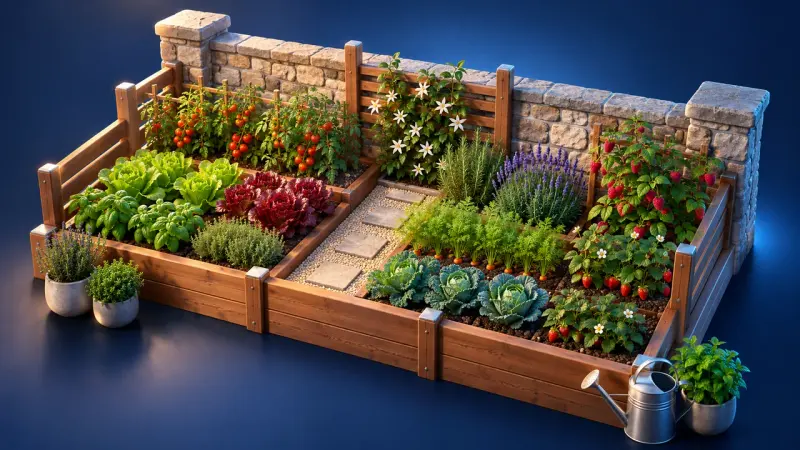
Which enclosure has the largest area? Picture and graph show the maximum, first by trying, then by exact calculation.
Grade 9 Baden-Württemberg: grade 9/10 Bavaria: grade 9 Berlin: grade 9 Brandenburg: grade 9 Bremen: grade 7–9 Hamburg: grade 9/10 Hesse: grade 9/10 Lower Saxony: grade 9/10 North Rhine-Westphalia: grade 9/10 Rhineland-Palatinate: grade 9/10 Saarland: grade 9 Saxony: grade 9 Saxony-Anhalt: grade 9 Schleswig-Holstein: grade 7–9
Unit S3 FrequenciesReading data critically, spotting manipulation, absolute and relative frequencies, pie charts, mean, median, quartiles and box plots.
Show the same data as bar, line and pie charts and more, and discover how charts can mislead.
Grade 6–9 Baden-Württemberg: grades 5/6, 7/8 Bavaria: grade 6 Berlin: grades 6, 7, 8, 9 Brandenburg: grades 5/6, 7, 8, 9 Bremen: grades 5/6, 7–9 Hamburg: grades 5/6, 7/8 Hesse: grades 5/6, 7/8 Lower Saxony: grade 5/6 North Rhine-Westphalia: grade 5/6 Rhineland-Palatinate: grades 5/6, 7/8, 9/10 Saarland: grade 5/6 Saxony: grades 6, 7, 9 Saxony-Anhalt: grade 5/6 Schleswig-Holstein: grades 5/6, 7–9
One outlier pulls the mean away while the median barely moves. Dragging single data points shows which value is how robust.
Grade 6–9 Baden-Württemberg: grades 5/6, 7/8 Bavaria: grade 7 Berlin: grades 7, 8, 9 Brandenburg: grades 7, 8, 9 Bremen: grade 7–9 Hamburg: grade 7/8 Hesse: grades 5/6, 7/8 Lower Saxony: grade 5/6 North Rhine-Westphalia: grade 5/6 Rhineland-Palatinate: grades 5/6, 7/8 Saarland: grade 5/6 Saxony: grade 9 Saxony-Anhalt: grades 5/6, 9 Schleswig-Holstein: grade 7–9
Unit S4 Probability IIThe Laplace rule, multi-stage Laplace experiments, chances and risks, the law of large numbers and simulations.
Toss a coin, a die or a drawing pin a thousand times: the more often you throw, the closer the relative frequency gets to the probability.
Grade 6–9 Baden-Württemberg: grade 7/8 Bavaria: grade 8 Berlin: grades 7, 8 Brandenburg: grades 7, 8 Bremen: grades 5/6, 7–9 Hamburg: grades 5/6, 7/8 Hesse: grade 5/6 Lower Saxony: grade 7/8 North Rhine-Westphalia: grade 7/8 Rhineland-Palatinate: grade 7/8 Saarland: grade 7 Saxony: grade 8 Saxony-Anhalt: grades 7/8, 9 Schleswig-Holstein: grade 7–9
Random points fall on a square with a circle inside. From the share inside the circle you can estimate π.
Grade 8–10 Baden-Württemberg: grade 9/10 Bavaria: grade 10 Berlin: grade 10 Brandenburg: grade 10 Bremen: grade 7–9 Hamburg: grade 7/8 Rhineland-Palatinate: grade 9/10 Saarland: grade 10 Saxony: grade 8 Saxony-Anhalt: grade 7/8 Schleswig-Holstein: grade 7–9
Unit S5 Statistics IITree diagrams for two- and multi-stage random experiments.
Draw balls from an urn, with or without replacement. The tree diagram and the path rules show how to calculate probabilities.
Grade 8–10 Baden-Württemberg: grades 7/8, 9/10 Bavaria: grades 8, 10 Berlin: grades 8, 9 Brandenburg: grades 8, 9 Bremen: grade 7–9 Hamburg: grades 7/8, 9/10 Hesse: grades 7/8, 9/10 Lower Saxony: grades 7/8, 9/10 North Rhine-Westphalia: grades 7/8, 9/10 Rhineland-Palatinate: grade 9/10 Saarland: grade 10 Saxony: grade 8 Saxony-Anhalt: grade 7/8 Schleswig-Holstein: grade 7–9
Unit S6 CombinatoricsCounting strategies and systematic counting.
How many outfits or ice cream combinations are there? A tree diagram grows step by step and shows why you multiply the options.
Grade 5–9 Baden-Württemberg: grade 7/8 Bavaria: grades 5, 8 Berlin: grades 5, 6, 7, 8 Brandenburg: grades 5/6, 7, 8 Bremen: grade 7–9 Hamburg: grades 7/8, 9/10 Hesse: grade 7/8 Lower Saxony: grade 7/8 North Rhine-Westphalia: grade 9/10 Rhineland-Palatinate: grade 5/6 Saarland: grade 7 Saxony: grade 8 Saxony-Anhalt: grade 7/8 Schleswig-Holstein: grades 5/6, 7–9
Unit S7 Probability IIIProbabilities of multi-stage experiments with the path rules.
Draw balls from an urn, with or without replacement. The tree diagram and the path rules show how to calculate probabilities.
Grade 8–10 Baden-Württemberg: grades 7/8, 9/10 Bavaria: grades 8, 10 Berlin: grades 8, 9 Brandenburg: grades 8, 9 Bremen: grade 7–9 Hamburg: grades 7/8, 9/10 Hesse: grades 7/8, 9/10 Lower Saxony: grades 7/8, 9/10 North Rhine-Westphalia: grades 7/8, 9/10 Rhineland-Palatinate: grade 9/10 Saarland: grade 10 Saxony: grade 8 Saxony-Anhalt: grade 7/8 Schleswig-Holstein: grade 7–9
The summaries describe the curriculum in our own words. The original text is authoritative. Original text (German): Bildungsplan, Gymnasium, Mathematics, grade 7–9