

Expression trees: the structure of terms
An expression drawn as a tree: whatever hangs lowest is calculated first. The order of operations stops being a rule and becomes visible.
Describing relationships with variables, evaluating terms with tables and spreadsheets, naming term structures.
An expression drawn as a tree: whatever hangs lowest is calculated first. The order of operations stops being a rule and becomes visible.
Laws of exponents, collecting like terms, expanding, factorising and the binomial formulas.

The three binomial formulas as areas: a square splits into smaller squares and rectangles.
Constructing symmetric figures with compass and ruler, perpendicular bisectors and angle bisectors; ordering quadrilaterals by their symmetries.

In a line or in a point: the shape flips over, and every construction step with the set square stays visible.

A point equally far from A and B never lies there by chance: the perpendicular bisector appears before you draw it with compasses.

Move one corner and the square becomes a kite. When does a quadrilateral get which name?
Vertical, adjacent, corresponding and alternate angles; proving the angle sum of a triangle and extending it to polygons.

Two lines cross and one of them turns. Which angles stay equal? At parallel lines they are called corresponding and alternate angles.

Tear off three corners, put them side by side, and you get a straight line: 180°, for every triangle. A quadrilateral gives 360°.
Setting up equations and solving them by equivalent transformations; more demanding percentage problems.

Solve linear equations on a balance: whatever you do to both sides keeps the scale balanced.

Discounts, VAT, surveys: one single bar holds the base value, the percentage and the part, one above the other.
Comparing median and mean, range and quartiles, drawing and interpreting box plots.

One outlier pulls the mean away while the median barely moves. Dragging single data points shows which value is how robust.
Congruence criteria, isosceles and equilateral triangles, theorems and their converses, circumcircle and incircle, Thales’s theorem, constructing tangents.
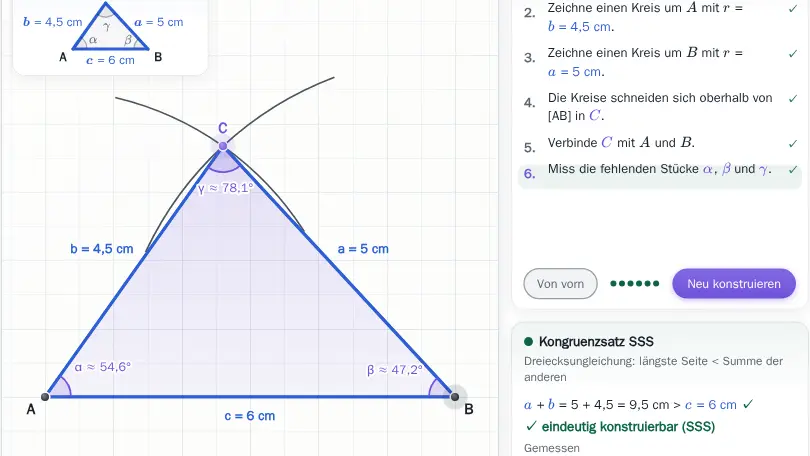
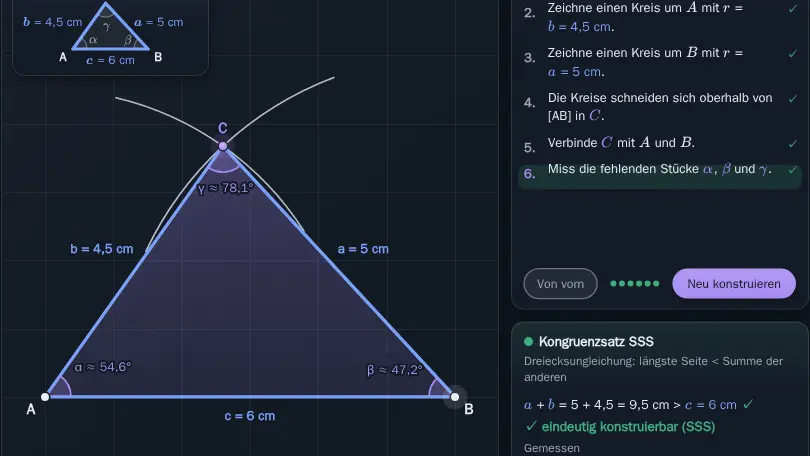
Construct triangles from three given parts with ruler and compass, step by step as in your exercise book. Sometimes there are no, one or two solutions.
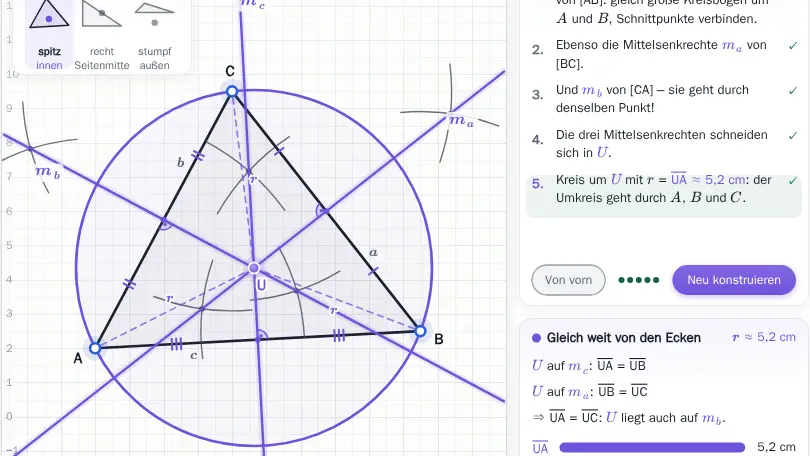

Construct the special lines in a triangle. Each set of three always meets in one point, for example at the centre of the circumcircle or the incircle.

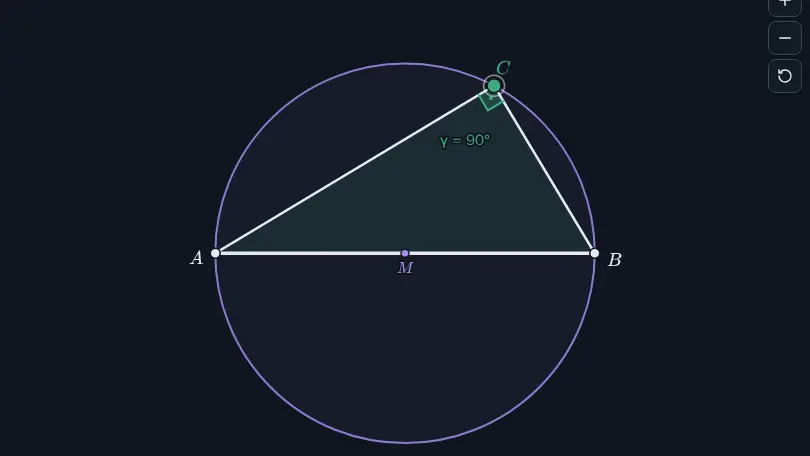
Drag a point along the semicircle: the angle there is always a right angle.
The summaries describe the curriculum in our own words. The original text is authoritative. Original text (German): LehrplanPLUS, Gymnasium, Mathematics, grade 7