

Square roots and Heron’s method
Step by step, a rectangle turns into a square with the same area. The method is almost 2000 years old and reaches √2 surprisingly quickly.
Definition of square roots, irrationality and real numbers, Heron’s method, calculating with roots.
Step by step, a rectangle turns into a square with the same area. The method is almost 2000 years old and reaches √2 surprisingly quickly.
Effect of a, d and e on the parabola, finding the vertex, reading off properties, the quadratic formula; standard, vertex and factored form.

Stretch, reflect and shift parabolas and read off the vertex and the zeros.
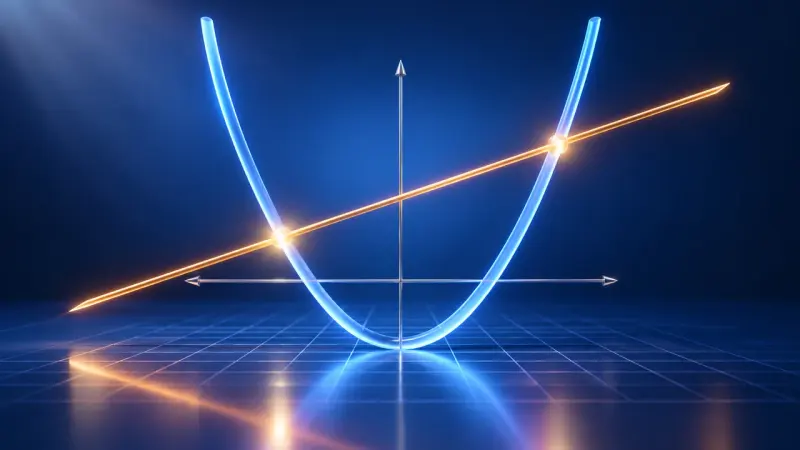
Draw both sides of an equation as graphs. The solutions are where the graphs cross.
Systems with three unknowns (parabola through three points), intersecting lines and hyperbolas, optimisation problems.

Drag three points and the matching parabola always passes through all of them. The equation is worked out step by step.
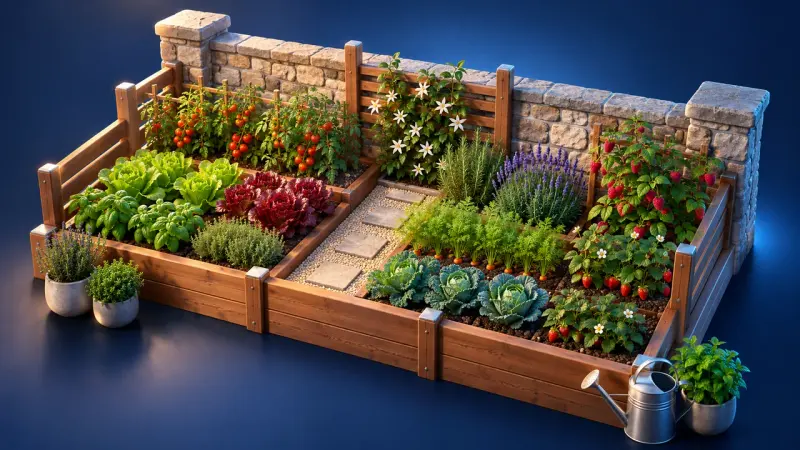
Which enclosure has the largest area? Picture and graph show the maximum, first by trying, then by exact calculation.
Intersection and union of events, Venn diagrams and two-way tables, the addition rule.

A two-way table, a Venn diagram and a tree diagram show the same data and are linked. Change one and the others follow.
Similar figures, the intercept theorems and how area and volume change when scaling.
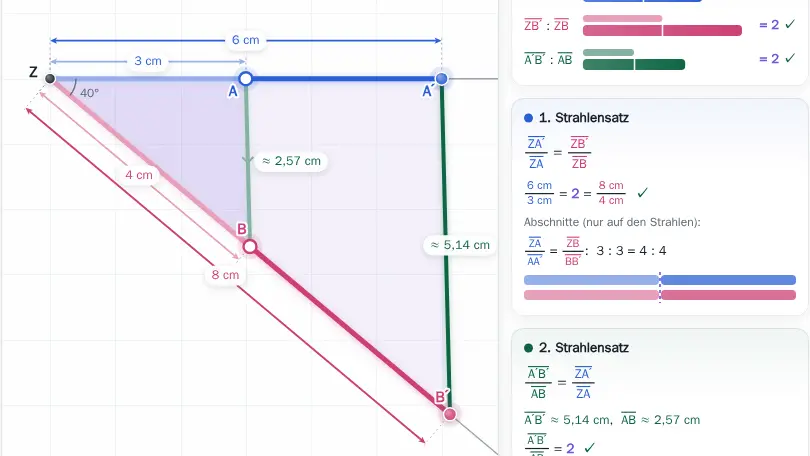
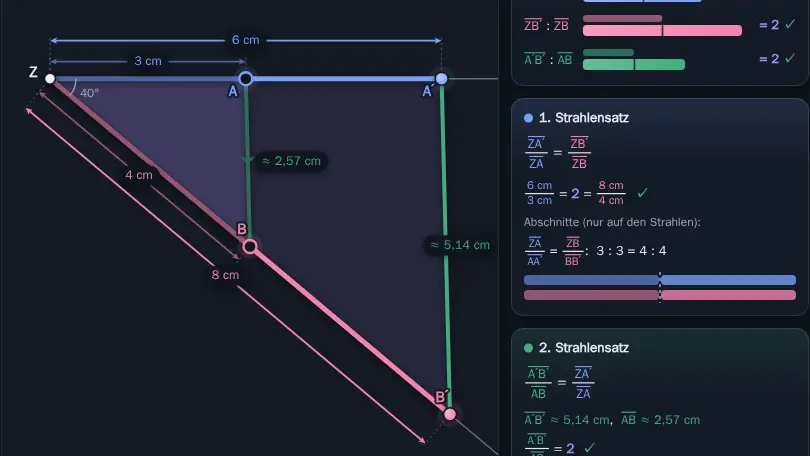
How tall is the tree without climbing it? Two rays and a parallel line are enough, because the ratios stay the same.

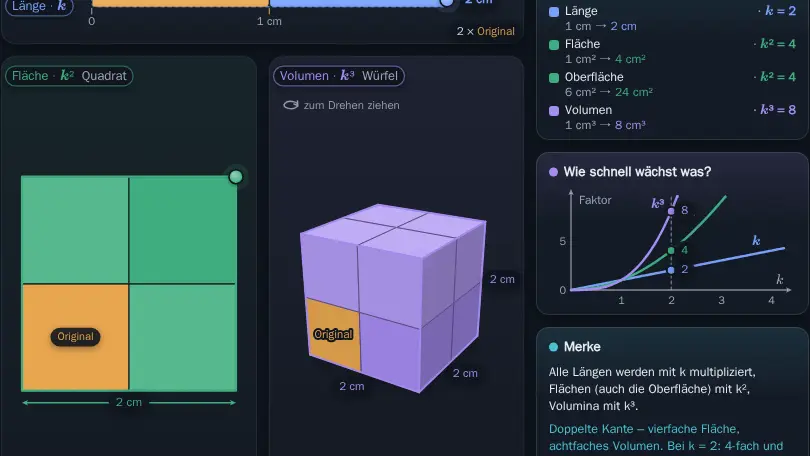
Enlarge lengths, areas and solids. Doubling the length makes the area four times and the volume eight times as large.
Graphs of y = a · xⁿ and their symmetry, nth roots, powers with rational exponents.
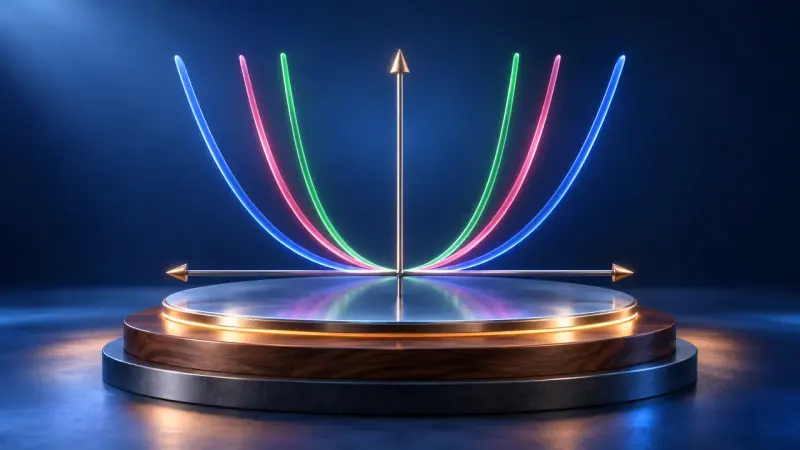
Even or odd, positive or negative: y = a · xⁿ changes with every exponent, and only a few points always stay the same.
Proof, converse and many applications in right triangles.
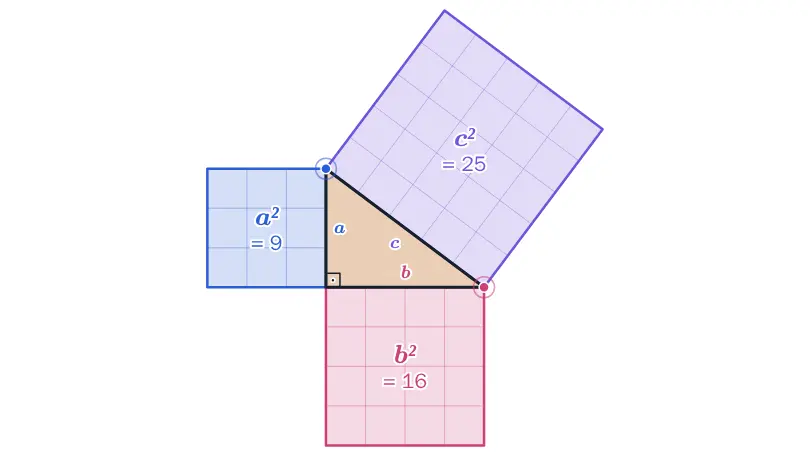

Squares on the sides of a right triangle and a puzzle proof show: a² + b² = c².
Ratios of sides as sine, cosine and tangent, relationships between them and calculations in applications.

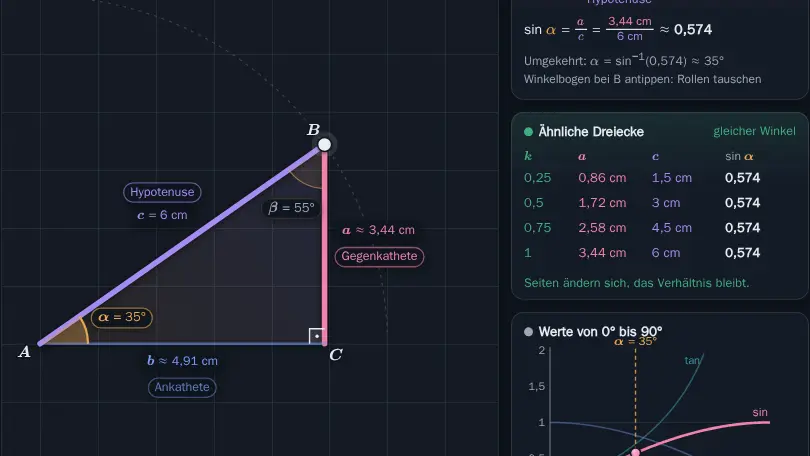
In a right triangle, the ratio of two sides depends only on the angle. This gives sine, cosine and tangent, with examples such as ramps and ladders.
Sine and cosine for angles up to 360° on the unit circle, the laws of sines and cosines.

Sine, cosine and tangent on the unit circle, and how the sine curve grows out of it.

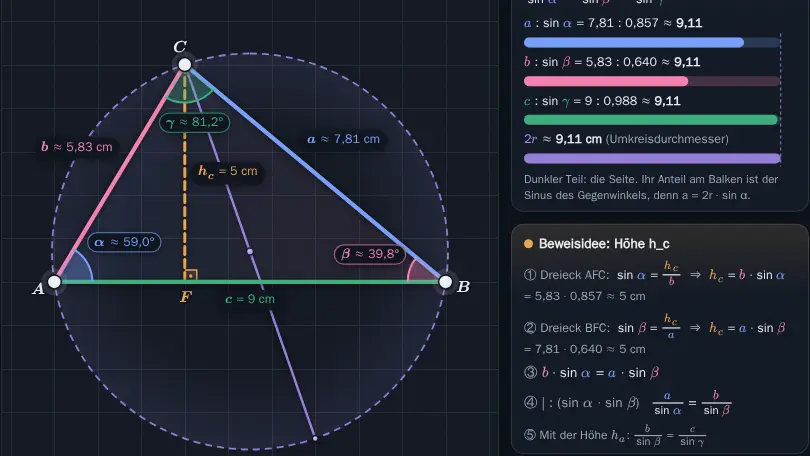
Calculate sides and angles in any triangle with the law of sines and the law of cosines. A helper shows which law fits your problem.
The summaries describe the curriculum in our own words. The original text is authoritative. Original text (German): LehrplanPLUS, Gymnasium, Mathematics, grade 9