Home Physics Saxony curriculum · Gymnasium Grade 11 Physics Saxony curriculum · Gymnasium
Physics – grade 11 Grade 11 with basic course (GK) and advanced course (LK). The GK/LK prefixes are ours; the numbers after them are the curriculum’s; W marks optional areas.
Unit GK-1 Foundations of mechanics (basic course)Conservation of energy, friction and motion on an inclined plane, superposition of forces, F = m · a and uniform circular motion.
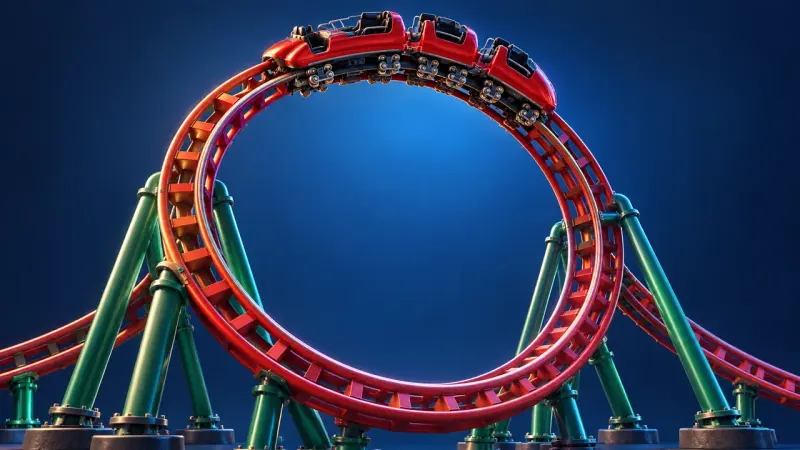
A car rides a roller coaster: energy bars show how potential and kinetic energy turn into each other.
Grade 7–11 Baden-Württemberg: grades 9/10, 11 Bavaria: grade 9 Berlin: grades 7/8, 9/10 Brandenburg: grades 7/8, 9/10 Bremen: grades 7–9, 10 Hamburg: grades 7, 8, 9 Hesse: grades 9/10, 11 Lower Saxony: grades 9/10, 11 North Rhine-Westphalia: grades 7–10, 11 Rhineland-Palatinate: grades 7–10, 11 Saarland: grades 8, 10, 11 Saxony: grades 7, 11 Saxony-Anhalt: grades 7/8, 9, 11/12 Schleswig-Holstein: grades 7–10, 11
A block sits on a slope. At what angle does it start to slide? The weight is split into two parts to find out.
Grade 8–11 Baden-Württemberg: grade 11 Bavaria: grade 8 Berlin: grades 7/8, 9/10 Brandenburg: grades 7/8, 9/10 Bremen: grade 10 Hamburg: grade 8 Hesse: grade 9/10 North Rhine-Westphalia: grades 7–10, 11 Rhineland-Palatinate: grades 7–10, 11 Saarland: grade 11 Saxony: grades 10, 11 Saxony-Anhalt: grades 9, 11/12 Schleswig-Holstein: grade 11
Two forces pull on one point. Use the parallelogram of forces to find the total force or to split a force into two.
Grade 8–11 Baden-Württemberg: grade 11 Bavaria: grade 8 Berlin: grades 7/8, 9/10 Brandenburg: grades 7/8, 9/10 Bremen: grades 7–9, 10 Hamburg: grade 8 Hesse: grade 9/10 Lower Saxony: grade 7/8 North Rhine-Westphalia: grades 7–10, 11 Rhineland-Palatinate: grades 7–10, 11 Saarland: grades 8, 11 Saxony: grades 10, 11 Saxony-Anhalt: grades 7/8, 9, 11/12 Schleswig-Holstein: grades 7–10, 11
A ball swings round on a string, a car drives through a bend. Which force keeps them on a circular path?
Grade 9–11 Baden-Württemberg: grade 11 Bavaria: grade 11 Berlin: grade 9/10 Brandenburg: grade 9/10 Bremen: grade 10 Hamburg: grade 10 Hesse: grade 11 Lower Saxony: grade 11 North Rhine-Westphalia: grade 11 Rhineland-Palatinate: grade 11 Saarland: grade 11 Saxony: grade 11 Saxony-Anhalt: grades 9, 11/12 Schleswig-Holstein: grade 11
Unit GK-2 Electric field (basic course)The concept of a field, field-line patterns, field strength, uniform and radial fields, capacitors with capacitance, charging and discharging.
Two charges and the field rearranges itself. A test charge measures where the force is strongest.
Grade 11–12 Baden-Württemberg: grade 12/13 Bavaria: grade 12 Berlin: grade 11 Brandenburg: grade 11 Bremen: grade 11/12 Hamburg: grade 11/12 Hesse: grade 12 Lower Saxony: grade 12/13 North Rhine-Westphalia: grade 12/13 Rhineland-Palatinate: grade 12/13 Saarland: grade 12 Saxony: grade 11 Saxony-Anhalt: grade 11/12 Schleswig-Holstein: grades 11, 12/13
A capacitor charges through a resistor and discharges again. The graphs show how voltage and current change over time.
Grade 11–12 Baden-Württemberg: grade 12/13 Bavaria: grade 12 Berlin: grade 11 Brandenburg: grade 11 Bremen: grade 11/12 Hamburg: grade 11/12 Hesse: grade 12 Lower Saxony: grade 12/13 North Rhine-Westphalia: grade 12/13 Rhineland-Palatinate: grade 12/13 Saarland: grade 12 Saxony: grade 11 Saxony-Anhalt: grade 11/12 Schleswig-Holstein: grades 11, 12/13
Unit GK-3 Magnetic field (basic course)Field-line patterns, flux density, the field around wires and inside coils.
No separate simulation is planned for this.
Unit GK-4 Charged particles and bodies in static fields (basic course)The Lorentz force and circular paths, the Millikan experiment, acceleration and deflection in an electric field.
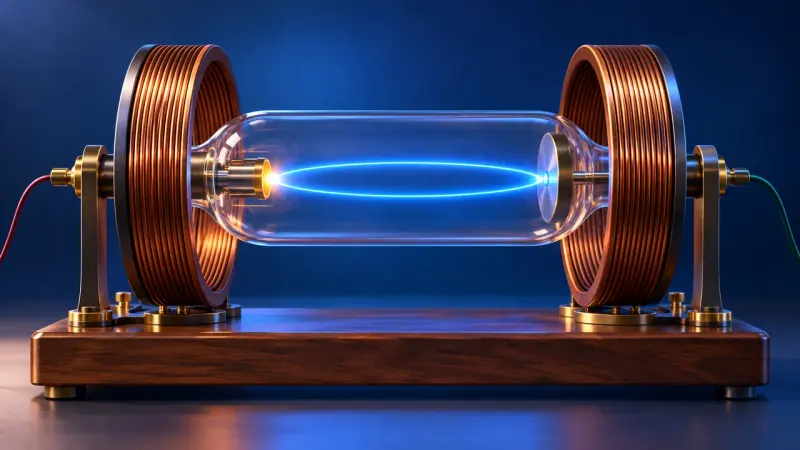
Electrons fly along a glowing circular path in a magnetic field. From the radius you determine a property of the electron.
Grade 10–13 Baden-Württemberg: grade 12/13 Bavaria: grades 10, 12 Berlin: grade 11 Brandenburg: grade 11 Bremen: grade 11/12 Hamburg: grade 11/12 Hesse: grade 12 Lower Saxony: grade 12/13 North Rhine-Westphalia: grades 7–10, 12/13 Rhineland-Palatinate: grade 12/13 Saarland: grades 10, 12 Saxony: grade 11 Saxony-Anhalt: grade 11/12 Schleswig-Holstein: grades 11, 12/13
Unit GK-5 Electromagnetic fields (basic course)The law of induction, magnetic flux and Lenz’s law.
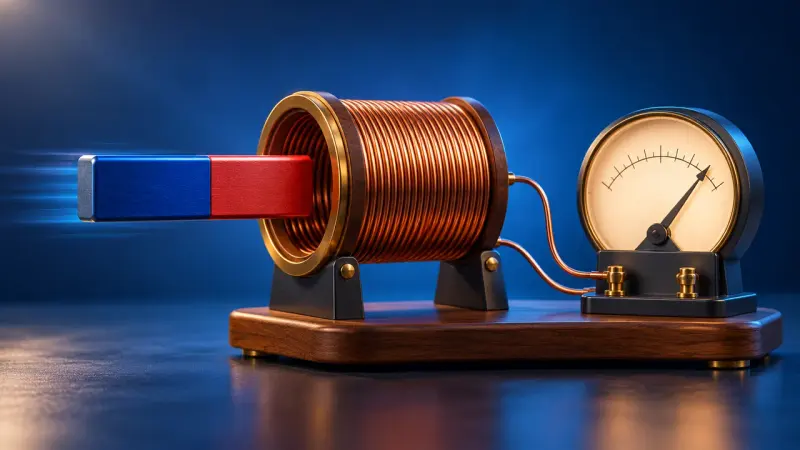
Magnet in, the needle swings. Magnet out, it swings the other way. Every generator works on the same principle.
Grade 9–13 Baden-Württemberg: grades 9/10, 12/13 Bavaria: grades 10, 12 Berlin: grades 9/10, 11 Brandenburg: grades 9/10, 11 Bremen: grades 7–9, 11/12 Hamburg: grades 9, 11/12 Hesse: grades 9/10, 12 Lower Saxony: grade 12/13 North Rhine-Westphalia: grades 7–10, 12/13 Rhineland-Palatinate: grades 7–10, 12/13 Saarland: grades 10, 12 Saxony: grades 9, 11 Saxony-Anhalt: grades 9, 11/12 Schleswig-Holstein: grades 7–10, 11, 12/13
Unit GK-W1 Conduction in semiconductors (optional, basic course)The band model, pn junction, diode and transistor.
No separate simulation is planned for this.
Unit GK-W2 Measuring and modelling (optional, basic course)Recording measurements with video analysis and data loggers and comparing them with models.
No separate simulation is planned for this.
Unit GK-W3 Relativity of time and space (optional, basic course)Postulates, time dilation and length contraction.
No separate simulation is planned for this.
Unit LK-1 Conservation laws and their applications (advanced course)Mechanical energy and work, conservation of energy, conservation of momentum in elastic and inelastic collisions.
A car rides a roller coaster: energy bars show how potential and kinetic energy turn into each other.
Grade 7–11 Baden-Württemberg: grades 9/10, 11 Bavaria: grade 9 Berlin: grades 7/8, 9/10 Brandenburg: grades 7/8, 9/10 Bremen: grades 7–9, 10 Hamburg: grades 7, 8, 9 Hesse: grades 9/10, 11 Lower Saxony: grades 9/10, 11 North Rhine-Westphalia: grades 7–10, 11 Rhineland-Palatinate: grades 7–10, 11 Saarland: grades 8, 10, 11 Saxony: grades 7, 11 Saxony-Anhalt: grades 7/8, 9, 11/12 Schleswig-Holstein: grades 7–10, 11
Two gliders collide on an air track. Before and after are compared to see what stays the same.
Grade 10–11 Baden-Württemberg: grade 11 Bavaria: grade 10 Bremen: grade 10 Hamburg: grade 10 Hesse: grade 11 North Rhine-Westphalia: grade 11 Rhineland-Palatinate: grades 7–10, 11 Saarland: grade 11 Saxony: grade 11 Saxony-Anhalt: grade 11/12 Schleswig-Holstein: grades 7–10, 11
Unit LK-2 Forces (advanced course)Friction, resolving forces on an inclined plane, Newton’s second law and circular motion.
A block sits on a slope. At what angle does it start to slide? The weight is split into two parts to find out.
Grade 8–11 Baden-Württemberg: grade 11 Bavaria: grade 8 Berlin: grades 7/8, 9/10 Brandenburg: grades 7/8, 9/10 Bremen: grade 10 Hamburg: grade 8 Hesse: grade 9/10 North Rhine-Westphalia: grades 7–10, 11 Rhineland-Palatinate: grades 7–10, 11 Saarland: grade 11 Saxony: grades 10, 11 Saxony-Anhalt: grades 9, 11/12 Schleswig-Holstein: grade 11
Two forces pull on one point. Use the parallelogram of forces to find the total force or to split a force into two.
Grade 8–11 Baden-Württemberg: grade 11 Bavaria: grade 8 Berlin: grades 7/8, 9/10 Brandenburg: grades 7/8, 9/10 Bremen: grades 7–9, 10 Hamburg: grade 8 Hesse: grade 9/10 Lower Saxony: grade 7/8 North Rhine-Westphalia: grades 7–10, 11 Rhineland-Palatinate: grades 7–10, 11 Saarland: grades 8, 11 Saxony: grades 10, 11 Saxony-Anhalt: grades 7/8, 9, 11/12 Schleswig-Holstein: grades 7–10, 11
A ball swings round on a string, a car drives through a bend. Which force keeps them on a circular path?
Grade 9–11 Baden-Württemberg: grade 11 Bavaria: grade 11 Berlin: grade 9/10 Brandenburg: grade 9/10 Bremen: grade 10 Hamburg: grade 10 Hesse: grade 11 Lower Saxony: grade 11 North Rhine-Westphalia: grade 11 Rhineland-Palatinate: grade 11 Saarland: grade 11 Saxony: grade 11 Saxony-Anhalt: grades 9, 11/12 Schleswig-Holstein: grade 11
Unit LK-3 Kinematics and dynamics – practical (advanced course)Measuring and classifying motion, graphs, horizontal projection and measurement uncertainty.
A car drives at a steady speed or speeds up. The graphs for distance, speed and acceleration are drawn live.
Grade 7–11 Baden-Württemberg: grades 7/8, 11 Bavaria: grades 8, 10 Berlin: grade 9/10 Brandenburg: grade 9/10 Bremen: grades 7–9, 10 Hamburg: grades 7, 8, 9 Hesse: grades 6–8, 11 Lower Saxony: grades 7/8, 11 North Rhine-Westphalia: grades 7–10, 11 Rhineland-Palatinate: grades 7–10, 11 Saarland: grades 7, 11 Saxony: grades 9, 11 Saxony-Anhalt: grades 9, 11/12 Schleswig-Holstein: grades 7–10, 11
Which launch angle goes furthest? On Earth it is 45°, and on the Moon the same ball flies six times as far.
Grade 10–11 Baden-Württemberg: grade 11 Bavaria: grades 10, 11 Bremen: grade 10 Hamburg: grade 10 Hesse: grade 11 Lower Saxony: grade 11 North Rhine-Westphalia: grade 11 Rhineland-Palatinate: grade 11 Saxony: grade 11 Saxony-Anhalt: grade 11/12 Schleswig-Holstein: grade 11
A ball falls on Earth, the Moon or Mars and gets faster every second. In a vacuum even a feather keeps up.
Grade 9–11 Baden-Württemberg: grade 11 Bavaria: grade 10 Berlin: grade 9/10 Brandenburg: grade 9/10 Bremen: grade 10 Hamburg: grade 9 Hesse: grade 11 Lower Saxony: grade 11 North Rhine-Westphalia: grades 7–10, 11 Rhineland-Palatinate: grade 11 Saarland: grade 11 Saxony: grades 9, 11 Saxony-Anhalt: grades 9, 11/12 Schleswig-Holstein: grade 11
Unit LK-4 Modelling and simulation (advanced course)Modelling motion numerically, varying parameters and comparing with experiment.
No separate simulation is planned for this.
Unit LK-5 Electric field (advanced course)Coulomb’s law, field lines and field strength, capacitors with dielectrics, charging and discharging curves, and potential and voltage.
Two charges and the field rearranges itself. A test charge measures where the force is strongest.
Grade 11–12 Baden-Württemberg: grade 12/13 Bavaria: grade 12 Berlin: grade 11 Brandenburg: grade 11 Bremen: grade 11/12 Hamburg: grade 11/12 Hesse: grade 12 Lower Saxony: grade 12/13 North Rhine-Westphalia: grade 12/13 Rhineland-Palatinate: grade 12/13 Saarland: grade 12 Saxony: grade 11 Saxony-Anhalt: grade 11/12 Schleswig-Holstein: grades 11, 12/13
A capacitor charges through a resistor and discharges again. The graphs show how voltage and current change over time.
Grade 11–12 Baden-Württemberg: grade 12/13 Bavaria: grade 12 Berlin: grade 11 Brandenburg: grade 11 Bremen: grade 11/12 Hamburg: grade 11/12 Hesse: grade 12 Lower Saxony: grade 12/13 North Rhine-Westphalia: grade 12/13 Rhineland-Palatinate: grade 12/13 Saarland: grade 12 Saxony: grade 11 Saxony-Anhalt: grade 11/12 Schleswig-Holstein: grades 11, 12/13
Unit LK-6 Magnetic field (advanced course)Field-line patterns, flux density, the field around wires and inside coils, matter in a magnetic field.
No separate simulation is planned for this.
Unit LK-7 Charged particles and bodies in static fields (advanced course)The Lorentz force, the specific charge of the electron, the Hall effect, the Wien filter, accelerators and mass spectrometers.
Electrons fly along a glowing circular path in a magnetic field. From the radius you determine a property of the electron.
Grade 10–13 Baden-Württemberg: grade 12/13 Bavaria: grades 10, 12 Berlin: grade 11 Brandenburg: grade 11 Bremen: grade 11/12 Hamburg: grade 11/12 Hesse: grade 12 Lower Saxony: grade 12/13 North Rhine-Westphalia: grades 7–10, 12/13 Rhineland-Palatinate: grade 12/13 Saarland: grades 10, 12 Saxony: grade 11 Saxony-Anhalt: grade 11/12 Schleswig-Holstein: grades 11, 12/13
Unit LK-8 Electromagnetic fields (advanced course)The law of induction, transformers, Lenz’s law, self-induction and magnetic field energy.
Magnet in, the needle swings. Magnet out, it swings the other way. Every generator works on the same principle.
Grade 9–13 Baden-Württemberg: grades 9/10, 12/13 Bavaria: grades 10, 12 Berlin: grades 9/10, 11 Brandenburg: grades 9/10, 11 Bremen: grades 7–9, 11/12 Hamburg: grades 9, 11/12 Hesse: grades 9/10, 12 Lower Saxony: grade 12/13 North Rhine-Westphalia: grades 7–10, 12/13 Rhineland-Palatinate: grades 7–10, 12/13 Saarland: grades 10, 12 Saxony: grades 9, 11 Saxony-Anhalt: grades 9, 11/12 Schleswig-Holstein: grades 7–10, 11, 12/13
Unit LK-W1 Introduction to relativity (optional, advanced course)Postulates, the Michelson experiment, time dilation and E = m · c².
No separate simulation is planned for this.
Unit LK-W2 Conduction in semiconductors (optional, advanced course)The band model, pn junction, diode and transistor.
No separate simulation is planned for this.
The summaries describe the curriculum in our own words. The original text is authoritative. Original text (German): Lehrplan, Gymnasium, Physics, grade 11