
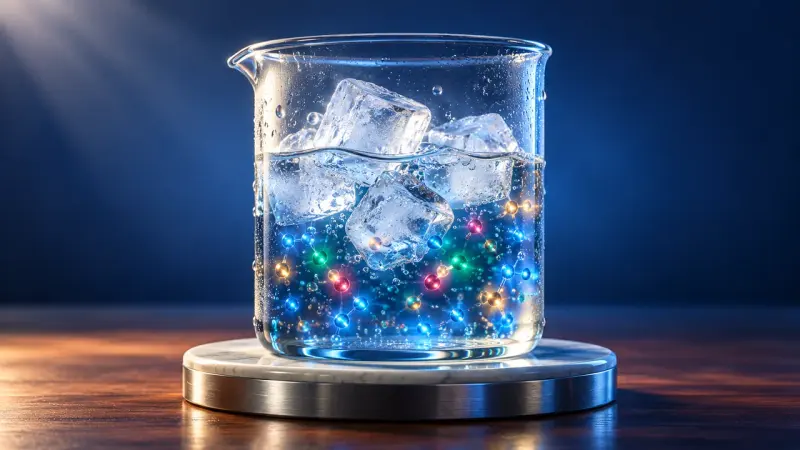
Particle model and temperature
Ice melts, water boils, and the temperature stops rising meanwhile. The particles show where the energy goes in between.
The curriculum assigns these units to exactly this grade (Saxony, Gymnasium up to grade 12; physics from grade 6). The unit numbers are the curriculum’s; optional areas (“Wahlbereiche”) are labelled W1–W3 here.
Pressure, hydrostatic pressure, buoyancy according to Archimedes and air pressure.
No separate simulation is planned for this.
Thermal energy in the particle model, heat and changes of state, heat transfer, and the Earth’s radiation budget and the greenhouse effect.
Ice melts, water boils, and the temperature stops rising meanwhile. The particles show where the energy goes in between.
Resistance and the resistance law, characteristic curves of components, Ohm’s law, and electrical energy and power.
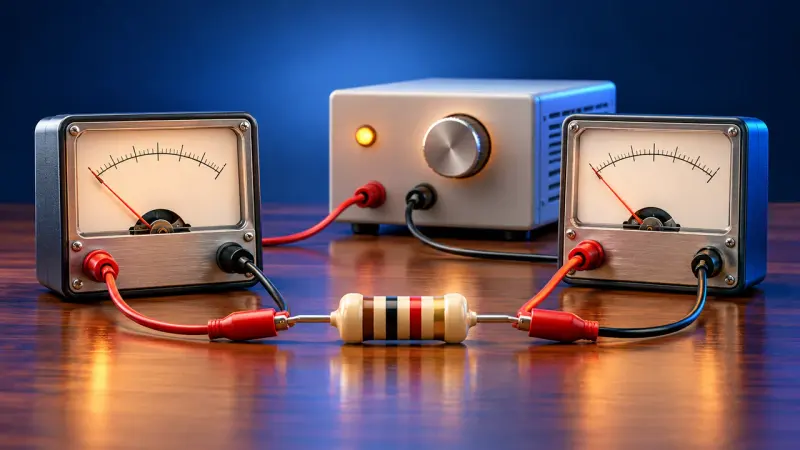
Turn up the voltage and the current rises, always in the same ratio. Point by point the characteristic curve appears, though not quite straight for a lamp.
Resistors in series and parallel, potentiometers and measurement uncertainty, also with digital data logging.

Connect lamps in series or in parallel and measure current and voltage at different points.
Static buoyancy in gases, hot-air balloons and airships.
No separate simulation is planned for this.
Transferring heat against the temperature gradient using energy.
No separate simulation is planned for this.
Sensors convert quantities such as temperature or light into voltages.
No separate simulation is planned for this.
The summaries describe the curriculum in our own words. The original text is authoritative. Original text (German): Lehrplan, Gymnasium, Physics, grade 8