
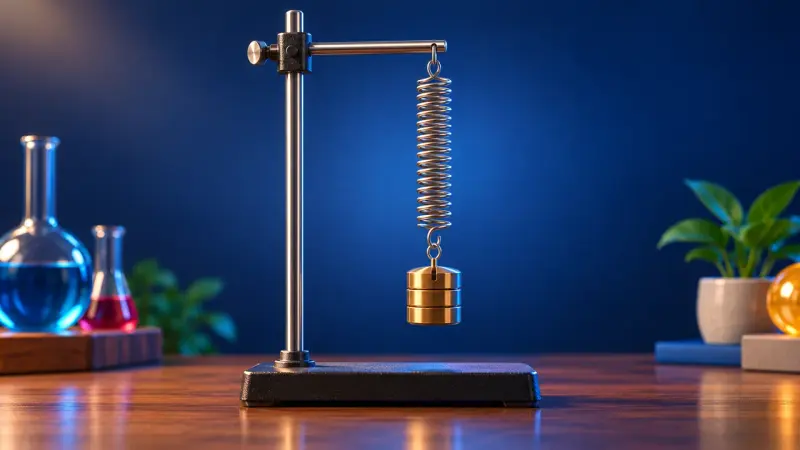
Hooke’s law
Hang weights on a spring and measure how far it stretches. Double the force means double the stretch.
The curriculum assigns these units to exactly this grade (Saxony, Gymnasium up to grade 12; physics from grade 6). The unit numbers are the curriculum’s; optional areas (“Wahlbereiche”) are labelled W1–W3 here.
Force as an arrow, weight, Hooke’s law, the law of the lever, friction, and magnetic and electrostatic forces with field-line patterns.
Hang weights on a spring and measure how far it stretches. Double the force means double the stretch.

How can a child lift an adult on a seesaw? With the longer arm. Wheelbarrows and bottle openers use the same trick.
Measuring current and voltage, conduction by electrons, rules for current and voltage in branched and unbranched circuits.
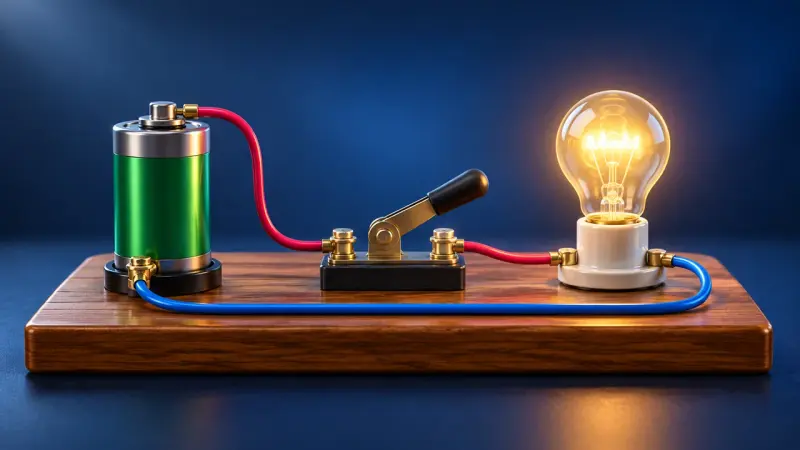
Build a circuit with a battery, a switch and a lamp, as a set-up and as a circuit diagram. When the circuit is closed, the lamp lights up.

Connect lamps in series or in parallel and measure current and voltage at different points.
Forms of energy and energy conversion, potential energy, conservation of energy in mechanics, efficiency and power.
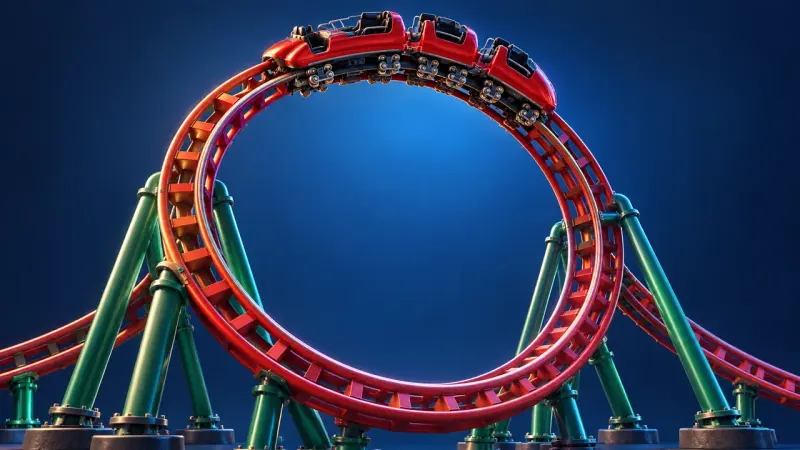
A car rides a roller coaster: energy bars show how potential and kinetic energy turn into each other.
Levers, pulley systems, the bicycle and the golden rule of mechanics.
How can a child lift an adult on a seesaw? With the longer arm. Wheelbarrows and bottle openers use the same trick.
Recognising everyday circuits and building an application.
Build a circuit with a battery, a switch and a lamp, as a set-up and as a circuit diagram. When the circuit is closed, the lamp lights up.
History of flight and dynamic lift on a wing.
No separate simulation is planned for this.
The summaries describe the curriculum in our own words. The original text is authoritative. Original text (German): Lehrplan, Gymnasium, Physics, grade 7