

Planetary orbits and Kepler’s laws
Too fast and the planet flies off, never to return. A little slower and it traces an ellipse around the Sun, exactly as Kepler's laws say.
Main phase, first and second half-year (here grade 12): topic fields for the basic and the advanced course; LK = advanced course only. The numbers are those of the curriculum.
The law of gravitation and the gravitational field, orbital data of celestial bodies for circular orbits only, without Kepler’s laws.
Too fast and the planet flies off, never to return. A little slower and it traces an ellipse around the Sun, exactly as Kepler's laws say.
Field lines and field strength, the parallel-plate capacitor and capacitance, energy in the electric field.

Two charges and the field rearranges itself. A test charge measures where the force is strongest.

A capacitor charges through a resistor and discharges again. The graphs show how voltage and current change over time.
Magnetic fields of conductors and coils, magnetic flux density.
No separate simulation is planned for this.
Charged particles in electric and magnetic fields, the Lorentz force.
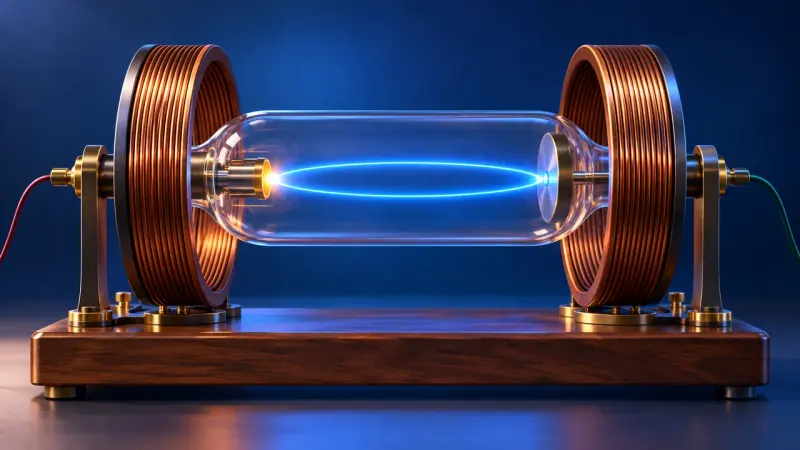
Electrons fly along a glowing circular path in a magnetic field. From the radius you determine a property of the electron.
The law of induction; LK: self-induction and the energy of the magnetic field.
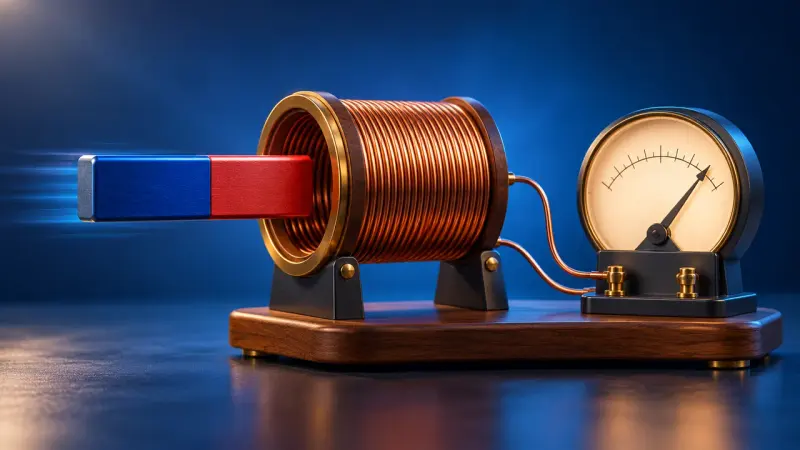
Magnet in, the needle swings. Magnet out, it swings the other way. Every generator works on the same principle.
Harmonic oscillation of spring and simple pendulums, damped oscillation; LK: forced oscillation and resonance.
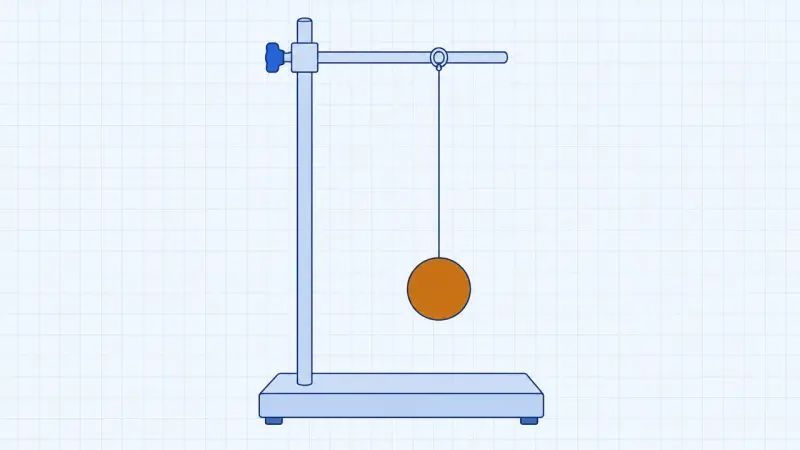
Pull a pendulum aside, let it go and measure how long one swing takes. What does it depend on? Also with large angles and damping.

A mass bounces up and down on a spring. Graphs show position, speed and energy during the oscillation.
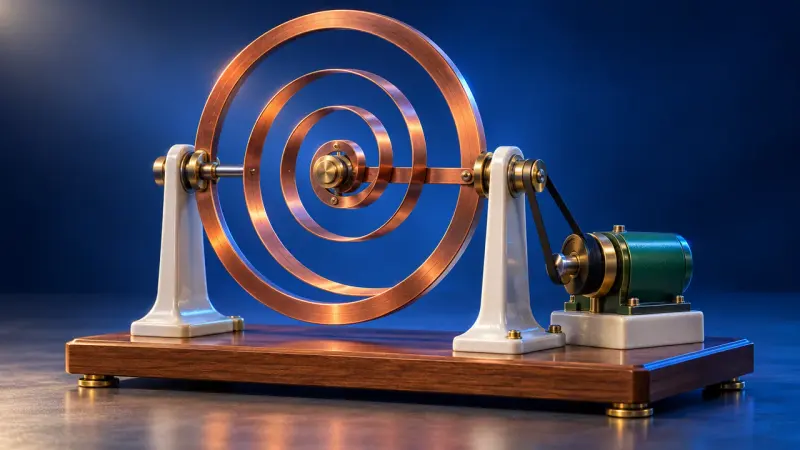
A motor drives an oscillating wheel. If the motor hits exactly the right rhythm, the wheel swings especially strongly: resonance.
Propagation and parameters of waves, superposition and interference, standing waves.
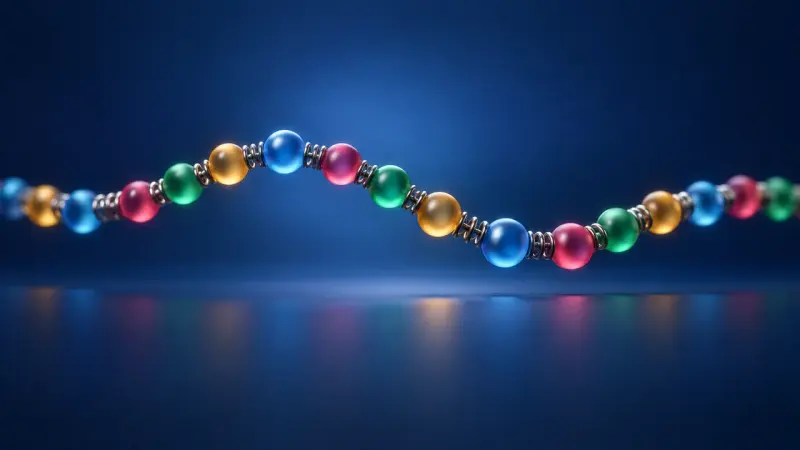
A wave travels through a chain of particles. Each particle only oscillates in place, across or along the direction of travel.
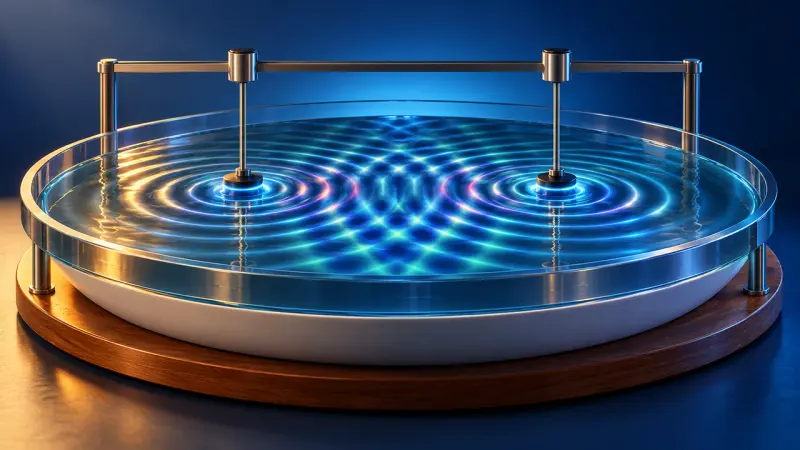
Two circular waves overlap: in some places they reinforce each other, in others they cancel out.
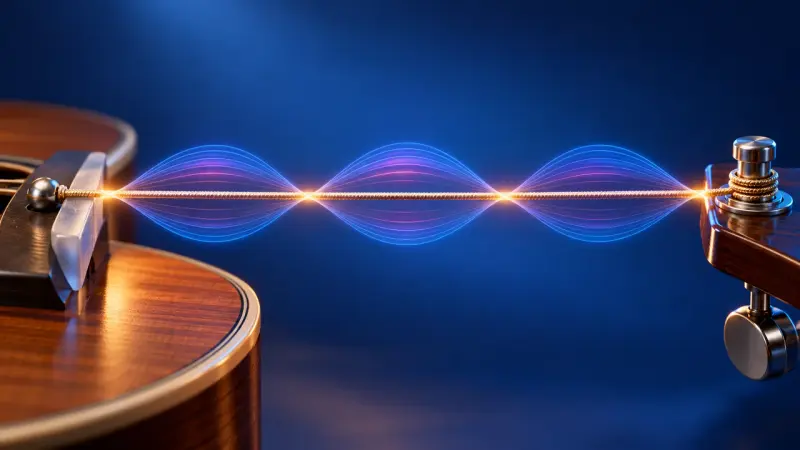
A wave is reflected at the end and a fixed pattern of nodes and antinodes appears, like on a guitar string.
The summaries describe the curriculum in our own words. The original text is authoritative. Original text (German): Lehrplan, Gymnasium, Physics, grade 12