

Field lines of point charges
Two charges and the field rearranges itself. A test charge measures where the force is strongest.
Qualification phase Q1 “Electric and magnetic field” and Q2 “Oscillations, induction and mechanical waves”. Q1.1–Q1.2 and Q2.1–Q2.3 are mandatory. Assigning them to grade 12 is an assumption (G9). “Advanced course only” marks the higher level.
Mandatory topic area. Field concept, field-line patterns and field strength, capacitor as energy store with charging and discharging, Coulomb's law and motion of charged particles in the field.
Field-line patterns (parallel plates, point charge, dipole), charge conservation and induction of charge.
Two charges and the field rearranges itself. A test charge measures where the force is strongest.
Defining field strength; radial field; graphical superposition.
Two charges and the field rearranges itself. A test charge measures where the force is strongest.
Capacitance, field energy and time behaviour during charging and discharging.

A capacitor charges through a resistor and discharges again. The graphs show how voltage and current change over time.
Force between point charges.
No separate simulation is planned for this.
Millikan experiment, acceleration of charged particles and deflection across the field.
No separate simulation is planned for this.
Surface charge density and quantitative superposition of fields.
Two charges and the field rearranges itself. A test charge measures where the force is strongest.
Dielectric, derivations and differential equation of discharge.
A capacitor charges through a resistor and discharges again. The graphs show how voltage and current change over time.
Electric potential and equipotential lines.
No separate simulation is planned for this.
Quantitative deflection (comparison with horizontal projectile), linear accelerator.
No separate simulation is planned for this.
Mandatory topic area. Magnetic field-line patterns and flux density, field of a long solenoid, and Lorentz force and circular paths of charged particles (fine-beam tube, e/m).
Field lines of permanent magnet, straight wire and solenoid.
No separate simulation is planned for this.
Defining flux density and determining it inside a long solenoid.
No separate simulation is planned for this.
Lorentz force as centripetal force and circular path in the fine-beam tube.
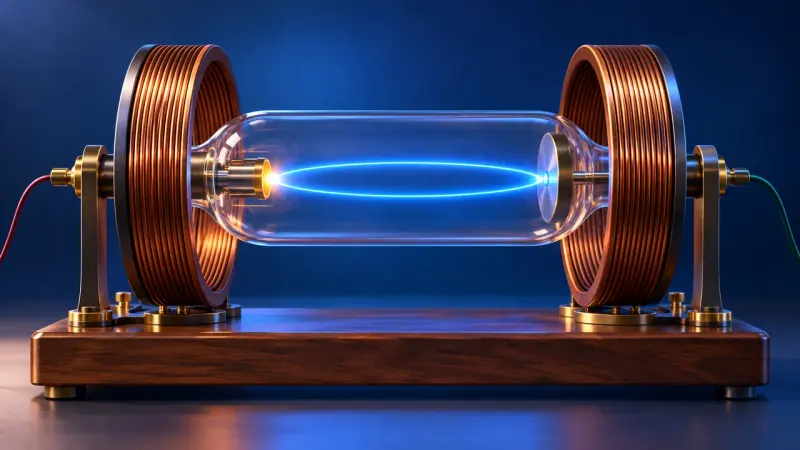
Electrons fly along a glowing circular path in a magnetic field. From the radius you determine a property of the electron.
Crossed fields and velocity filter.
Electrons fly along a glowing circular path in a magnetic field. From the radius you determine a property of the electron.
Explaining the voltage across a conductor in a magnetic field.
No separate simulation is planned for this.
Working principle of e.g. cyclotron and synchrotron.
No separate simulation is planned for this.
Mandatory topic area. Harmonic oscillations of spring and simple pendulums with their parameters, equation of motion, energy conversion and damping; in the advanced course forced oscillations and resonance.
Displacement, amplitude, period, frequency and energy (qualitative).

A mass bounces up and down on a spring. Graphs show position, speed and energy during the oscillation.
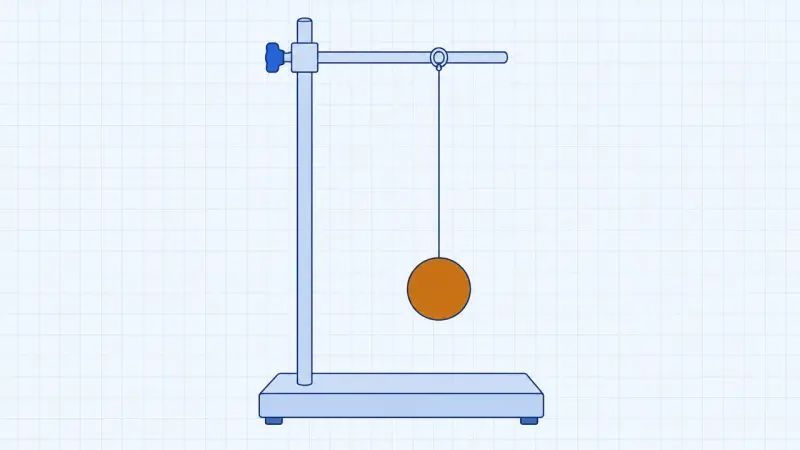
Pull a pendulum aside, let it go and measure how long one swing takes. What does it depend on? Also with large angles and damping.
Linear restoring force, period of spring and simple pendulum, equation of motion.
A mass bounces up and down on a spring. Graphs show position, speed and energy during the oscillation.
Pull a pendulum aside, let it go and measure how long one swing takes. What does it depend on? Also with large angles and damping.
Describing the decrease in amplitude qualitatively.
No separate simulation is planned for this.
Differential equation of undamped oscillation with trial solution.
A mass bounces up and down on a spring. Graphs show position, speed and energy during the oscillation.
Describing damping behaviour (without derivation).
No separate simulation is planned for this.
Natural frequency, resonance, resonance curves and resonance disaster.
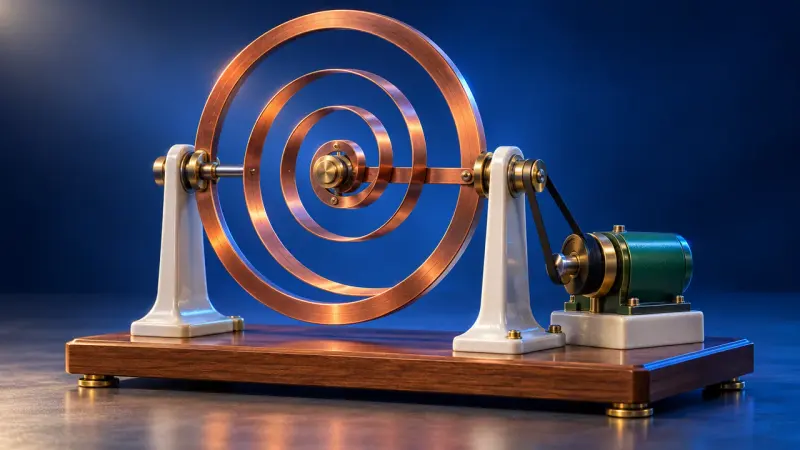
A motor drives an oscillating wheel. If the motor hits exactly the right rhythm, the wheel swings especially strongly: resonance.
Mandatory topic area. Induction through change of magnetic flux, Lenz's law, self-induction and the electromagnetic oscillating circuit.
Magnetic flux and law of induction with average rate of change.
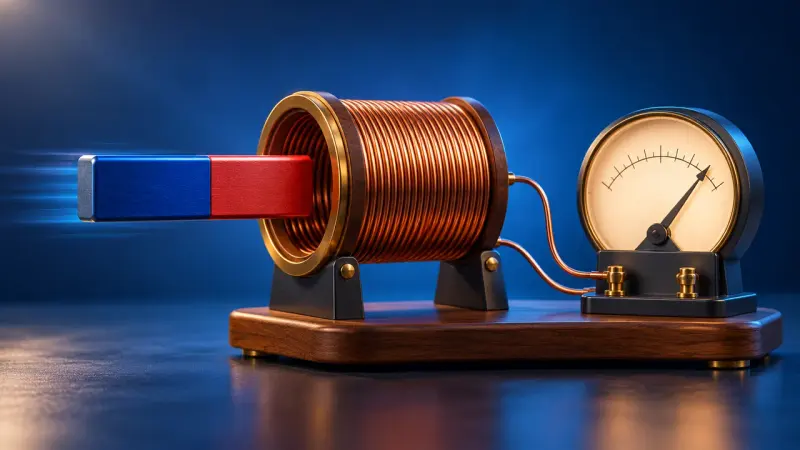
Magnet in, the needle swings. Magnet out, it swings the other way. Every generator works on the same principle.
Justifying the direction of the induced current.
Magnet in, the needle swings. Magnet out, it swings the other way. Every generator works on the same principle.
Observing and describing self-induction in coils.
No separate simulation is planned for this.
Explaining e.g. a generator or transformer.
No separate simulation is planned for this.
LC circuit: parameters, energy conversion, Thomson's formula.
No separate simulation is planned for this.
Law of induction in differential form, including non-linear cases.
Magnet in, the needle swings. Magnet out, it swings the other way. Every generator works on the same principle.
Switch-on and switch-off processes, definition of inductance.
No separate simulation is planned for this.
Magnetic field energy (without derivation).
No separate simulation is planned for this.
Analogies between pendulum and LC circuit.
No separate simulation is planned for this.
Damping in the LC circuit.
No separate simulation is planned for this.
Resonance in the electromagnetic circuit.
A motor drives an oscillating wheel. If the motor hits exactly the right rhythm, the wheel swings especially strongly: resonance.
Mandatory topic area. Formation and parameters of harmonic waves, longitudinal and transverse waves, typical wave phenomena, interference and standing waves.
Generation, propagation, wavelength, frequency and c = λ·f.

A wave travels through a chain of particles. Each particle only oscillates in place, across or along the direction of travel.
Representation in t-y and x-y diagrams, longitudinal and transverse waves, polarisation.
A wave travels through a chain of particles. Each particle only oscillates in place, across or along the direction of travel.
Wave phenomena e.g. in a ripple tank; Huygens' principle.
No separate simulation is planned for this.
Interference of two sources, path difference, positions of maxima and minima.
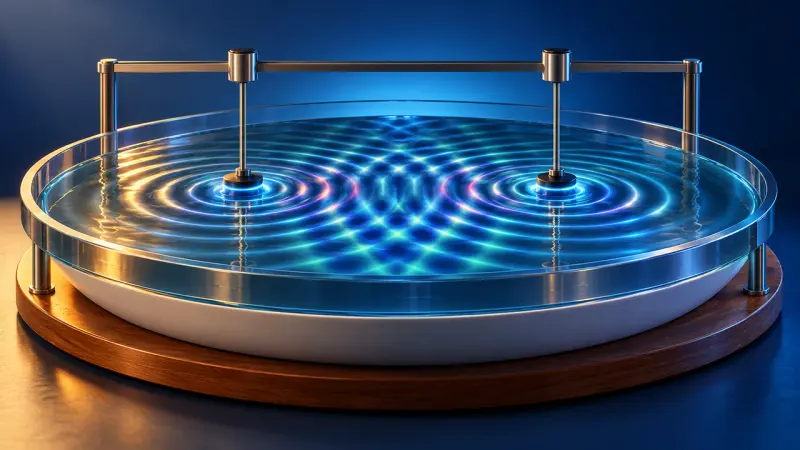
Two circular waves overlap: in some places they reinforce each other, in others they cancel out.
One-dimensional standing waves and determining the wavelength.
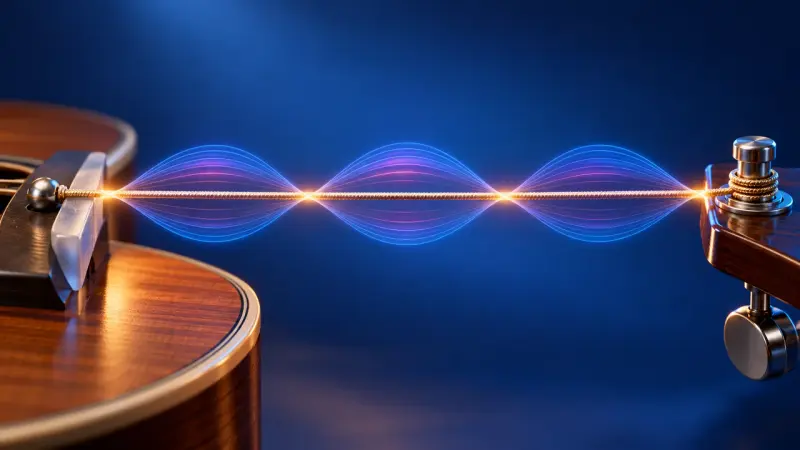
A wave is reflected at the end and a fixed pattern of nodes and antinodes appears, like on a guitar string.
Wave equation for development in space and time.
A wave travels through a chain of particles. Each particle only oscillates in place, across or along the direction of travel.
Reflection at fixed and free ends.
A wave is reflected at the end and a fixed pattern of nodes and antinodes appears, like on a guitar string.
The summaries describe the curriculum in our own words. The original text is authoritative. Original text (German): Kerncurriculum, Gymnasium, Physics, grade 12