

Uniform and accelerated motion (distance–time and velocity–time graphs)
A car drives at a steady speed or speeds up. The graphs for distance, speed and acceleration are drawn live.
Introductory phase E1/E2 “Mechanics”. Topic areas E.1–E.3 are mandatory. The core curriculum only names course half-years; assigning them to grade 11 is an assumption (G9).
Mandatory topic area. Investigating uniform and uniformly accelerated motion, representing it in t-s, t-v and t-a diagrams and describing it with equations of motion, e.g. free fall.
Measuring motion and evaluating the data.
A car drives at a steady speed or speeds up. The graphs for distance, speed and acceleration are drawn live.
Representing and interpreting motion in diagrams.
A car drives at a steady speed or speeds up. The graphs for distance, speed and acceleration are drawn live.
Defining velocity and measuring it experimentally.
A car drives at a steady speed or speeds up. The graphs for distance, speed and acceleration are drawn live.
Acceleration, average vs. instantaneous velocity; free fall including determining g.
A car drives at a steady speed or speeds up. The graphs for distance, speed and acceleration are drawn live.

A ball falls on Earth, the Moon or Mars and gets faster every second. In a vacuum even a feather keeps up.
Point mass and neglect of friction as model assumptions.
No separate simulation is planned for this.
Deriving and linking the laws of motion from diagrams.
A car drives at a steady speed or speeds up. The graphs for distance, speed and acceleration are drawn live.
Mandatory topic area. Newton's three laws and conservation of energy and momentum, applied to elastic and inelastic collisions.
Law of inertia, F = m·a, action–reaction principle and inertial frames.
No separate simulation is planned for this.
Kinetic and potential energy, conservation in frictionless closed systems.
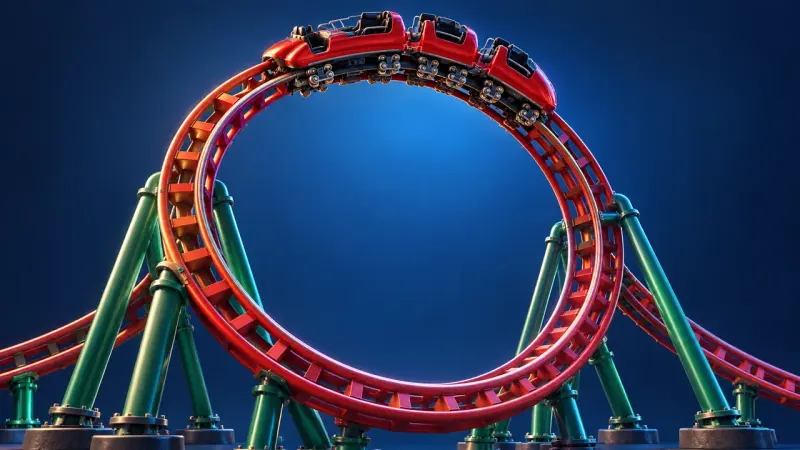
A car rides a roller coaster: energy bars show how potential and kinetic energy turn into each other.
Elastic and inelastic collisions, recoil and momentum as a conserved quantity.
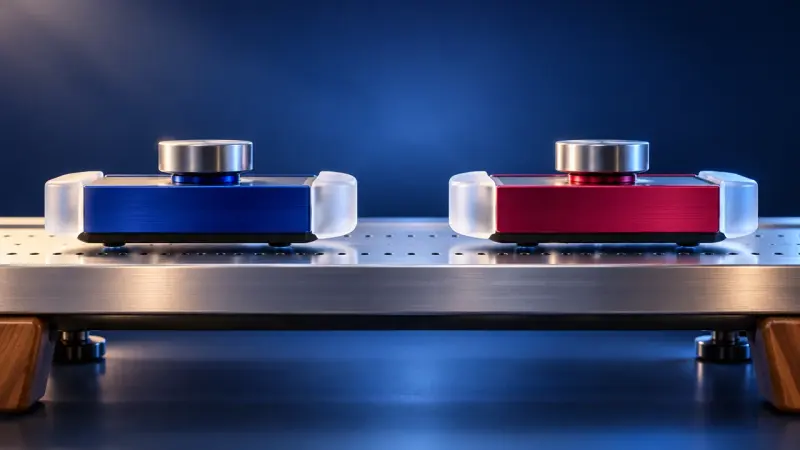
Two gliders collide on an air track. Before and after are compared to see what stays the same.
Mandatory topic area. Superposing motions (horizontal projectile) and describing uniform circular motion with linear and angular velocity and centripetal force.
Representing horizontal projectile motion as a superposition of two motions.

Which launch angle goes furthest? On Earth it is 45°, and on the Moon the same ball flies six times as far.
Defining and comparing both velocities.

A ball swings round on a string, a car drives through a bend. Which force keeps them on a circular path?
Centripetal force as the cause, e.g. when cornering; fictitious forces.
A ball swings round on a string, a car drives through a bend. Which force keeps them on a circular path?
Optional topic area. Oblique projectile motion, motion with friction and numerical simulation of motion.
Describing trajectories for oblique launch.
Which launch angle goes furthest? On Earth it is 45°, and on the Moon the same ball flies six times as far.
Motion with friction; free fall with air resistance and terminal velocity.
No separate simulation is planned for this.
Calculating motion step by step with difference quotients (e.g. spreadsheet).
No separate simulation is planned for this.
Optional topic area. Gravitational field and law of gravitation, planetary motion and Kepler's laws.
Gravitational field, law of gravitation and weight.
No separate simulation is planned for this.
Kepler's laws and the development of the astronomical world view.

Too fast and the planet flies off, never to return. A little slower and it traces an ellipse around the Sun, exactly as Kepler's laws say.
Optional topic area. Internal energy, reversible and irreversible processes, laws of thermodynamics and entropy.
Concept of internal energy and its historical background.
No separate simulation is planned for this.
Distinguishing reversible and irreversible processes.
No separate simulation is planned for this.
Conservation of energy and the direction of heat processes.
No separate simulation is planned for this.
Entropy as a measure of the direction of natural processes; limits of efficiency.
No separate simulation is planned for this.
Optional topic area. Torque, angular momentum as a conserved quantity and moment of inertia with applications.
Effect of forces on rotatable bodies.

How can a child lift an adult on a seesaw? With the longer arm. Wheelbarrows and bottle openers use the same trick.
Angular momentum as a conserved quantity; precession.
No separate simulation is planned for this.
Applications such as a pirouette.
No separate simulation is planned for this.
The summaries describe the curriculum in our own words. The original text is authoritative. Original text (German): Kerncurriculum, Gymnasium, Physics, grade 11