
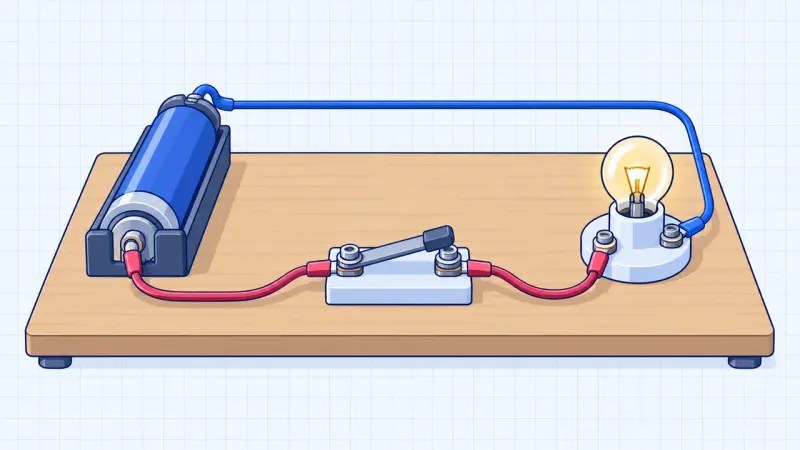
Simple circuit
Build a circuit with a battery, a switch and a lamp, as a set-up and as a circuit diagram. When the circuit is closed, the lamp lights up.
PhysicsBerlin curriculum · Gymnasium
Grades 9/10: the content of the topic fields is compulsory within the two grades, so the units are the same for grades 9 and 10 and are shown as one stage. Topic fields 3.5 and 3.6 are listed here too because, depending on the timetable, they are taught in 7/8 or 9/10. The topic fields are numbered in the curriculum.
Simple circuits with source, switch and converter, effects of current, charge and the electroscope, the model of electric field lines, current as moving charge.
Build a circuit with a battery, a switch and a lamp, as a set-up and as a circuit diagram. When the circuit is closed, the lamp lights up.
Measuring current and voltage, Ohm’s law and resistance, series and parallel circuits, electrical energy and power.
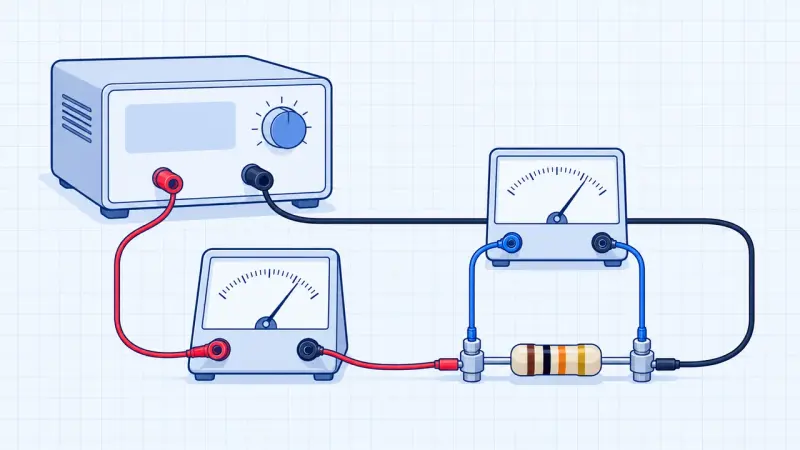
Turn up the voltage and the current rises, always in the same ratio. Point by point the characteristic curve appears, though not quite straight for a lamp.
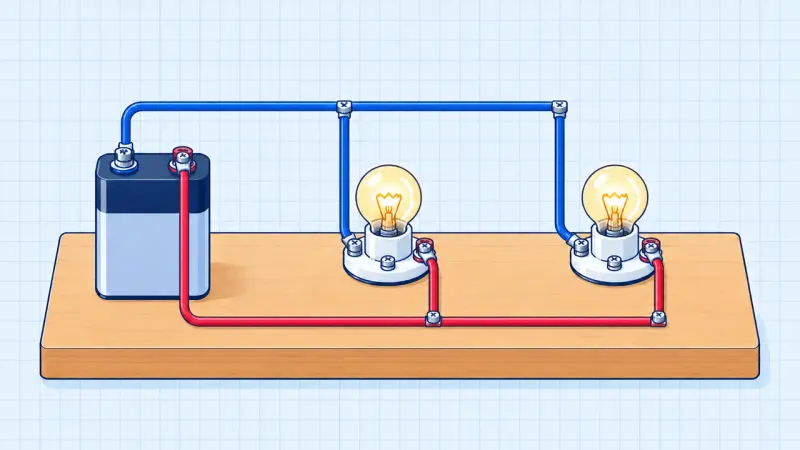
Connect lamps in series or in parallel and measure current and voltage at different points.
Build a circuit with a battery, a switch and a lamp, as a set-up and as a circuit diagram. When the circuit is closed, the lamp lights up.
Frames of reference, instantaneous and average speed, acceleration, laws of motion with s(t) and v(t) graphs, free fall.

A car drives at a steady speed or speeds up. The graphs for distance, speed and acceleration are drawn live.

A ball falls on Earth, the Moon or Mars and gets faster every second. In a vacuum even a feather keeps up.
The laws of inertia, interaction and the fundamental law of dynamics, resolving and adding forces, friction and centripetal force (qualitative).

Two forces pull on one point. Use the parallelogram of forces to find the total force or to split a force into two.

A block sits on a slope. At what angle does it start to slide? The weight is split into two parts to find out.

A ball swings round on a string, a car drives through a bend. Which force keeps them on a circular path?
Permanent magnets and electromagnets, magnetic field lines, forces on current-carrying wires, the electric motor, the law of induction (qualitative), generator and transformer.

Magnet in, the needle swings. Magnet out, it swings the other way. Every generator works on the same principle.
Types of radiation, detection and absorption, activity and half-life, radiation in the environment, biological effects and nuclear fission.
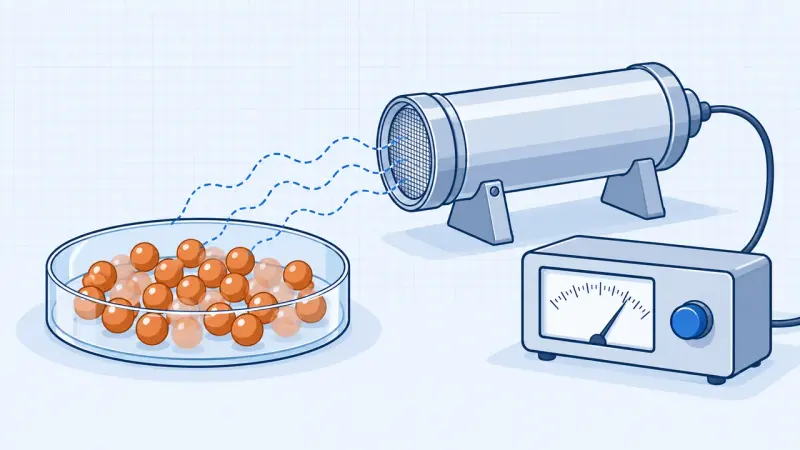
Many nuclei decay at random and a Geiger counter clicks. Even so, after each half-life almost exactly half are left.
Calculating potential and kinetic energy, heat and specific heat capacity, efficiency and energy flow diagrams.
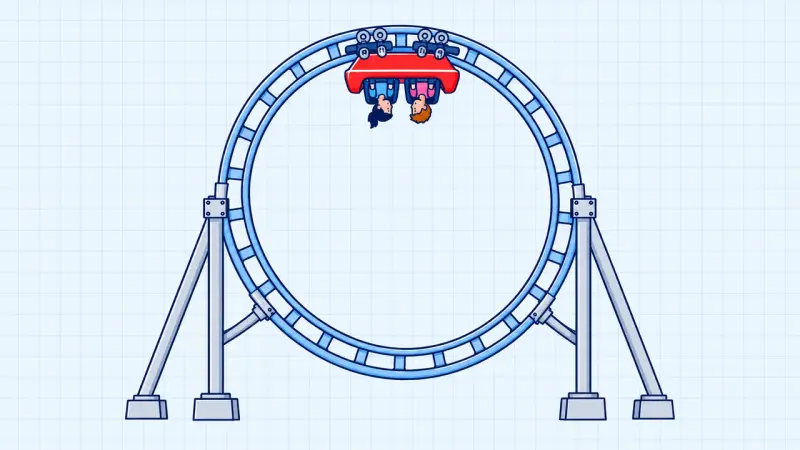
A car rides a roller coaster: energy bars show how potential and kinetic energy turn into each other.
Parameters of harmonic oscillations, the simple pendulum and the spring oscillator, damping and resonance, parameters of mechanical waves, reflection, refraction, diffraction and interference.

Pull a pendulum aside, let it go and measure how long one swing takes. What does it depend on? Also with large angles and damping.
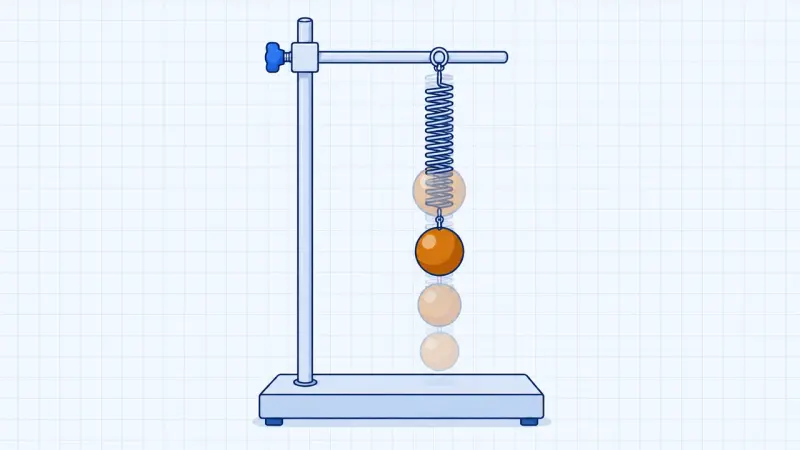
A mass bounces up and down on a spring. Graphs show position, speed and energy during the oscillation.
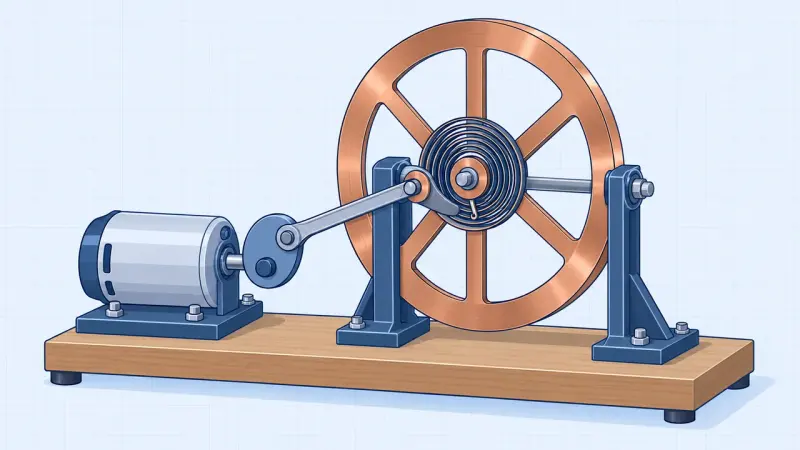
A motor drives an oscillating wheel. If the motor hits exactly the right rhythm, the wheel swings especially strongly: resonance.
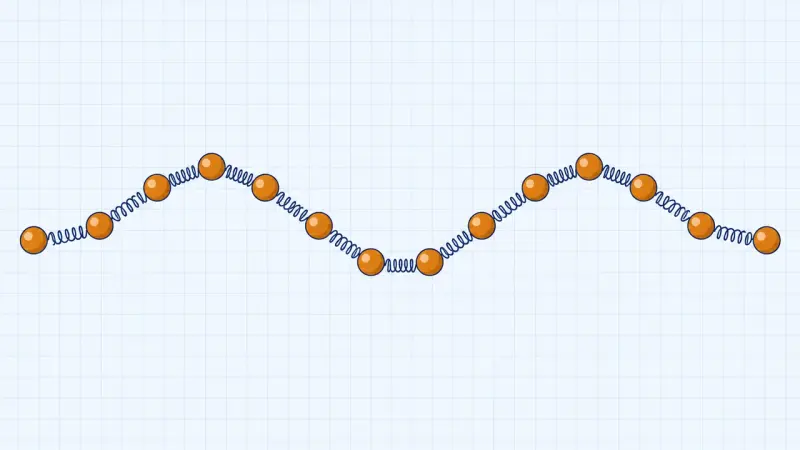
A wave travels through a chain of particles. Each particle only oscillates in place, across or along the direction of travel.

Two circular waves overlap: in some places they reinforce each other, in others they cancel out.
The light-ray model, laws of reflection and refraction, total internal reflection, image formation by a converging lens with the lens equation, the spectrum from a prism and additive colour mixing.
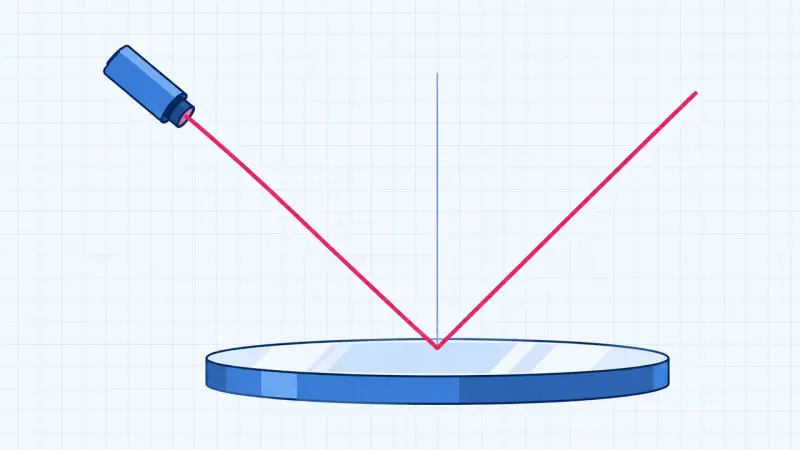
Laser at the mirror, measure the angles: angle of incidence equals angle of reflection, every time. And why does the candle appear just as far behind the mirror?

A light ray bends when it passes into glass or water. At a shallow angle it cannot get out at all: total internal reflection, as in an optical fibre.
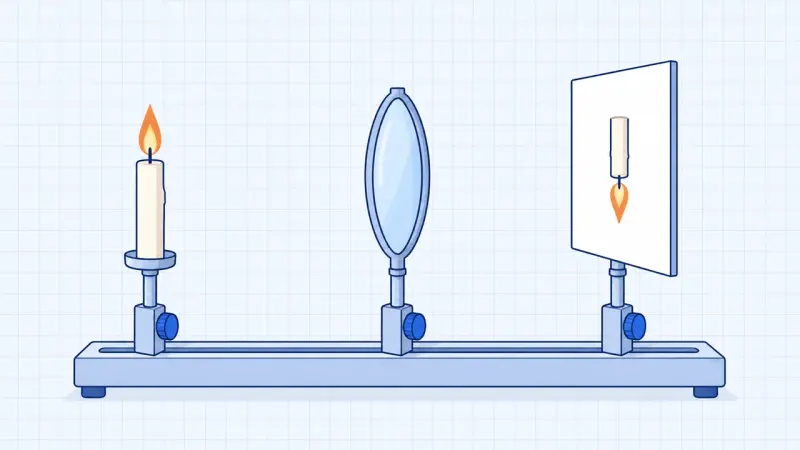
Move a candle in front of a lens and construct the image with three special rays. It becomes sharp on the screen.
The summaries describe the curriculum in our own words. The original text is authoritative. Original text (German): Rahmenlehrplan, Gymnasium, Physics, grade 9/10