
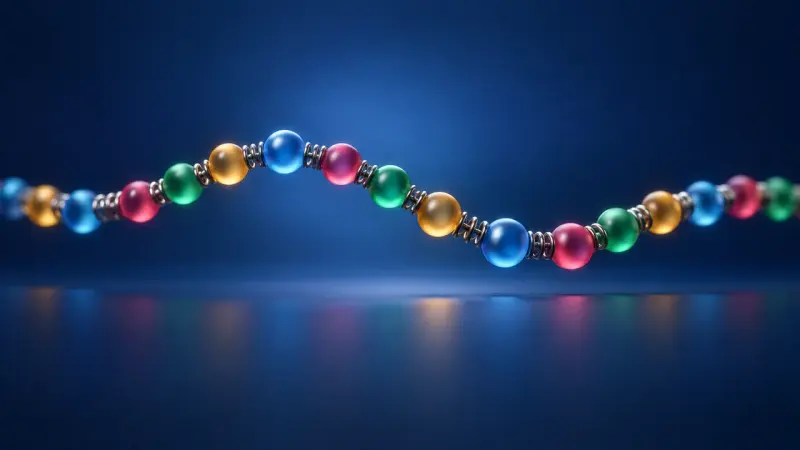
Transverse and longitudinal waves
A wave travels through a chain of particles. Each particle only oscillates in place, across or along the direction of travel.
Qualification phase, third and fourth half-year (Q3, Q4; at the Gymnasium with Abitur after grade 12: grade 12). The topic fields are numbered in the curriculum.
Propagation and parameters of waves, standing waves, diffraction, refraction and interference, interference of light at a double slit and a grating.
A wave travels through a chain of particles. Each particle only oscillates in place, across or along the direction of travel.
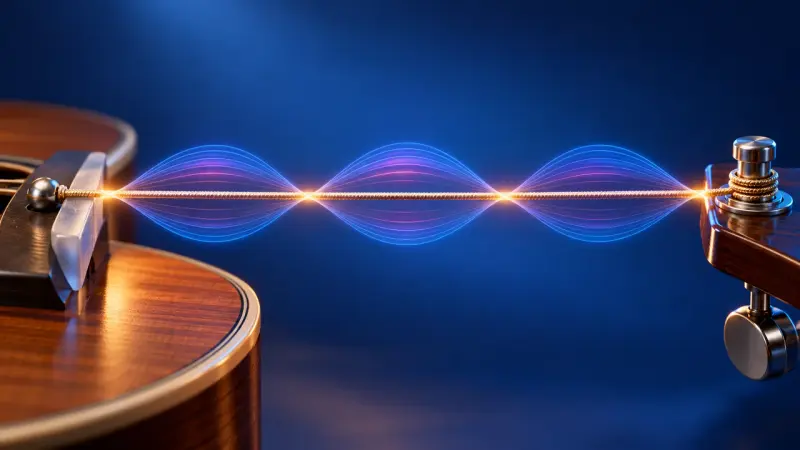
A wave is reflected at the end and a fixed pattern of nodes and antinodes appears, like on a guitar string.
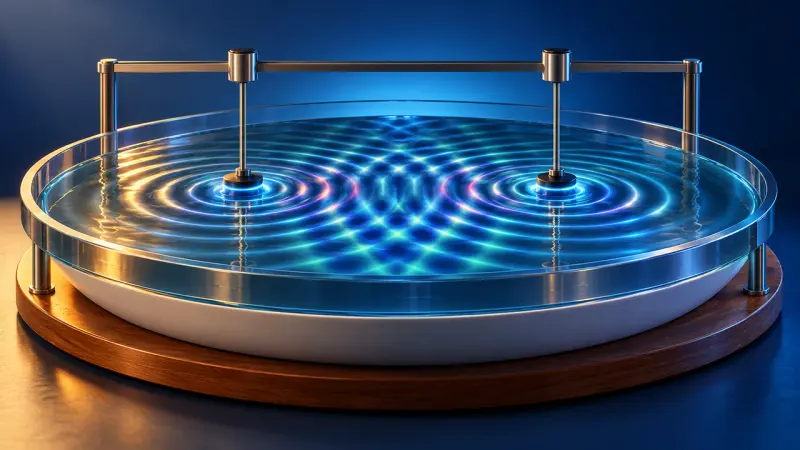
Two circular waves overlap: in some places they reinforce each other, in others they cancel out.
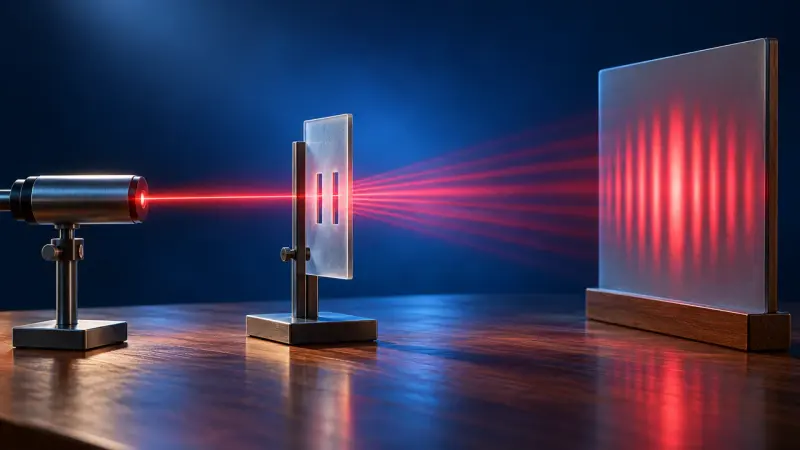
Laser light passes through a double slit or a grating. A pattern of bright and dark stripes appears on the screen.
The photoelectric effect with the influence of intensity and frequency, photons, electron diffraction, stochastic predictability at the double slit and basic aspects of quantum physics.
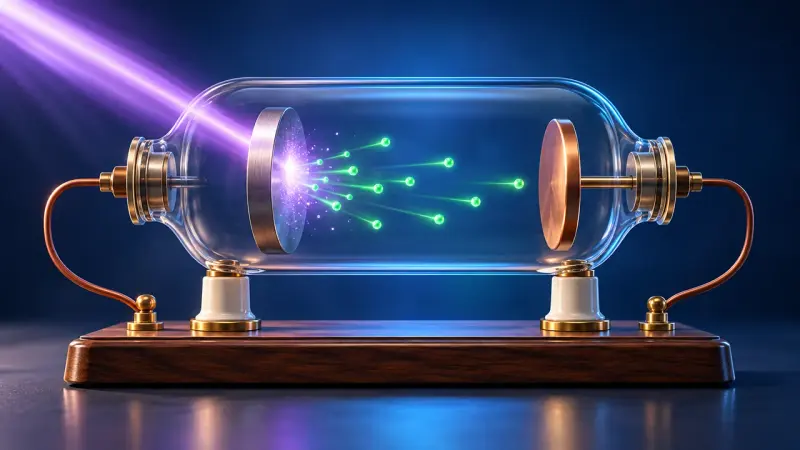
Red light can be as bright as you like, it frees not a single electron. Short-wave light does it at once. A puzzle for waves, not for photons.
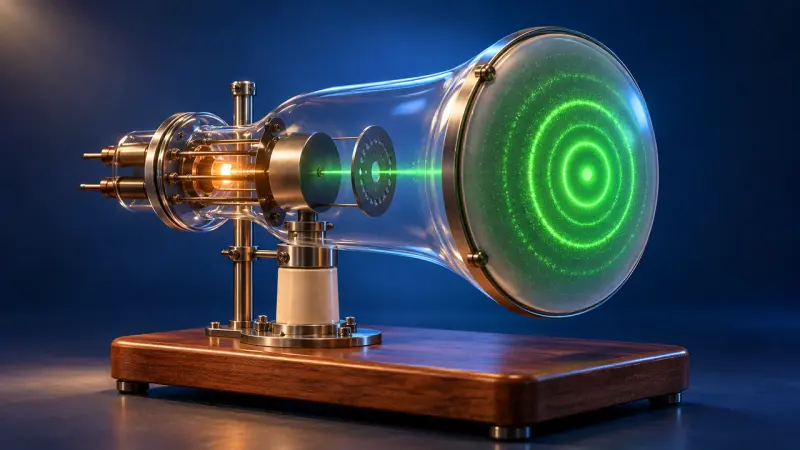
Electrons hit a thin layer of graphite and form rings on the screen, just like waves do.
Laser light passes through a double slit or a grating. A pattern of bright and dark stripes appears on the screen.
Energy levels and line spectra, the quantum model of the atom with detection probabilities and optical spectral analysis.

Every element glows in its own colours. When an electron drops one level, exactly one line appears in the spectrum.
The summaries describe the curriculum in our own words. The original text is authoritative. Original text (German): Rahmenlehrplan, Gymnasium, Physics, grade 12