

Particle model and temperature
Ice melts, water boils, and the temperature stops rising meanwhile. The particles show where the energy goes in between.
PhysicsBerlin curriculum · Gymnasium
Grades 7/8: the content of the topic fields is compulsory within the two grades, so the units are the same for grades 7 and 8 and are shown as one stage. Topic fields 3.5 and 3.6 (electricity) can also be taught in grades 9/10, depending on the timetable. The topic fields are numbered in the curriculum.
Expansion of solids, liquids and gases with temperature, density, pressure and temperature of a gas, states of matter in the particle model.
Ice melts, water boils, and the temperature stops rising meanwhile. The particles show where the energy goes in between.
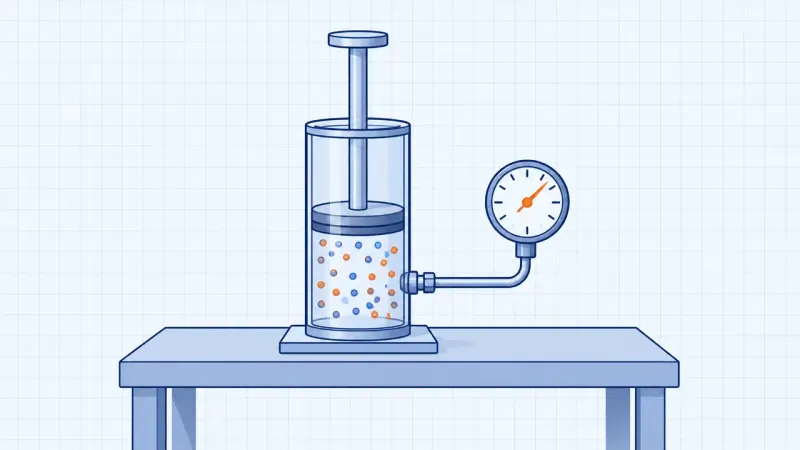
Push the piston halfway in and the pressure doubles. Heat the gas and it pushes the piston out. Pressure, volume and temperature are tightly linked.
Force as an interaction between two bodies, force arrows, measuring forces, weight and Hooke’s law.

Hang weights on a spring and measure how far it stretches. Double the force means double the stretch.

Two forces pull on one point. Use the parallelogram of forces to find the total force or to split a force into two.
Forms of energy, potential energy, mechanical work and power, the golden rule of mechanics and conservation of energy.
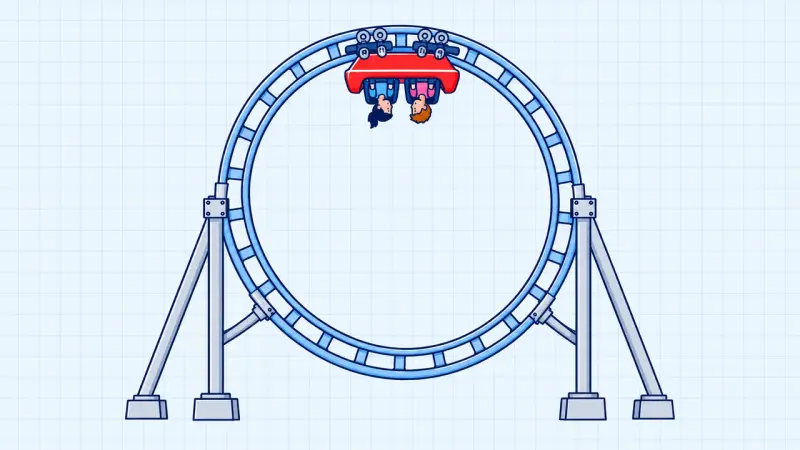
A car rides a roller coaster: energy bars show how potential and kinetic energy turn into each other.

How can a child lift an adult on a seesaw? With the longer arm. Wheelbarrows and bottle openers use the same trick.

A block sits on a slope. At what angle does it start to slide? The weight is split into two parts to find out.
Thermal energy and heat, temperature equalisation, latent heat of melting and vaporisation, conduction, convection and radiation in the particle model.
Ice melts, water boils, and the temperature stops rising meanwhile. The particles show where the energy goes in between.
Simple circuits with source, switch and converter, effects of current, charge and the electroscope, the model of electric field lines, current as moving charge.
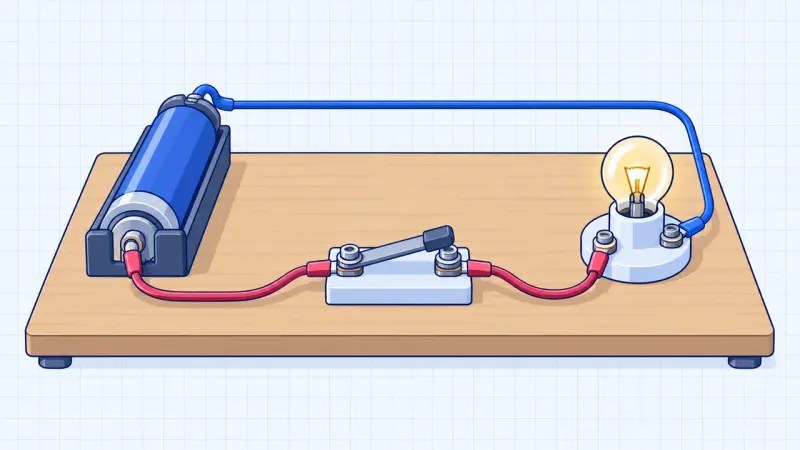
Build a circuit with a battery, a switch and a lamp, as a set-up and as a circuit diagram. When the circuit is closed, the lamp lights up.
Measuring current and voltage, Ohm’s law and resistance, series and parallel circuits, electrical energy and power.
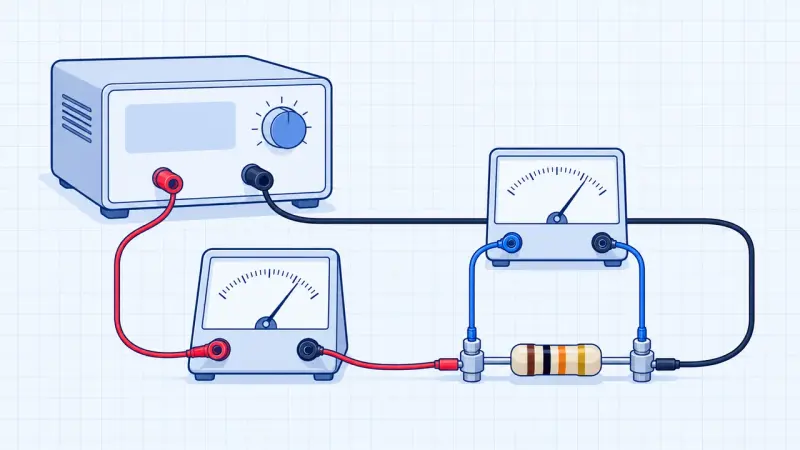
Turn up the voltage and the current rises, always in the same ratio. Point by point the characteristic curve appears, though not quite straight for a lamp.
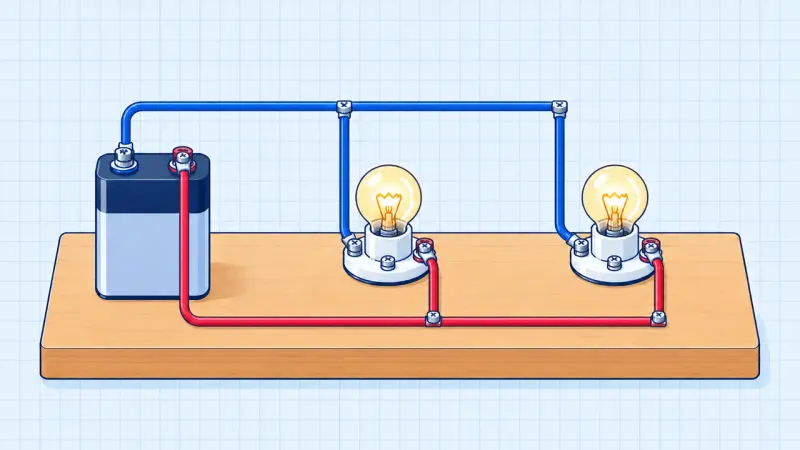
Connect lamps in series or in parallel and measure current and voltage at different points.
Build a circuit with a battery, a switch and a lamp, as a set-up and as a circuit diagram. When the circuit is closed, the lamp lights up.
The summaries describe the curriculum in our own words. The original text is authoritative. Original text (German): Rahmenlehrplan, Gymnasium, Physics, grade 7/8