

Square roots and Heron’s method
Step by step, a rectangle turns into a square with the same area. The method is almost 2000 years old and reaches √2 surprisingly quickly.
Grade 9: the framework curriculum for grades 1–10 is organised by levels A–H, not by grades; at the Gymnasium grade 9 works at level G; G and H are linked within grades 9/10. Units are the subject areas, sub-units their topics; the numbers are our own.
π and square roots as irrational numbers, approximations of real numbers, the number sets up to the real numbers.
Step by step, a rectangle turns into a square with the same area. The method is almost 2000 years old and reaches √2 surprisingly quickly.
Powers with negative exponents, laws of exponents for integer exponents, the link between powers and roots.
Step by step, a rectangle turns into a square with the same area. The method is almost 2000 years old and reaches √2 surprisingly quickly.
Unit prefixes from nano to tera, taking measurements from technical drawings.
Matching simulations are listed under Grade 5/6, Grade 7, Grade 10
Sine, cosine and tangent in right triangles, volume and surface area of pyramids, cones and spheres, the sine rule and the cosine rule.

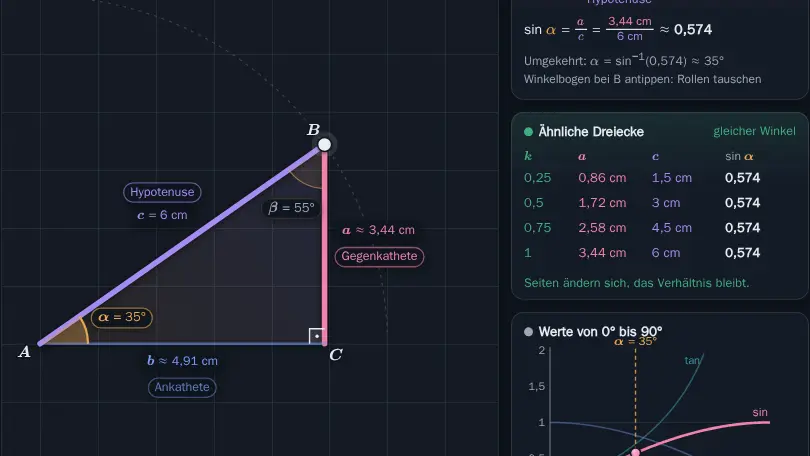
In a right triangle, the ratio of two sides depends only on the angle. This gives sine, cosine and tangent, with examples such as ramps and ladders.

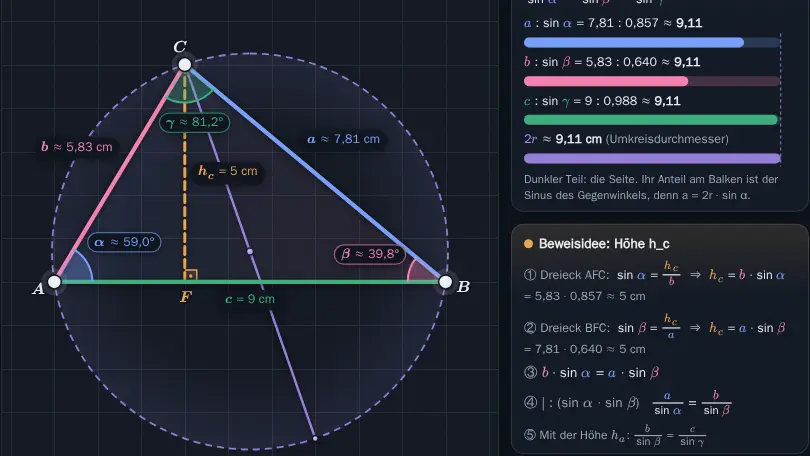
Calculate sides and angles in any triangle with the law of sines and the law of cosines. A helper shows which law fits your problem.

Pour three times and the prism is full: a pyramid holds exactly one third. Cones and spheres can be turned and measured in 3D.
Describing composite and hollow solids, oblique drawings of cones, cylinders and pyramids, constructions with the theorems of Thales and Pythagoras.
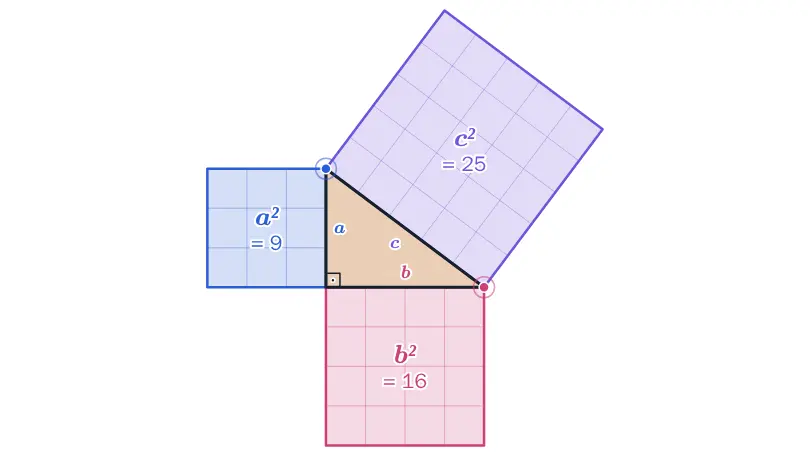

Squares on the sides of a right triangle and a puzzle proof show: a² + b² = c².
Pour three times and the prism is full: a pyramid holds exactly one third. Cones and spheres can be turned and measured in 3D.
Using transformations in complex contexts, enlarging and reducing solids to scale.

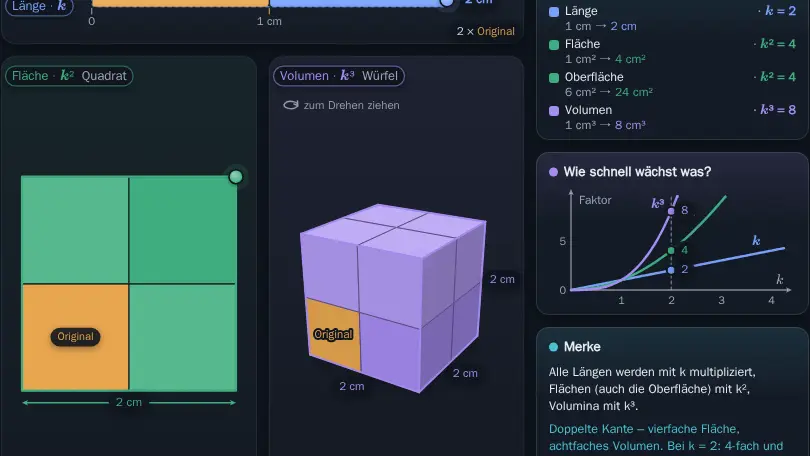
Enlarge lengths, areas and solids. Doubling the length makes the area four times and the volume eight times as large.
Transforming terms with binomial formulas, solving quadratic equations and linear systems algebraically and graphically and examining their solvability.

The three binomial formulas as areas: a square splits into smaller squares and rectangles.
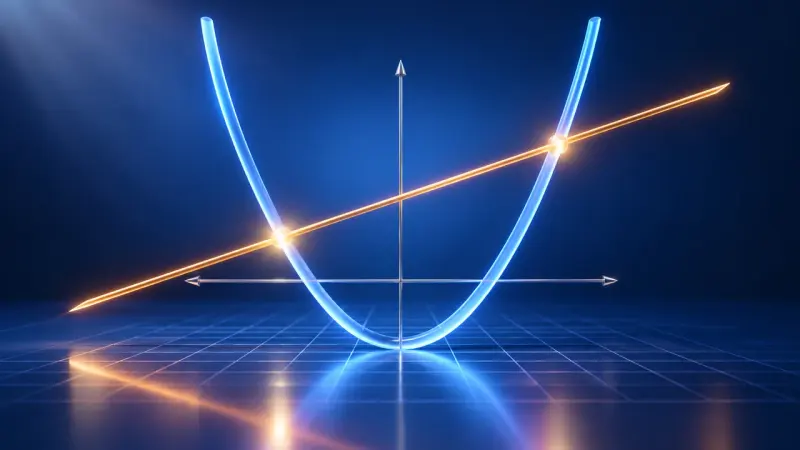
Draw both sides of an equation as graphs. The solutions are where the graphs cross.
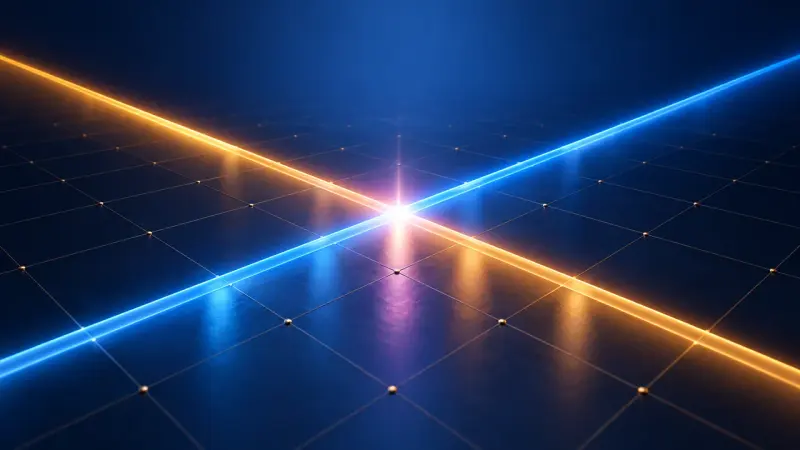
Two equations are two lines. Their point of intersection is the solution, which you can read off and check.
Quadratic functions y = a(x + d)² + e, trigonometric functions y = a·sin(bx) and exponential functions with parameters, symmetry and vertex; modelling.
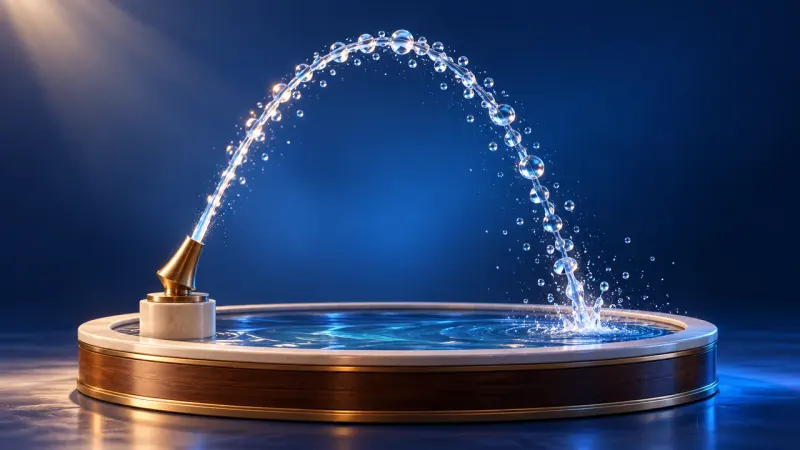
Stretch, reflect and shift parabolas and read off the vertex and the zeros.
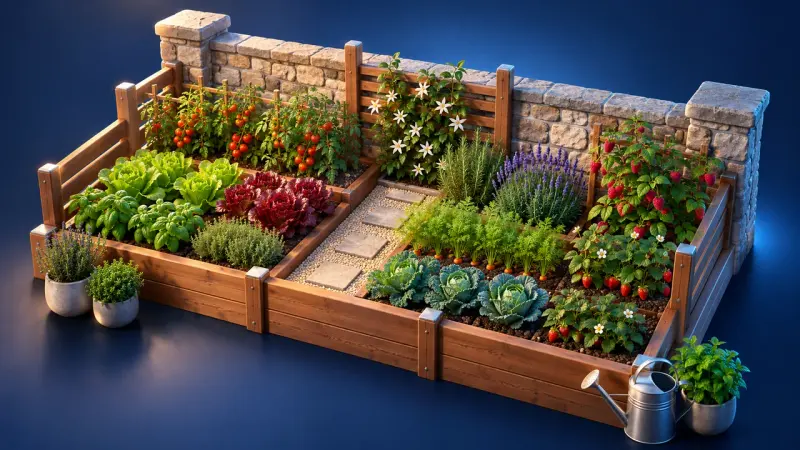
Which enclosure has the largest area? Picture and graph show the maximum, first by trying, then by exact calculation.

Drag three points and the matching parabola always passes through all of them. The equation is worked out step by step.

Up to three of your own functions at once, with a table of values, zeros and intersections. The tool for anything that can be a graph.
Planning and evaluating surveys independently, recognising trends, exposing manipulation in charts.

Show the same data as bar, line and pie charts and more, and discover how charts can mislead.

One outlier pulls the mean away while the median barely moves. Dragging single data points shows which value is how robust.
Multi-stage experiments with tree diagrams, path rules, two-way tables and urn models, including conditional probabilities.

Draw balls from an urn, with or without replacement. The tree diagram and the path rules show how to calculate probabilities.

A two-way table, a Venn diagram and a tree diagram show the same data and are linked. Change one and the others follow.

A medical test is positive, but how likely is it that you are really ill? 1000 people show why the answer is often surprising.
How likely is it that two people in a class share a birthday? From just 23 people on, it is more likely than not.
The summaries describe the curriculum in our own words. The original text is authoritative. Original text (German): Rahmenlehrplan, Gymnasium, Mathematics, grade 9