
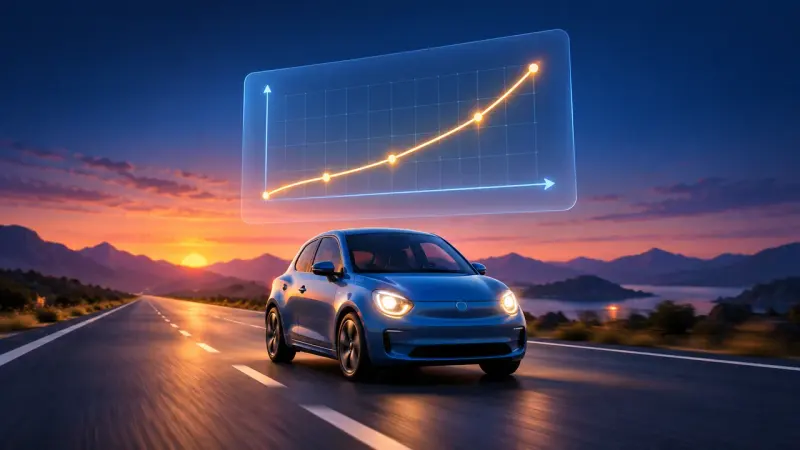
Uniform and accelerated motion (distance–time and velocity–time graphs)
A car drives at a steady speed or speeds up. The graphs for distance, speed and acceleration are drawn live.
Qualification phase (grades 11/12): the curriculum describes both grades together, organised into subject areas with focal points and split into the basic level (gA), the higher level (eA) and the two-hour elective (WPF). The units are therefore the same for grades 11 and 12, and both are shown as one stage. The three-hour elective matches the basic level. The numbers are our own.
Mechanics as a foundation, plus mechanical oscillations and waves and light as a wave.
Motion with initial conditions and its superposition in projectile motion, circular motion, conservation of energy, momentum and its conservation.
A car drives at a steady speed or speeds up. The graphs for distance, speed and acceleration are drawn live.

A ball falls on Earth, the Moon or Mars and gets faster every second. In a vacuum even a feather keeps up.
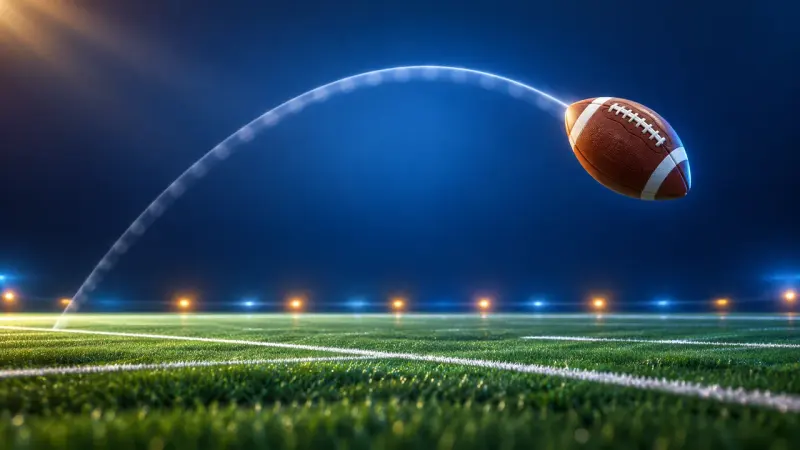
Which launch angle goes furthest? On Earth it is 45°, and on the Moon the same ball flies six times as far.

A ball swings round on a string, a car drives through a bend. Which force keeps them on a circular path?
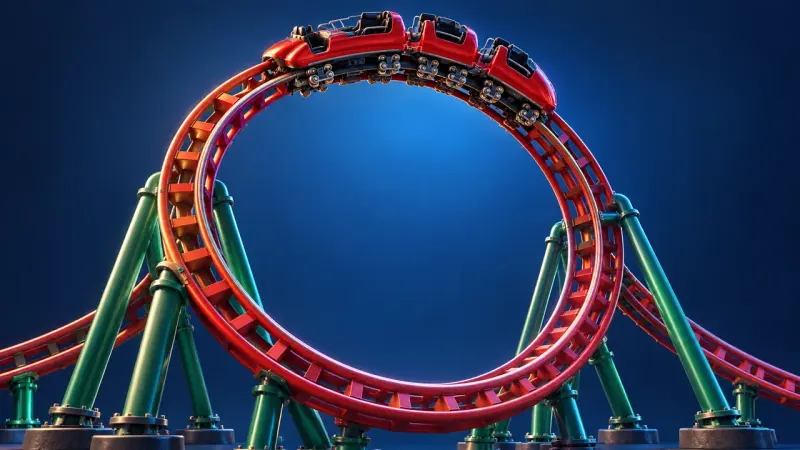
A car rides a roller coaster: energy bars show how potential and kinetic energy turn into each other.
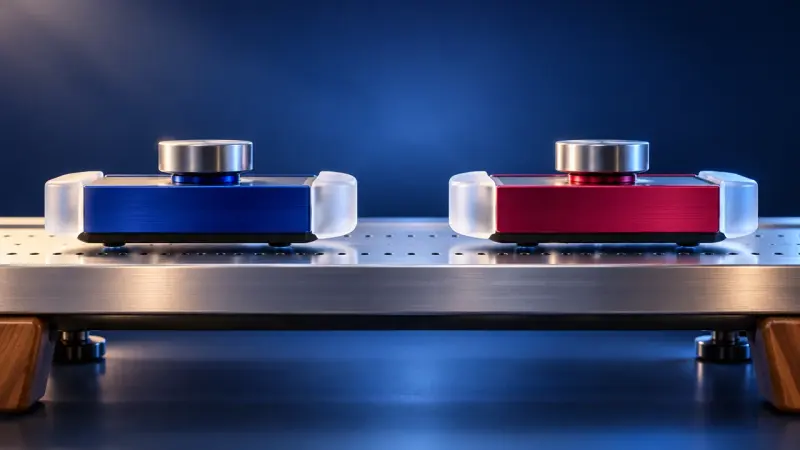
Two gliders collide on an air track. Before and after are compared to see what stays the same.
Parameters of harmonic oscillations on a spring oscillator, forced oscillations and resonance; propagation, interference and standing waves.

A mass bounces up and down on a spring. Graphs show position, speed and energy during the oscillation.
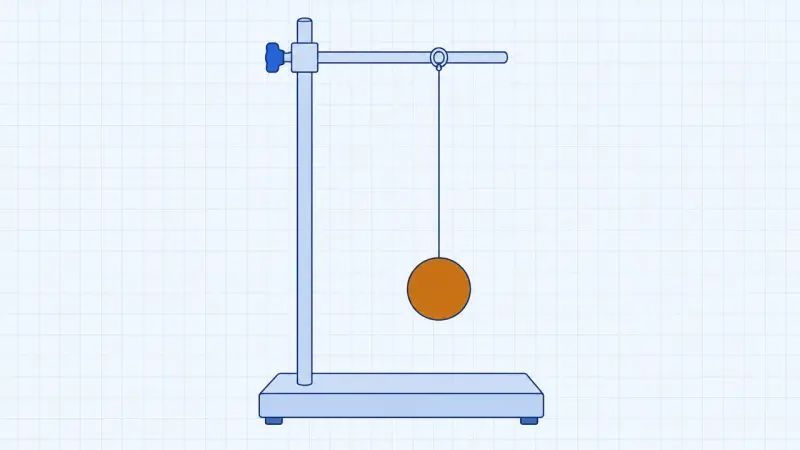
Pull a pendulum aside, let it go and measure how long one swing takes. What does it depend on? Also with large angles and damping.
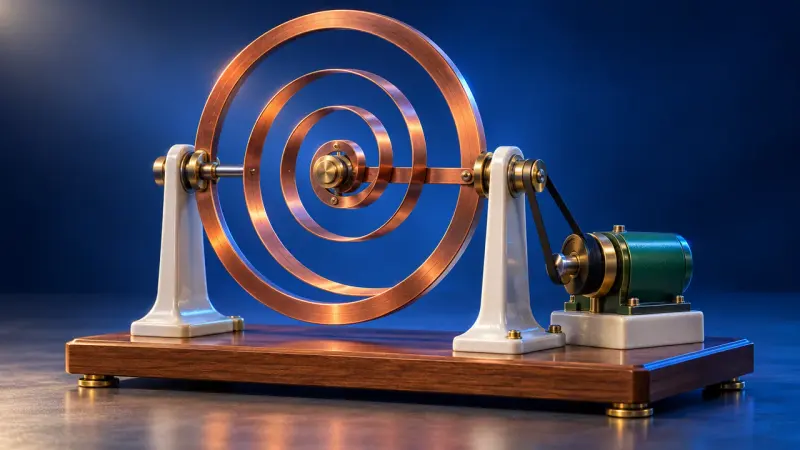
A motor drives an oscillating wheel. If the motor hits exactly the right rhythm, the wheel swings especially strongly: resonance.
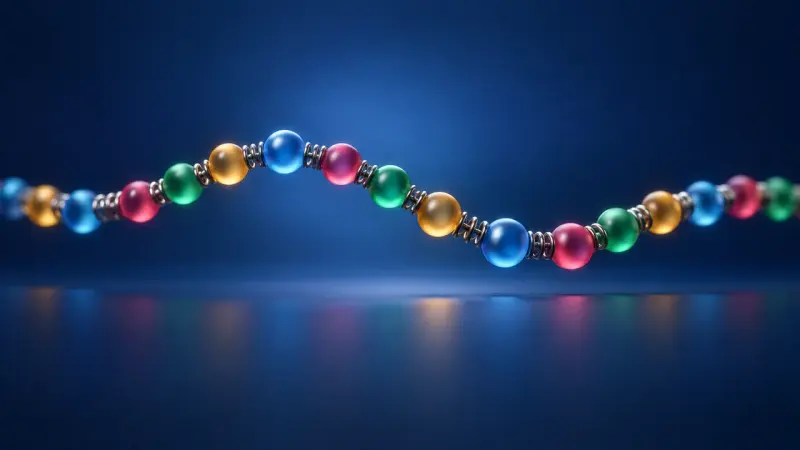
A wave travels through a chain of particles. Each particle only oscillates in place, across or along the direction of travel.
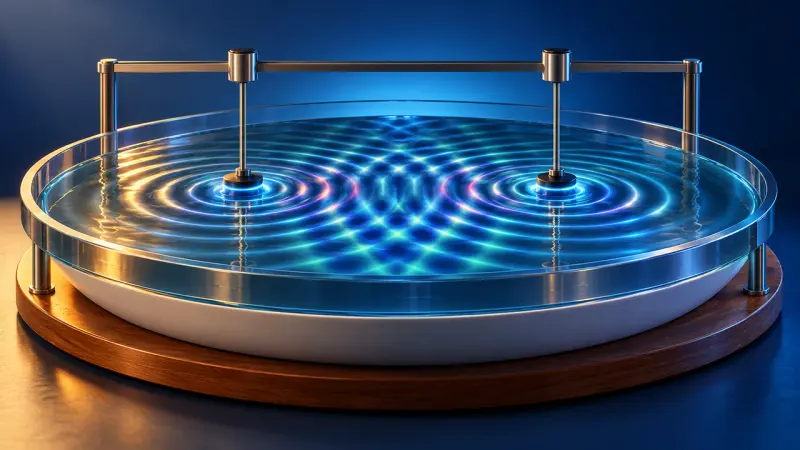
Two circular waves overlap: in some places they reinforce each other, in others they cancel out.
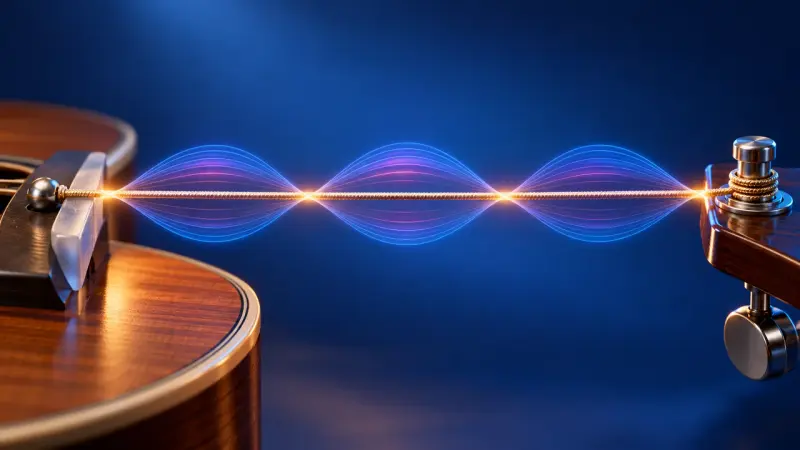
A wave is reflected at the end and a fixed pattern of nodes and antinodes appears, like on a guitar string.
Light as an electromagnetic wave, interference at a double slit and a grating, determining wavelength, colours, dispersion and polarisation.
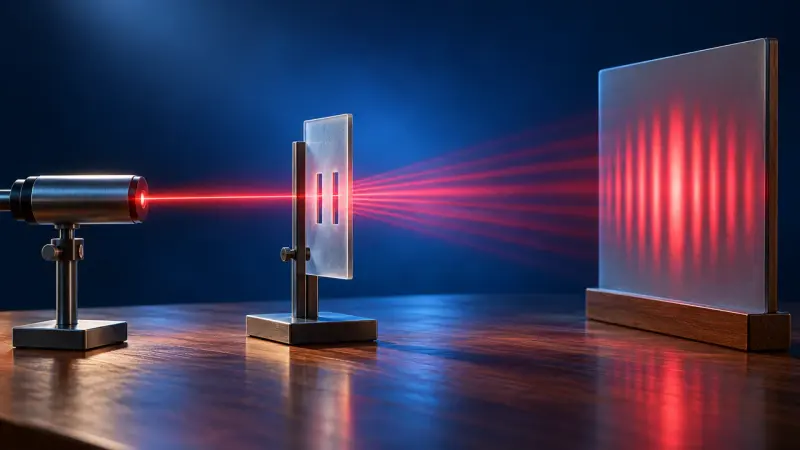
Laser light passes through a double slit or a grating. A pattern of bright and dark stripes appears on the screen.
Electric and magnetic fields and electromagnetic induction.
Field-line patterns and field strength, the parallel-plate capacitor with capacitance and energy, charging and discharging, motion of charged particles in the field.

Two charges and the field rearranges itself. A test charge measures where the force is strongest.

A capacitor charges through a resistor and discharges again. The graphs show how voltage and current change over time.
Magnetic fields of magnets, conductors and coils, magnetic flux density, the Lorentz force and circular paths of charged particles.
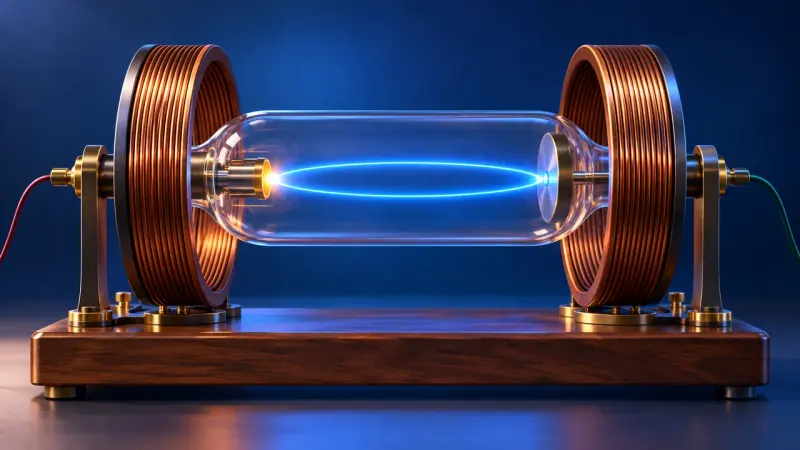
Electrons fly along a glowing circular path in a magnetic field. From the radius you determine a property of the electron.
Induced voltage and magnetic flux, the law of induction and Lenz’s rule, the transformer, energy in an LC circuit qualitatively.
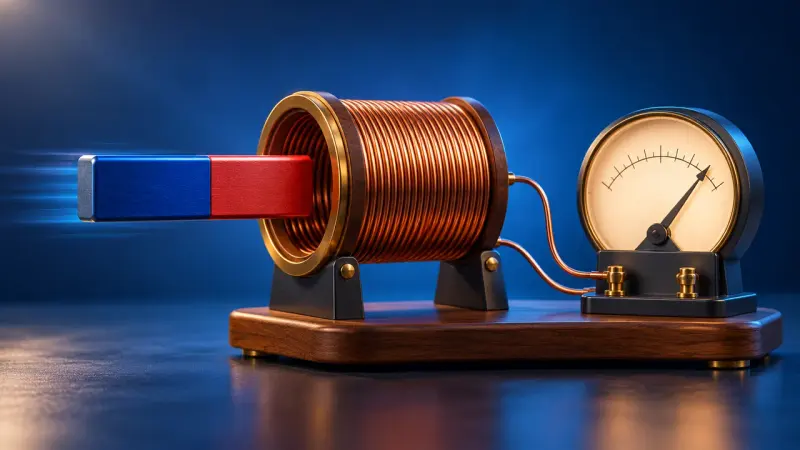
Magnet in, the needle swings. Magnet out, it swings the other way. Every generator works on the same principle.
Quantum objects such as photons and electrons and the quantum model of the atom.
The photoelectric effect and photons, Planck’s constant, electrons as waves after de Broglie, key features of quantum physics at the double slit.
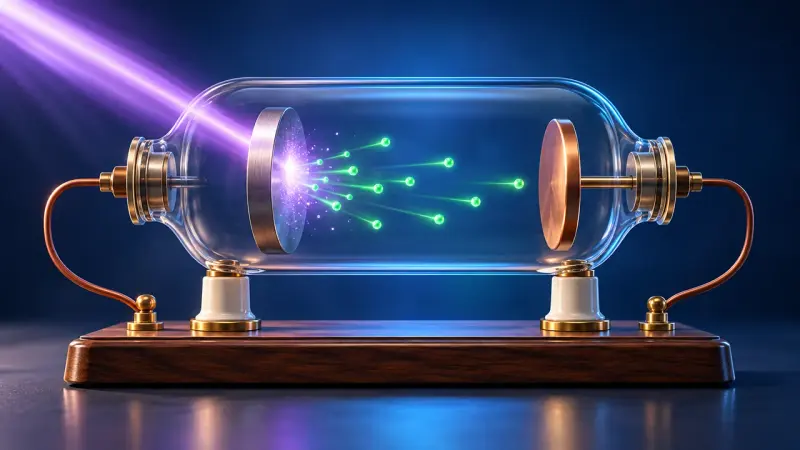
Red light can be as bright as you like, it frees not a single electron. Short-wave light does it at once. A puzzle for waves, not for photons.
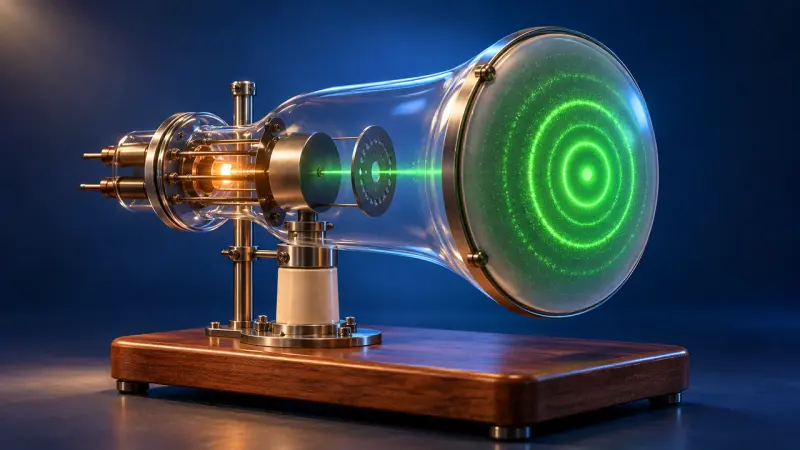
Electrons hit a thin layer of graphite and form rings on the screen, just like waves do.
Energy levels of the hydrogen atom, orbitals, emission and absorption and how line spectra arise.

Every element glows in its own colours. When an electron drops one level, exactly one line appears in the spectrum.
Experimenting and problem solving as focal points in their own right.
Planning and evaluating experiments independently, estimating measurement uncertainties.
No separate simulation is planned for this.
Practising strategies for physics problems: balances, analogies, simplifying and choosing suitable models.
No separate simulation is planned for this.
Oscillations, waves and light in more depth, plus an advanced course in mechanics with collisions.
The harmonic oscillator with a linear restoring force, simple pendulum and spring oscillator, damped oscillations, natural frequency, forced oscillations and the resonance curve.
Pull a pendulum aside, let it go and measure how long one swing takes. What does it depend on? Also with large angles and damping.
A mass bounces up and down on a spring. Graphs show position, speed and energy during the oscillation.
A motor drives an oscillating wheel. If the motor hits exactly the right rhythm, the wheel swings especially strongly: resonance.
Describing harmonic waves mathematically, Huygens’ principle, interference, polarisation, standing waves and sound.
A wave travels through a chain of particles. Each particle only oscillates in place, across or along the direction of travel.
Two circular waves overlap: in some places they reinforce each other, in others they cancel out.
A wave is reflected at the end and a fixed pattern of nodes and antinodes appears, like on a guitar string.
As at the basic level, plus interferometers, X-rays and spectral analysis.
Laser light passes through a double slit or a grating. A pattern of bright and dark stripes appears on the screen.
Forces on an inclined plane with friction, laws of motion using calculus, projectile motion, energy and momentum balances in elastic and inelastic collisions.
A car drives at a steady speed or speeds up. The graphs for distance, speed and acceleration are drawn live.
A ball falls on Earth, the Moon or Mars and gets faster every second. In a vacuum even a feather keeps up.
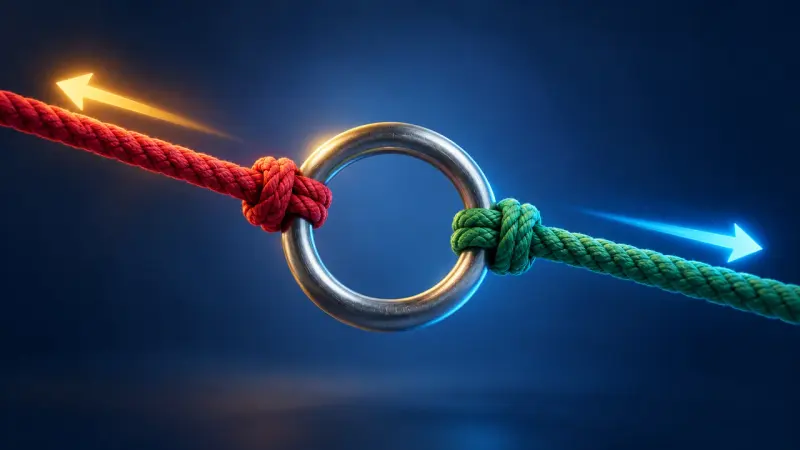
Two forces pull on one point. Use the parallelogram of forces to find the total force or to split a force into two.
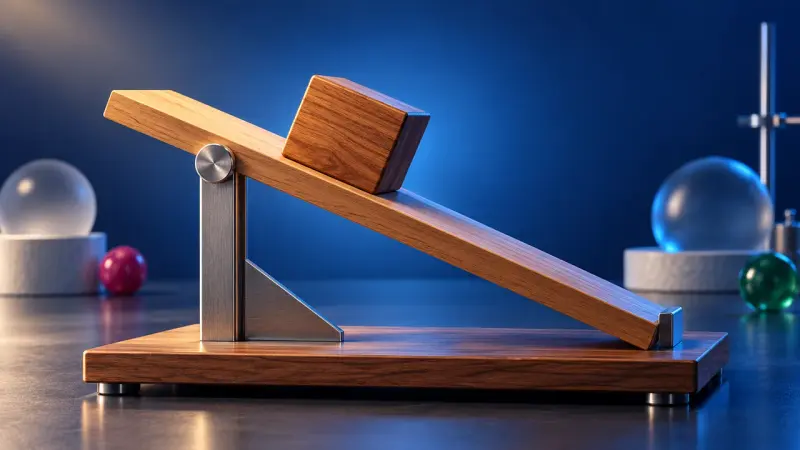
A block sits on a slope. At what angle does it start to slide? The weight is split into two parts to find out.
Which launch angle goes furthest? On Earth it is 45°, and on the Moon the same ball flies six times as far.
A car rides a roller coaster: energy bars show how potential and kinetic energy turn into each other.
Two gliders collide on an air track. Before and after are compared to see what stays the same.
Fields and induction in more depth, plus alternating current and electromagnetic oscillations.
As at the basic level, plus Coulomb’s law, potential, the radial field, charging and discharging quantitatively and Millikan’s experiment.
Two charges and the field rearranges itself. A test charge measures where the force is strongest.
A capacitor charges through a resistor and discharges again. The graphs show how voltage and current change over time.
The Lorentz force quantitatively, the Hall effect, the specific charge of the electron, flux density of a coil and the mass spectrograph.
Electrons fly along a glowing circular path in a magnetic field. From the radius you determine a property of the electron.
The law of induction in differential form, eddy currents, generator and loaded transformer, self-induction and inductance.
Magnet in, the needle swings. Magnet out, it swings the other way. Every generator works on the same principle.
RMS values, inductive and capacitive reactance with phasor diagrams, the LC circuit and Thomson’s equation.
No separate simulation is planned for this.
Special relativity, quantum objects and the quantum model of the atom.
Einstein’s postulates, relativity of simultaneity, time dilation and length contraction, relativistic mass and energy.
No separate simulation is planned for this.
As at the basic level, plus photon momentum, the electron diffraction tube, the Compton effect, the uncertainty principle and the wave function.
Red light can be as bright as you like, it frees not a single electron. Short-wave light does it at once. A puzzle for waves, not for photons.
Electrons hit a thin layer of graphite and form rings on the screen, just like waves do.
The potential well, energy levels and orbitals of the hydrogen atom, the Franck–Hertz experiment, line spectra and X-ray spectra.
Every element glows in its own colours. When an electron drops one level, exactly one line appears in the spectrum.
Experimenting and problem solving as focal points in their own right.
Planning and evaluating experiments independently, estimating measurement uncertainties.
No separate simulation is planned for this.
Practising strategies for physics problems, including force approaches and choosing a suitable frame of reference.
No separate simulation is planned for this.
The field concept, bodies in static fields and induction in brief.
Describing electric and magnetic fields with field lines, the parallel-plate capacitor as an energy store.
Two charges and the field rearranges itself. A test charge measures where the force is strongest.
A capacitor charges through a resistor and discharges again. The graphs show how voltage and current change over time.
Forces on charged particles in electric and magnetic fields, the Lorentz force and the resulting paths.
Electrons fly along a glowing circular path in a magnetic field. From the radius you determine a property of the electron.
Induction by a changing magnetic flux, the generator principle and the law of induction.
Magnet in, the needle swings. Magnet out, it swings the other way. Every generator works on the same principle.
Mechanical oscillations and waves up to light as a wave.
Parameters of mechanical oscillations on a simple pendulum, energy conversions, also in an LC circuit.
Pull a pendulum aside, let it go and measure how long one swing takes. What does it depend on? Also with large angles and damping.
Harmonic waves, light as an electromagnetic wave, interference at a double slit and a grating, standing waves.
A wave travels through a chain of particles. Each particle only oscillates in place, across or along the direction of travel.
Laser light passes through a double slit or a grating. A pattern of bright and dark stripes appears on the screen.
A wave is reflected at the end and a fixed pattern of nodes and antinodes appears, like on a guitar string.
Key features of quantum physics and models of the atom.
Overview of key features of quantum physics, energy and wavelength of quantum objects, Planck’s constant.
Red light can be as bright as you like, it frees not a single electron. Short-wave light does it at once. A puzzle for waves, not for photons.
Energy levels and orbitals of the hydrogen atom, absorption and emission lines.
Every element glows in its own colours. When an electron drops one level, exactly one line appears in the spectrum.
The summaries describe the curriculum in our own words. The original text is authoritative. Original text (German): Fachlehrplan, Gymnasium, Physics, grade 11/12