
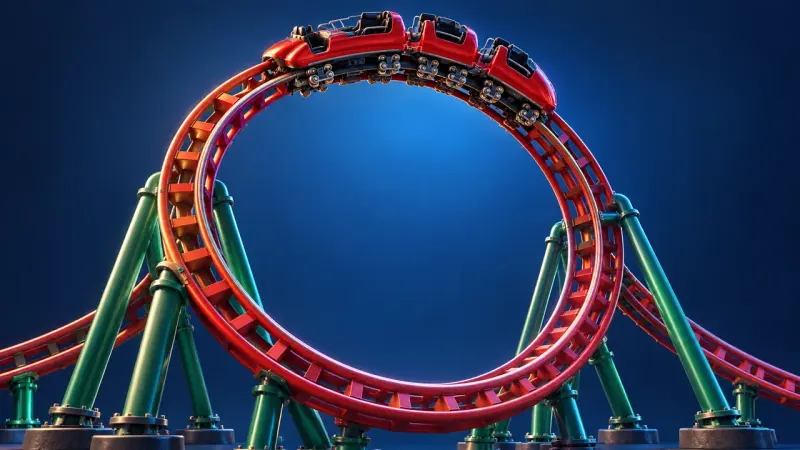
Conservation of energy (roller coaster)
A car rides a roller coaster: energy bars show how potential and kinetic energy turn into each other.
Double grade 9/10: the core curriculum states its expectations “by the end of grade 10”, so the units are the same for grades 9 and 10. Each school decides the order of the topic areas. The grades are therefore shown as one stage. The numbers are our own and run through all double grades.
Temperature and internal energy, phase changes in terms of energy, energy dissipation, power, work and heat, and calculating potential and kinetic energy with the law of conservation of energy.
A car rides a roller coaster: energy bars show how potential and kinetic energy turn into each other.
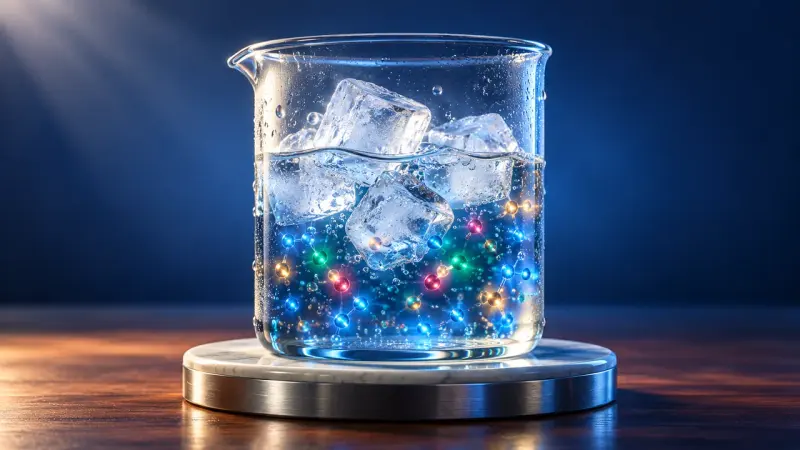
Ice melts, water boils, and the temperature stops rising meanwhile. The particles show where the energy goes in between.
Conductors and semiconductors, the pn junction, LEDs and solar cells, motor, generator and transformer as energy converters, and direct and alternating current.
No separate simulation is planned for this.
The nuclear model of the atom and isotopes, nuclear radiation and its effects, the Geiger counter, alpha, beta and gamma radiation, radiation protection, half-life, and nuclear fission and chain reactions.
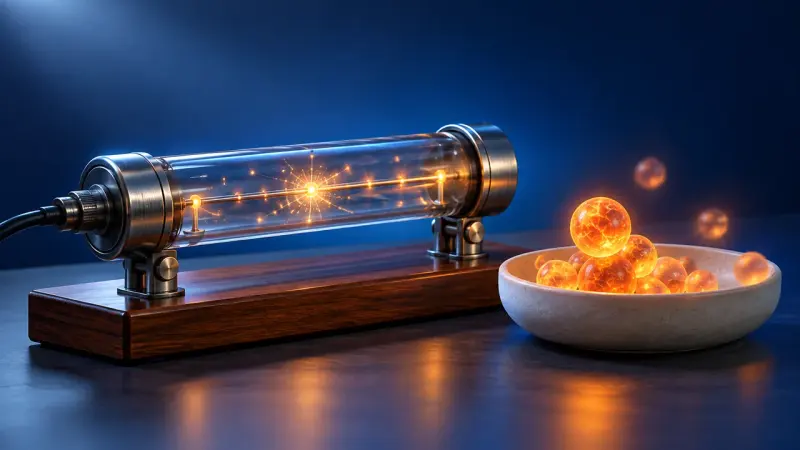
Many nuclei decay at random and a Geiger counter clicks. Even so, after each half-life almost exactly half are left.
Gas pressure in the particle model, the laws of Boyle–Mariotte and Gay-Lussac, the Kelvin scale, the Stirling engine and the maximum possible efficiency.
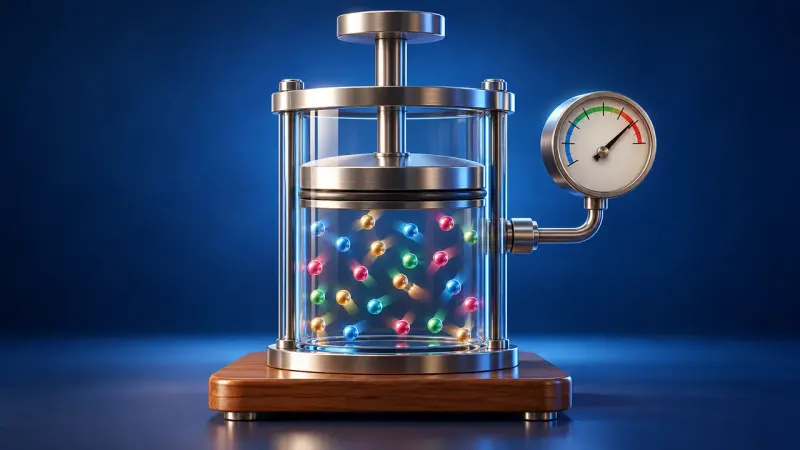
Push the piston halfway in and the pressure doubles. Heat the gas and it pushes the piston out. Pressure, volume and temperature are tightly linked.
The summaries describe the curriculum in our own words. The original text is authoritative. Original text (German): Kerncurriculum, Gymnasium, Physics, grade 9/10