
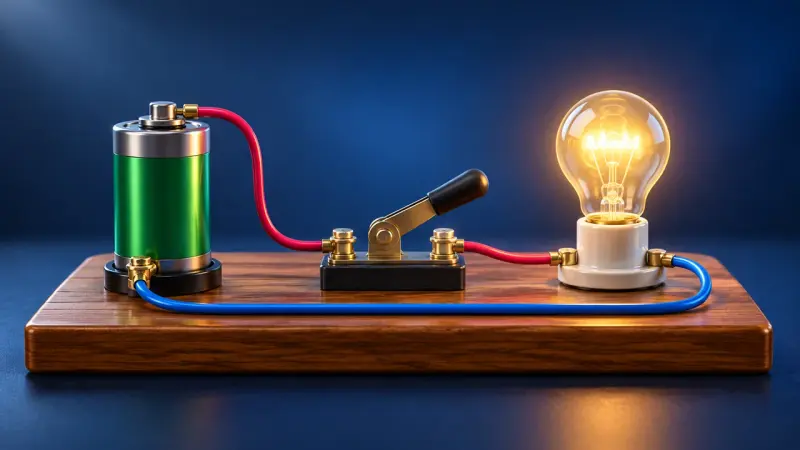
Simple circuit
Build a circuit with a battery, a switch and a lamp, as a set-up and as a circuit diagram. When the circuit is closed, the lamp lights up.
Double grade 7/8: the core curriculum states its expectations “by the end of grade 8”, so the units are the same for grades 7 and 8. Each school decides the order of the topic areas. The grades are therefore shown as one stage. The numbers are our own and run through all double grades.
Describing energy in transfer chains and flow diagrams, the joule, qualitative energy balances and conservation of energy including the flow to the surroundings.
No separate simulation is planned for this.
Circuits as energy carriers, electrons in metals, measuring current, voltage and power, the junction and loop rules, resistance and Ohm’s law.
Build a circuit with a battery, a switch and a lamp, as a set-up and as a circuit diagram. When the circuit is closed, the lamp lights up.
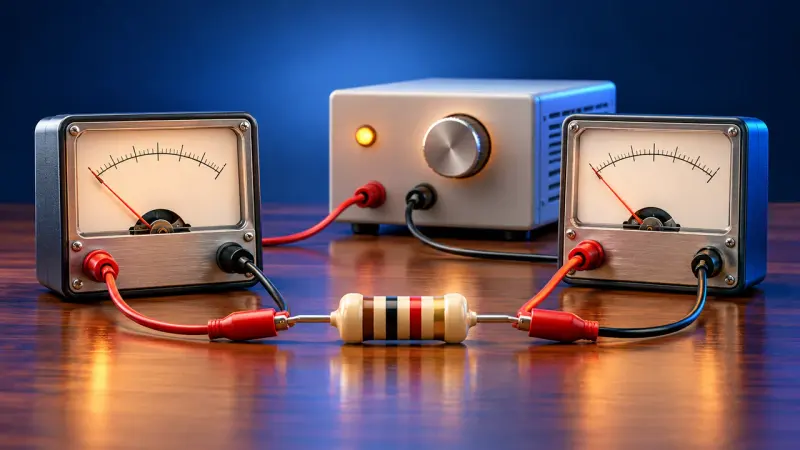
Turn up the voltage and the current rises, always in the same ratio. Point by point the characteristic curve appears, though not quite straight for a lamp.

Connect lamps in series or in parallel and measure current and voltage at different points.
Straight-line motion in t–s and t–v graphs, inertia and mass, force as the cause of changes in motion and deformation, Hooke’s law, weight and adding forces as arrows.

A car drives at a steady speed or speeds up. The graphs for distance, speed and acceleration are drawn live.
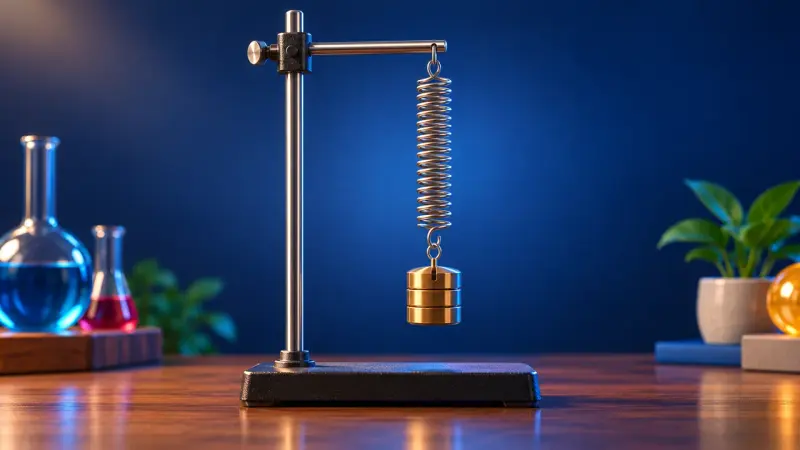
Hang weights on a spring and measure how far it stretches. Double the force means double the stretch.
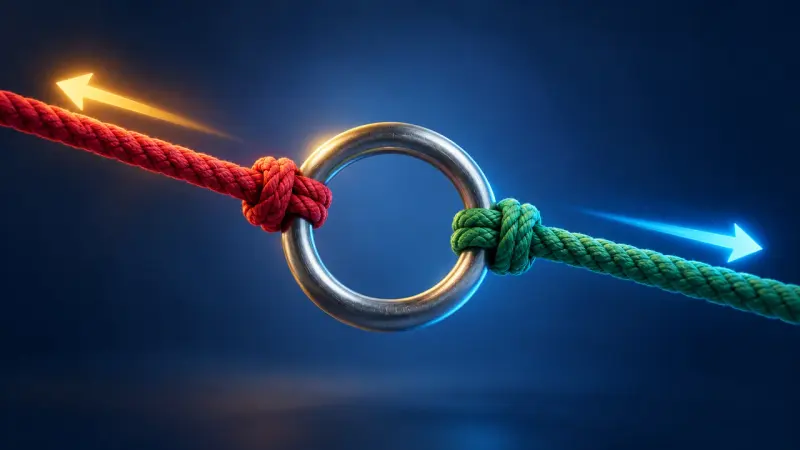
Two forces pull on one point. Use the parallelogram of forces to find the total force or to split a force into two.
The summaries describe the curriculum in our own words. The original text is authoritative. Original text (German): Kerncurriculum, Gymnasium, Physics, grade 7/8