
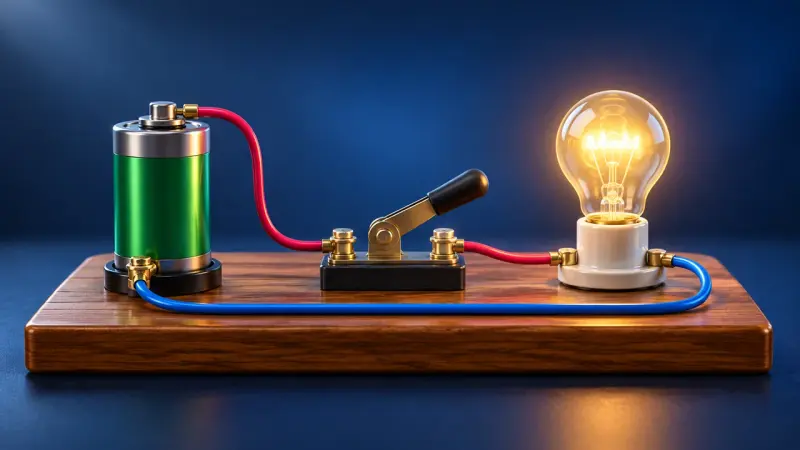
Simple circuit
Build a circuit with a battery, a switch and a lamp, as a set-up and as a circuit diagram. When the circuit is closed, the lamp lights up.
Double grade 5/6: the core curriculum states its expectations “by the end of grade 6”, so the units are the same for grades 5 and 6. Each school decides the order of the topic areas. The grades are therefore shown as one stage. The numbers are our own and run through all double grades.
Magnets attract some materials and have north and south poles that cannot be separated; the Earth as a magnet, the compass and the model of elementary magnets.
No separate simulation is planned for this.
Building simple circuits from a diagram, telling series and parallel circuits apart, conductors and insulators, voltage ratings, dangers of electricity and the electromagnet.
Build a circuit with a battery, a switch and a lamp, as a set-up and as a circuit diagram. When the circuit is closed, the lamp lights up.
Seeing with the sender–receiver model, straight-line propagation, shadows, eclipses and lunar phases; reflection, scattering and refraction; images in mirrors, pinholes and converging lenses; white light as a mixture of colours.
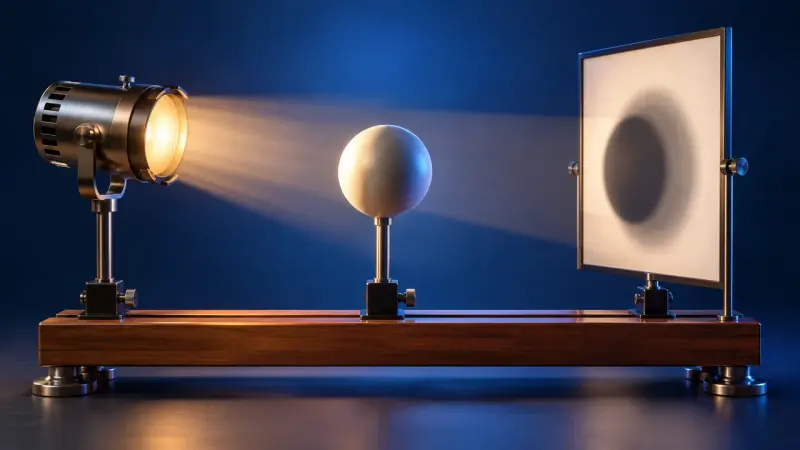
One lamp casts a sharp shadow, two lamps a penumbra. Solar and lunar eclipses form in just the same way.
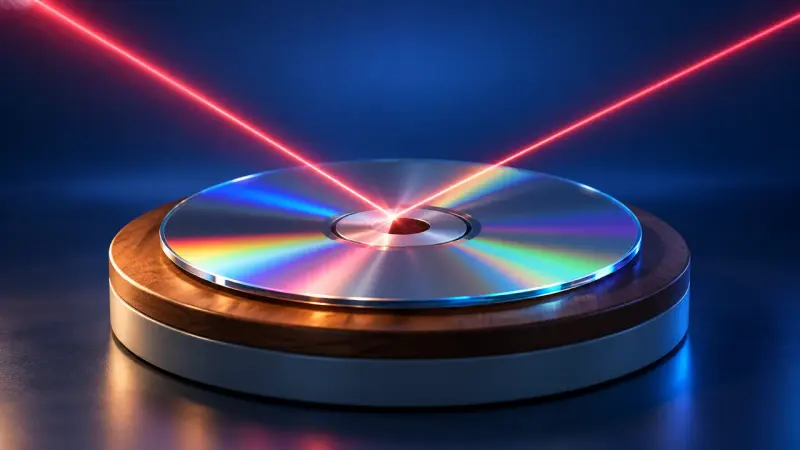
Laser at the mirror, measure the angles: angle of incidence equals angle of reflection, every time. And why does the candle appear just as far behind the mirror?

A light ray bends when it passes into glass or water. At a shallow angle it cannot get out at all: total internal reflection, as in an optical fibre.
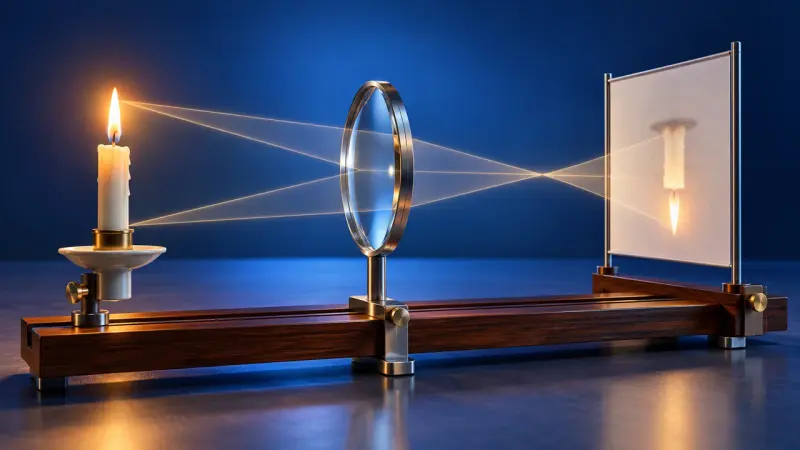
Move a candle in front of a lens and construct the image with three special rays. It becomes sharp on the screen.
The summaries describe the curriculum in our own words. The original text is authoritative. Original text (German): Kerncurriculum, Gymnasium, Physics, grade 5/6