

Circular motion and centripetal force
A ball swings round on a string, a car drives through a bend. Which force keeps them on a circular path?
Grade 10: introduction to upper secondary at the Gymnasium; some content already belongs to upper secondary level. The numbers are those of the curriculum (topic field.topic).
Magnetic fields of a straight conductor and a coil, the field line model and field concept, electromagnet, relay and electric motor, transport and storage of electrical energy.
No separate simulation is planned for this.
Horizontal and vertical projection with the superposition principle, momentum and its conservation with collisions, circular motion and centripetal force, frames of reference, harmonic oscillation; optionally satellite orbits.
A ball swings round on a string, a car drives through a bend. Which force keeps them on a circular path?

Which launch angle goes furthest? On Earth it is 45°, and on the Moon the same ball flies six times as far.

Two gliders collide on an air track. Before and after are compared to see what stays the same.

Too fast and the planet flies off, never to return. A little slower and it traces an ellipse around the Sun, exactly as Kepler's laws say.
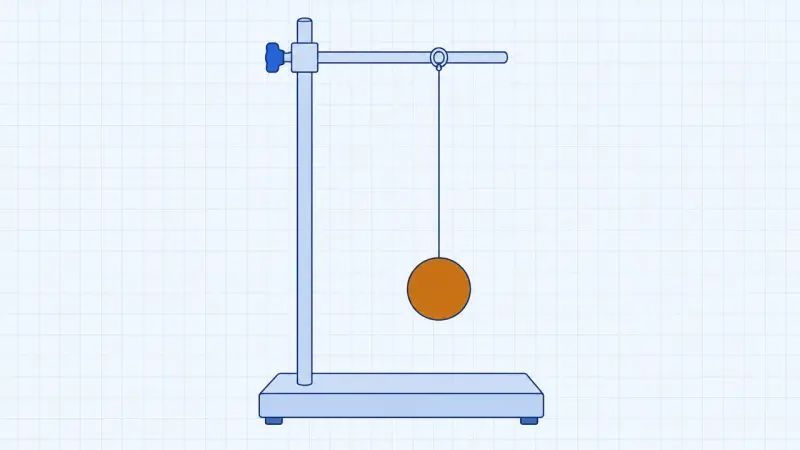
Pull a pendulum aside, let it go and measure how long one swing takes. What does it depend on? Also with large angles and damping.

A mass bounces up and down on a spring. Graphs show position, speed and energy during the oscillation.
The summaries describe the curriculum in our own words. The original text is authoritative. Original text (German): Bildungsplan, Gymnasium, Physics, grade 10