

Particle model and temperature
Ice melts, water boils, and the temperature stops rising meanwhile. The particles show where the energy goes in between.
PhysicsBaden-Württemberg curriculum · Gymnasium
Section 3.1 covers the double grade 7/8; the same content is also listed under grade 8. Simulations are listed only where their grade range fits. According to the curriculum, the “Introduction to physics” sections (3.1.2–3.1.4) belong to the introduction in grade 7.
Distinguishing observation from explanation, testing physical statements with experiments, using models and knowing the SI system of units.
No separate simulation is planned for this.
Producing, transmitting and hearing sound; linking loudness and pitch to amplitude and frequency of an oscillation, and judging the risk of hearing damage from noise.
No separate simulation is planned for this.
Observing water as it is heated and cooled, understanding the Celsius scale, and building and judging a measuring device with its own scale.
Ice melts, water boils, and the temperature stops rising meanwhile. The particles show where the energy goes in between.
Basic properties of energy and energy chains; investigating conduction, convection and thermal radiation, testing insulating materials and deriving rules for saving energy.
No separate simulation is planned for this.
Describing motion in words and with distance–time graphs, calculating speed as distance over time and drawing conclusions for road safety.

A car drives at a steady speed or speeds up. The graphs for distance, speed and acceleration are drawn live.
Forces change motion and deform bodies: inertia, Hooke’s law, mass and weight, and balanced forces and resultant force along one line.

Hang weights on a spring and measure how far it stretches. Double the force means double the stretch.

How can a child lift an adult on a seesaw? With the longer arm. Wheelbarrows and bottle openers use the same trick.
Vision, propagation of light in the ray model, shadows, moon phases and eclipses; reflection, refraction, the converging lens and splitting white light into a spectrum.

One lamp casts a sharp shadow, two lamps a penumbra. Solar and lunar eclipses form in just the same way.
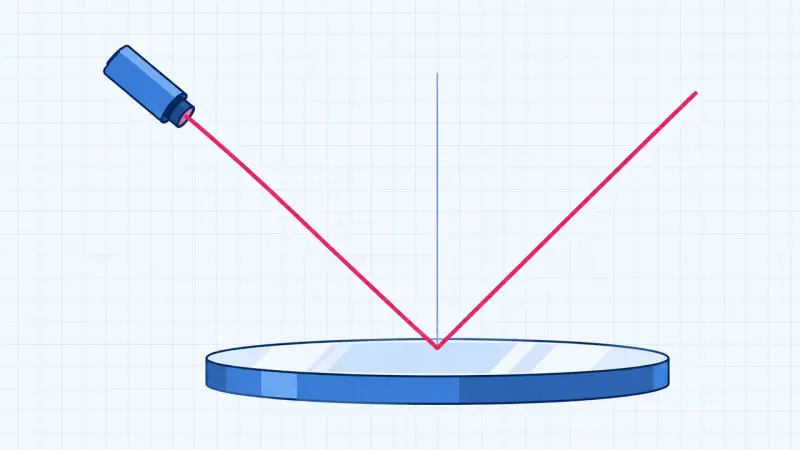
Laser at the mirror, measure the angles: angle of incidence equals angle of reflection, every time. And why does the candle appear just as far behind the mirror?

A light ray bends when it passes into glass or water. At a shallow angle it cannot get out at all: total internal reflection, as in an optical fibre.
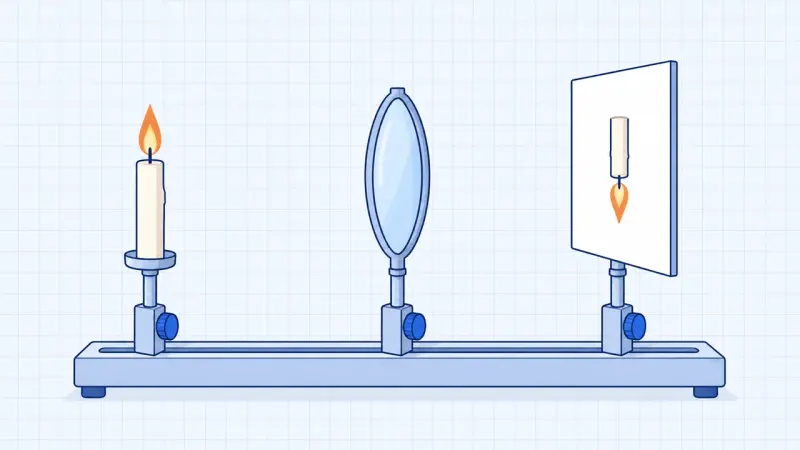
Move a candle in front of a lens and construct the image with three special rays. It becomes sharp on the screen.
Investigating magnets, poles and magnetic fields experimentally and describing them with field lines of bar and horseshoe magnets, including the Earth’s magnetic field.
No separate simulation is planned for this.
The summaries describe the curriculum in our own words. The original text is authoritative. Original text (German): Bildungsplan, Gymnasium, Physics, grade 7/8