

Points and solids in 3D coordinates
Place points in 3D coordinates, rotate the view and calculate distances with Pythagoras' theorem.
MathematicsGrade 10–13 · University
Points, vectors, lines, planes and spheres in space – rotatable in 3D, with relative positions and distances.
Place points in 3D coordinates, rotate the view and calculate distances with Pythagoras' theorem.

Drag vector arrows in space, add them and multiply them by numbers. The calculation is shown alongside in column form.
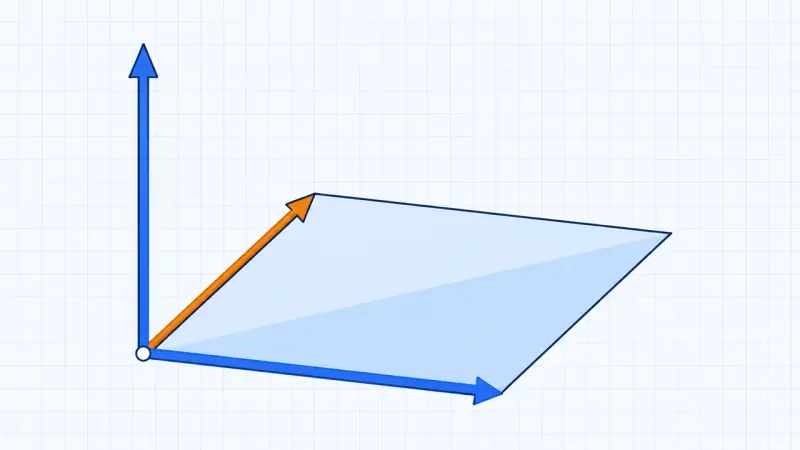
The dot product tells you the angle between two vectors; the cross product gives a perpendicular vector and an area.
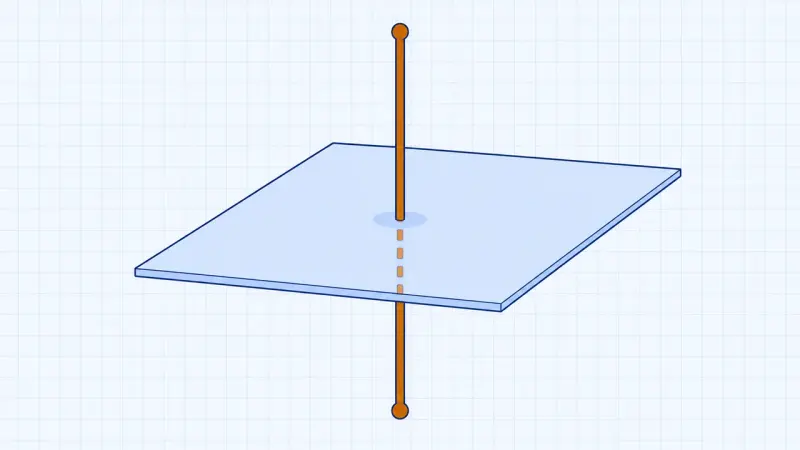
A point travels along a line through space, two vectors span a plane. Parametric, normal and coordinate forms all describe the same thing.

Do the lines meet, run parallel or pass each other by? In a 3D space you can turn, intersections, angles and distances become visible.

A plane cuts the sphere in a circle, touches it at a point or misses it entirely. Including the equation of the sphere and the tangent plane.

Two arrows decide everything: wherever they point, the matrix rotates, stretches or reflects the whole grid.