
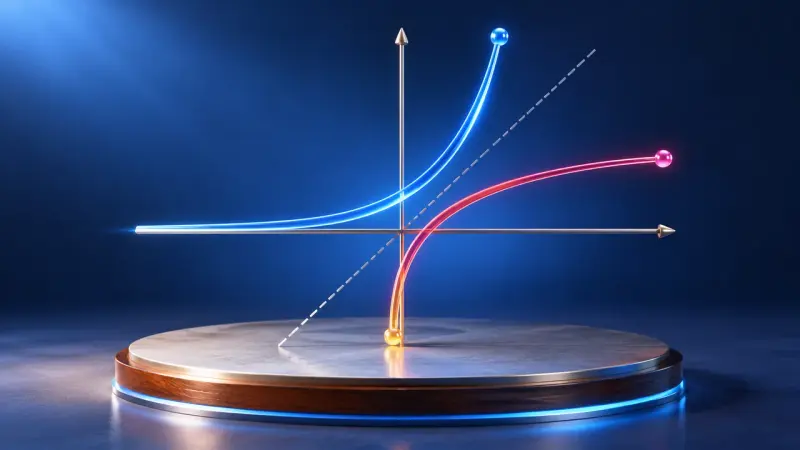
Logarithms as the inverse of exponentiation
The logarithm answers the question: to what power do I raise the base to get this number? With graphs, rules and exponential equations.
Grade 10: the framework curriculum for grades 1–10 is organised by levels A–H, not by grades; at the Gymnasium grade 10 works at level H, the entry requirements for the qualification phase. Units are the subject areas, sub-units their topics; the numbers are our own.
Representing numbers to suit the situation, using integers, rational and real numbers appropriately, nesting intervals for square roots or π.
Matching simulations are listed under Grade 5, Grade 6, Grade 7, Grade 8, Grade 9
Powers with rational exponents and laws of roots, logarithms as the inverse of taking powers.
The logarithm answers the question: to what power do I raise the base to get this number? With graphs, rules and exponential equations.
Radians and degrees on the unit circle, approximating figures with curved boundaries.

Sine, cosine and tangent on the unit circle, and how the sine curve grows out of it.
Volume of oblique prisms, cylinders and pyramids with Cavalieri’s principle, the cosine rule also for angles.

Push a stack of coins sideways: the shape changes, but the volume stays the same. This is Cavalieri's principle.

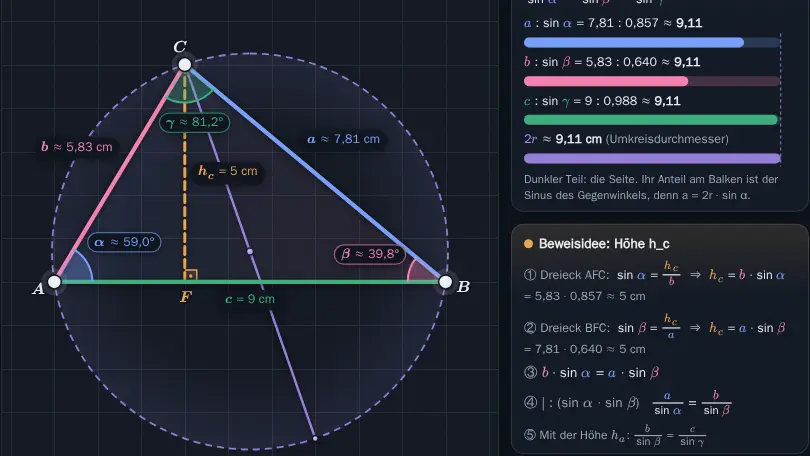
Calculate sides and angles in any triangle with the law of sines and the law of cosines. A helper shows which law fits your problem.

Pour three times and the prism is full: a pyramid holds exactly one third. Cones and spheres can be turned and measured in 3D.
Justifying properties of geometric objects with symmetry, angle theorems, trigonometric relations and the theorems of Thales and Pythagoras.

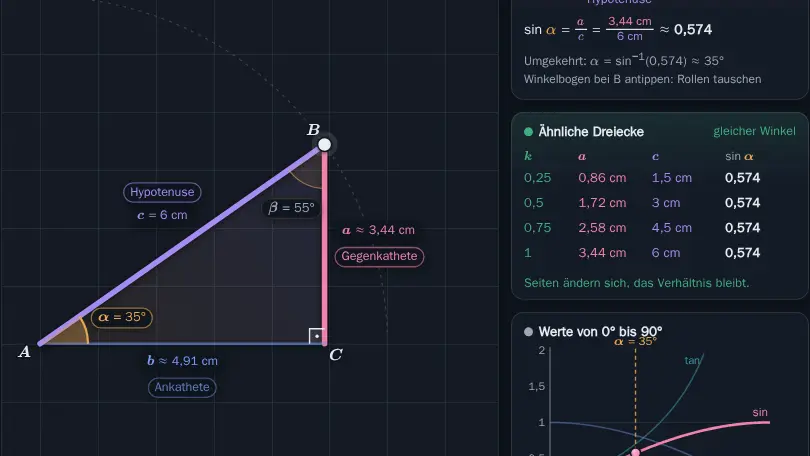
In a right triangle, the ratio of two sides depends only on the angle. This gives sine, cosine and tangent, with examples such as ramps and ladders.
Completing the square, exponential equations with logarithms, higher-degree equations and linear systems in three variables, for example to reconstruct quadratic functions.

Drag three points and the matching parabola always passes through all of them. The equation is worked out step by step.
The logarithm answers the question: to what power do I raise the base to get this number? With graphs, rules and exponential equations.
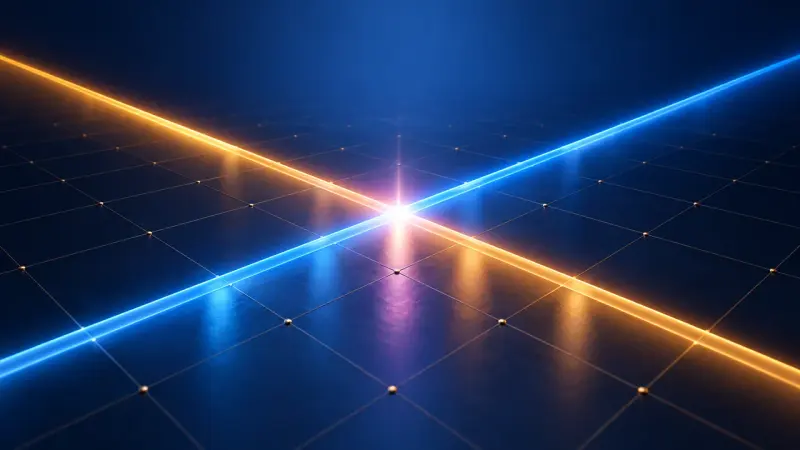
Two equations are two lines. Their point of intersection is the solution, which you can read off and check.
Quadratic, trigonometric, power and exponential functions with parameters, inverse functions, average and local rate of change of polynomial functions and a sketch of the derivative.

Stretch, reflect and shift parabolas and read off the vertex and the zeros.

Change the amplitude, period and shift of a sine curve with sliders or by dragging.
Sine, cosine and tangent on the unit circle, and how the sine curve grows out of it.

Even or odd, positive or negative: y = a · xⁿ changes with every exponent, and only a few points always stay the same.

The hyperbola gets ever closer to its asymptotes and yet never touches them. Shifting and stretching show what the parameters do.

Water lilies on a pond, compound interest and decay: exponential growth compared with linear growth.

Reflect the graph in y = x and the inverse function appears. It only works if no function value occurs twice.
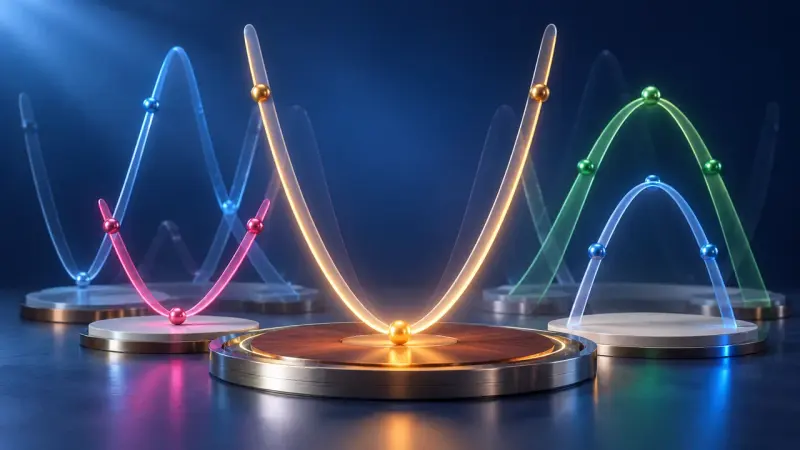
Shift, stretch, reflect: every move of the graph leaves its mark in the function's equation.
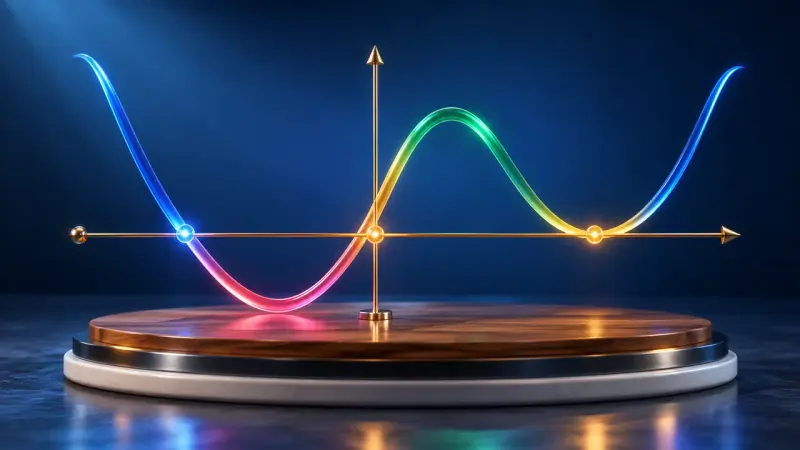
Does the graph cross the x-axis or only touch it? The multiplicity of the zero decides, the highest power decides what happens far out.

Let a point Q move towards P: the secant becomes the tangent, and the average slope becomes the derivative.

A tangent slides along the graph and draws its slope as a new graph: the derivative function.

Up to three of your own functions at once, with a table of values, zeros and intersections. The tool for anything that can be a graph.
Analysing and interpreting averages and measures of spread such as range and box width.
Matching simulations are listed under Grade 6, Grade 7, Grade 8, Grade 9
Counting with factorials and binomial coefficients, estimating probabilities from relative frequencies and simulations and predicting frequencies.

How likely is it that two people in a class share a birthday? From just 23 people on, it is more likely than not.

Random points fall on a square with a circle inside. From the share inside the circle you can estimate π.

A medical test is positive, but how likely is it that you are really ill? 1000 people show why the answer is often surprising.
The summaries describe the curriculum in our own words. The original text is authoritative. Original text (German): Rahmenlehrplan, Gymnasium, Mathematics, grade 10