

Uniform and accelerated motion (distance–time and velocity–time graphs)
A car drives at a steady speed or speeds up. The graphs for distance, speed and acceleration are drawn live.
PhysicsRhineland-Palatinate curriculum · Gymnasium
Introductory phase of the Mainz upper secondary (grade 11). Units are the compulsory and elective modules; the basic course (GF) chooses one elective module, the advanced course (LF) two. The curriculum does not number the modules; the numbers are our own.
Kinematics, dynamics and conserved quantities in mechanics.
Position, time, velocity and acceleration; uniform and uniformly accelerated linear motion and uniform circular motion, shown in graphs.
A car drives at a steady speed or speeds up. The graphs for distance, speed and acceleration are drawn live.

A ball falls on Earth, the Moon or Mars and gets faster every second. In a vacuum even a feather keeps up.

A ball swings round on a string, a car drives through a bend. Which force keeps them on a circular path?
Causes of changes in motion, the interaction principle and inertia, using momentum or force.

Two forces pull on one point. Use the parallelogram of forces to find the total force or to split a force into two.
A ball swings round on a string, a car drives through a bend. Which force keeps them on a circular path?
Conservation of energy and momentum as a method of balancing, friction in real processes and the vector nature of momentum.
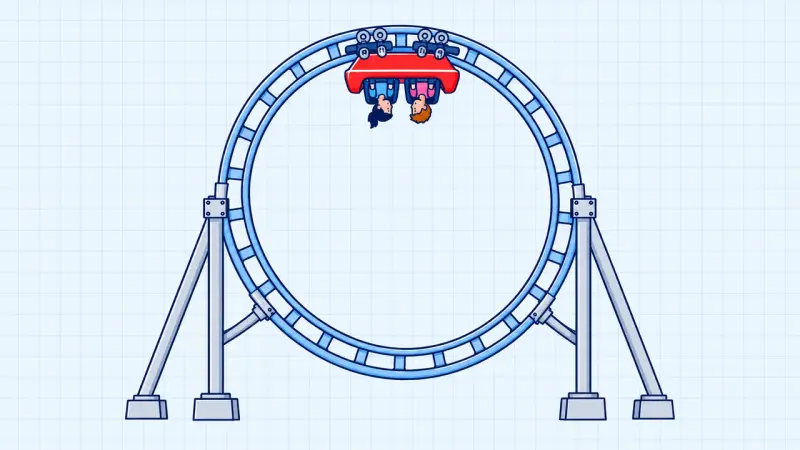
A car rides a roller coaster: energy bars show how potential and kinetic energy turn into each other.

Two gliders collide on an air track. Before and after are compared to see what stays the same.
Projectile motion or gravitation.
The superposition principle, vertical and horizontal projection.

Which launch angle goes furthest? On Earth it is 45°, and on the Moon the same ball flies six times as far.
A ball falls on Earth, the Moon or Mars and gets faster every second. In a vacuum even a feather keeps up.
The law of gravitation and satellite motion.

Too fast and the planet flies off, never to return. A little slower and it traces an ellipse around the Sun, exactly as Kepler's laws say.
A ball swings round on a string, a car drives through a bend. Which force keeps them on a circular path?
Kinematics with error analysis, dynamics and conserved quantities in mechanics.
Quantities describing motion and their functional relations, idealised forms of motion, analysing a real motion and error analysis.
A car drives at a steady speed or speeds up. The graphs for distance, speed and acceleration are drawn live.
A ball falls on Earth, the Moon or Mars and gets faster every second. In a vacuum even a feather keeps up.
A ball swings round on a string, a car drives through a bend. Which force keeps them on a circular path?
Causes of changes in motion, the interaction principle and inertia, built up into the concept of interaction.
Two forces pull on one point. Use the parallelogram of forces to find the total force or to split a force into two.

A block sits on a slope. At what angle does it start to slide? The weight is split into two parts to find out.
A ball swings round on a string, a car drives through a bend. Which force keeps them on a circular path?
Balancing energy and momentum, friction and the vector treatment of momentum.
A car rides a roller coaster: energy bars show how potential and kinetic energy turn into each other.
Two gliders collide on an air track. Before and after are compared to see what stays the same.
Projectile motion, gravitation or rotation of rigid bodies.
The superposition principle, vertical, horizontal and oblique projection.
Which launch angle goes furthest? On Earth it is 45°, and on the Moon the same ball flies six times as far.
A ball falls on Earth, the Moon or Mars and gets faster every second. In a vacuum even a feather keeps up.
The law of gravitation, satellite motion, energy in the gravitational field and escape velocity.
Too fast and the planet flies off, never to return. A little slower and it traces an ellipse around the Sun, exactly as Kepler's laws say.
A ball swings round on a string, a car drives through a bend. Which force keeps them on a circular path?
Moment of inertia, angular momentum, torque and rotational energy by analogy with translation.

How can a child lift an adult on a seesaw? With the longer arm. Wheelbarrows and bottle openers use the same trick.
The summaries describe the curriculum in our own words. The original text is authoritative. Original text (German): Rahmenlehrplan und Lehrplan, Gymnasium, Physics, grade 11