

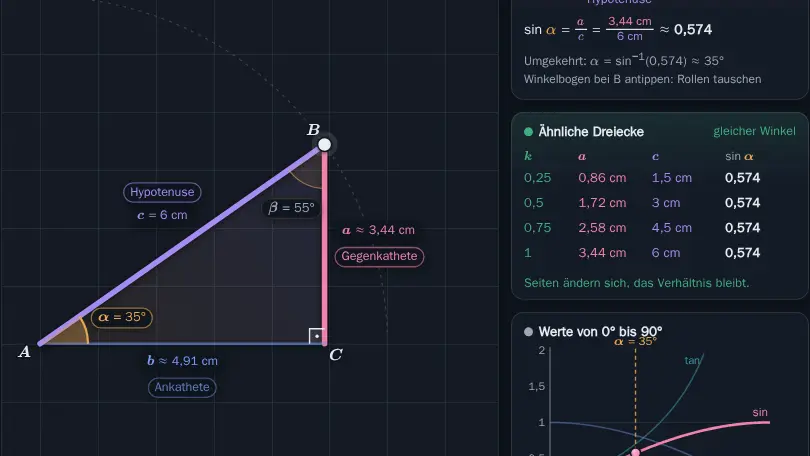
Sine, cosine and tangent in right triangles
In a right triangle, the ratio of two sides depends only on the angle. This gives sine, cosine and tangent, with examples such as ramps and ladders.
Grade 10: trigonometry, circles and solids at a higher level, trigonometric and exponential functions, logarithms and similarity. The key ideas number and operation and data and chance have no topics of their own for grade 10 in the distribution table. The numbers are our own.
Trigonometry, circles and sectors, and further calculations with solids.
Sine, cosine and tangent in right triangles and on the unit circle, the sine rule and the cosine rule.
In a right triangle, the ratio of two sides depends only on the angle. This gives sine, cosine and tangent, with examples such as ramps and ladders.

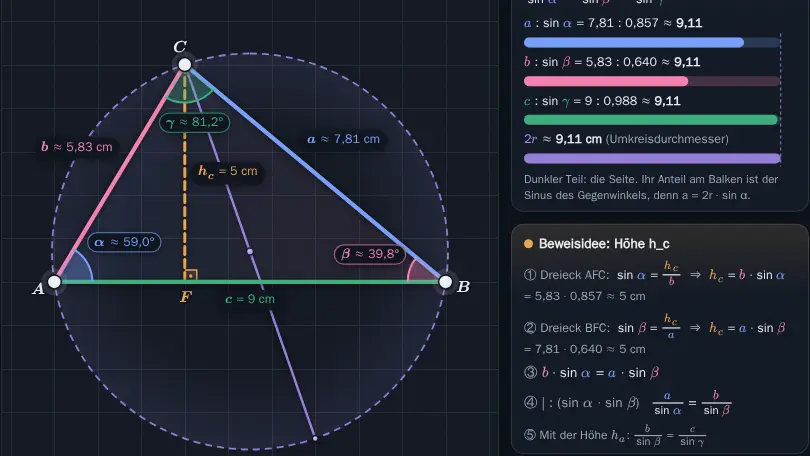
Calculate sides and angles in any triangle with the law of sines and the law of cosines. A helper shows which law fits your problem.

Sine, cosine and tangent on the unit circle, and how the sine curve grows out of it.
Arc length and area of sectors and composite figures, radians.
Sine, cosine and tangent on the unit circle, and how the sine curve grows out of it.
Calculations with solids at a higher level, including composite solids with cones or spheres.

Pour three times and the prism is full: a pyramid holds exactly one third. Cones and spheres can be turned and measured in 3D.
Trigonometric functions, exponential functions, exponential equations and logarithms; deepening the topics marked *.
Periodic processes, projection on the unit circle, radians and the meaning of the parameters a, b, c.
Sine, cosine and tangent on the unit circle, and how the sine curve grows out of it.

Change the amplitude, period and shift of a sine curve with sliders or by dragging.

Shift, stretch, reflect: every move of the graph leaves its mark in the function's equation.
Exponential growth, monotonicity, doubling time and half-life, asymptotic behaviour and parameters.

Water lilies on a pond, compound interest and decay: exponential growth compared with linear growth.

What happens to a graph when x gets very large? A point runs outwards and a magnifier shows how close it gets to the asymptote.
Shift, stretch, reflect: every move of the graph leaves its mark in the function's equation.
Solving exponential equations by trial, graphically and with logarithms.
Water lilies on a pond, compound interest and decay: exponential growth compared with linear growth.
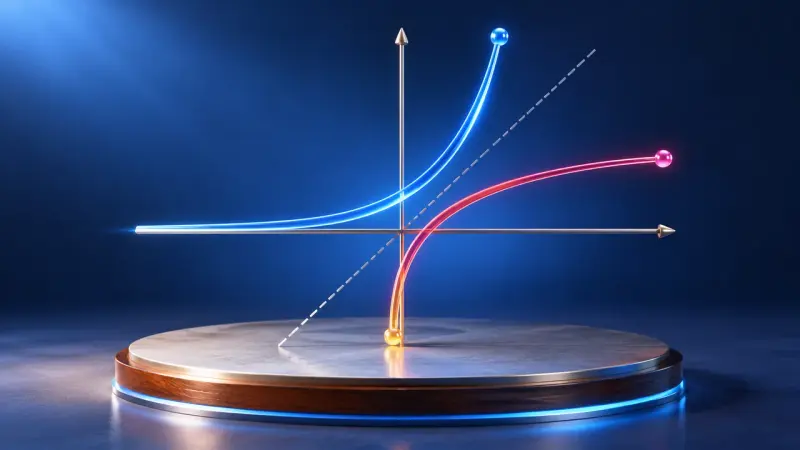
The logarithm answers the question: to what power do I raise the base to get this number? With graphs, rules and exponential equations.
Understanding and using the logarithm as the inverse of taking powers.
The logarithm answers the question: to what power do I raise the base to get this number? With graphs, rules and exponential equations.
The topics from grades 7–9 marked * can be deepened in grade 10.

Stretch, reflect and shift parabolas and read off the vertex and the zeros.
Similarity of figures and the similarity criterion for triangles.
Similar figures and the similarity criterion for triangles; the effect of the scale factor on lengths, areas and volumes.

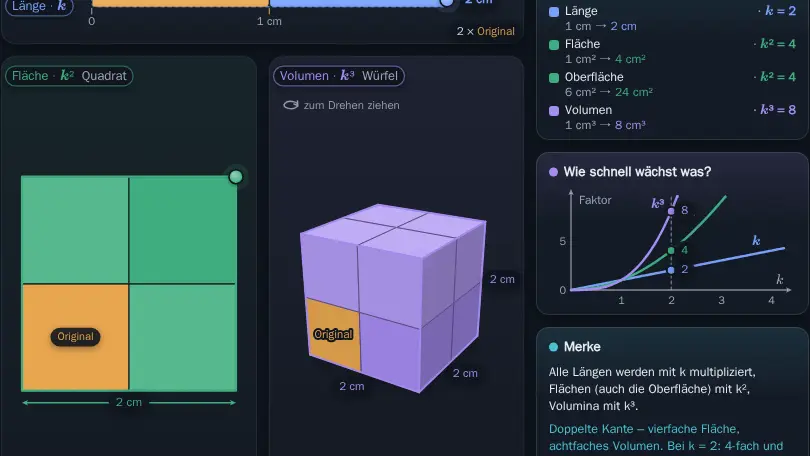
Enlarge lengths, areas and solids. Doubling the length makes the area four times and the volume eight times as large.
The summaries describe the curriculum in our own words. The original text is authoritative. Original text (German): Fachanforderungen, Gymnasium, Mathematics, grade 10