

Square roots and Heron’s method
Step by step, a rectangle turns into a square with the same area. The method is almost 2000 years old and reaches √2 surprisingly quickly.
MathematicsRhineland-Palatinate curriculum · Gymnasium
Grades 9 and 10 (intermediate school certificate): the framework curriculum describes both grades together, so the units are the same for grades 9 and 10 and are shown as one stage. At the Gymnasium basic (B), extension (E) and deepening (V) content apply; the separate part “grade 9 (vocational qualification)” does not apply to the Gymnasium and is not shown. The numbers are our own.
Square roots and real numbers, approximation methods for roots and π, and powers with integer and fractional exponents, nth roots and logarithms.
Finding and estimating square roots as the inverse of squaring, applying the laws of roots, introducing irrational and real numbers (E).
Step by step, a rectangle turns into a square with the same area. The method is almost 2000 years old and reaches √2 surprisingly quickly.
Justifying and carrying out an iterative method for irrational roots and one for π, also with software (E); features of an algorithm (V).
Step by step, a rectangle turns into a square with the same area. The method is almost 2000 years old and reaches √2 surprisingly quickly.

A wheel rolls once and travels a bit more than three times its diameter. Cut into pieces, the circle becomes a rectangle and the area formula follows.
Extending powers to negative and fractional exponents, scientific notation, the laws of exponents, nth roots and logarithms as inverses (E).

The logarithm answers the question: to what power do I raise the base to get this number? With graphs, rules and exponential equations.
Intercept theorems and fractional equations, sine, cosine and tangent in right triangles, radians, and volume and surface area of pyramids, cones and spheres.
Calculating length ratios in centrally enlarged figures with the intercept theorems and using them for measurements outdoors, solving simple fractional equations (E).

How tall is the tree without climbing it? Two rays and a parallel line are enough, because the ratios stay the same.
Sine, cosine and tangent as side ratios in right triangles, relations between them and word problems; the sine or cosine rule can be worked out as an example (E).
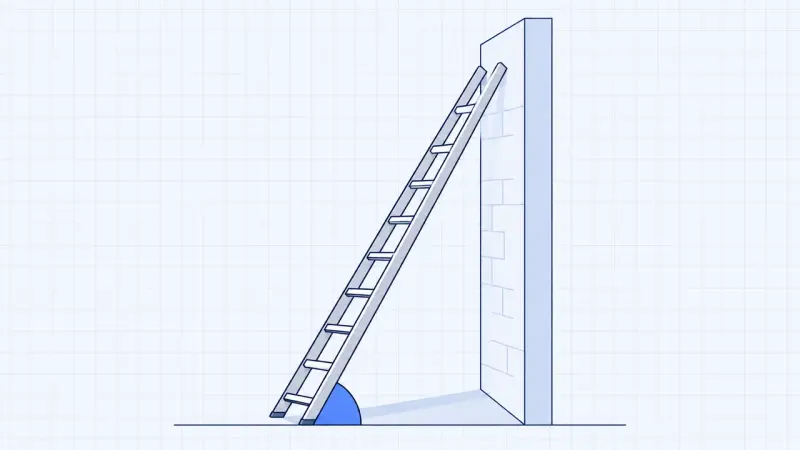
In a right triangle, the ratio of two sides depends only on the angle. This gives sine, cosine and tangent, with examples such as ramps and ladders.

Calculate sides and angles in any triangle with the law of sines and the law of cosines. A helper shows which law fits your problem.
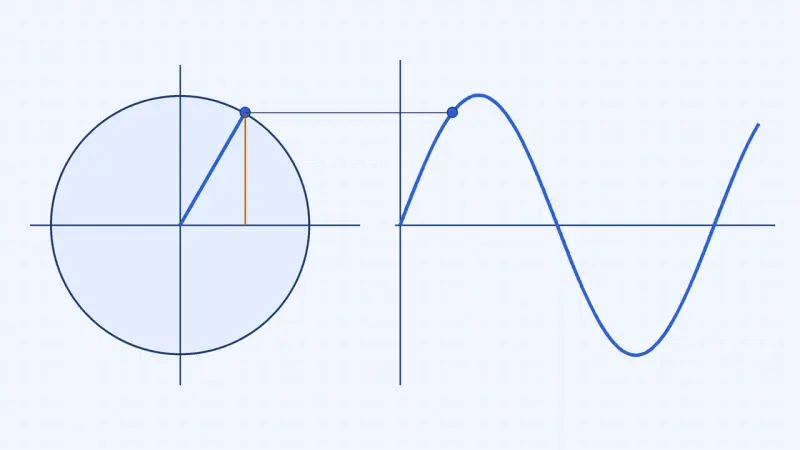
Sine, cosine and tangent on the unit circle, and how the sine curve grows out of it.
Converting angles between degrees and radians and giving sine, cosine and tangent for angles in radians (V).
Sine, cosine and tangent on the unit circle, and how the sine curve grows out of it.
Calculating volume and surface area of pyramids, cones and spheres (E), including composite solids; deriving formulas, for example with Cavalieri’s principle (E).
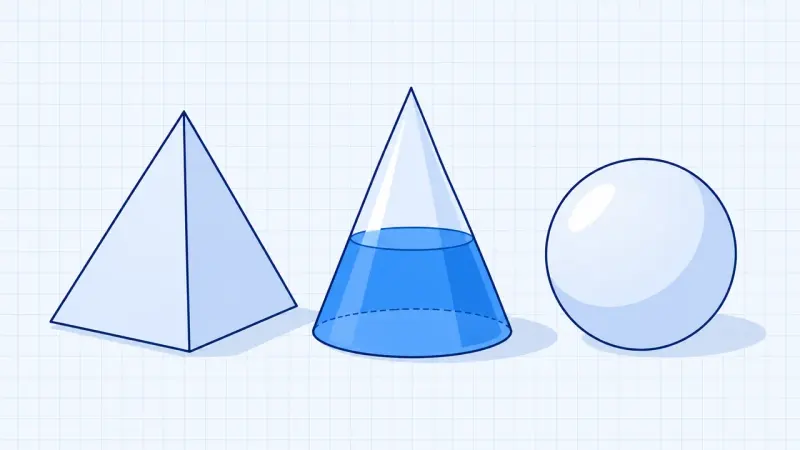
Pour three times and the prism is full: a pyramid holds exactly one third. Cones and spheres can be turned and measured in 3D.

Push a stack of coins sideways: the shape changes, but the volume stays the same. This is Cavalieri's principle.
Similar figures and central enlargement, the Pythagorean group of theorems, and oblique drawings and nets of pyramids and cones.
Creating similar figures by enlarging and reducing, examining the effect on angles, lengths and area; central enlargement (E), similarity transformations (V).

Enlarge lengths, areas and solids. Doubling the length makes the area four times and the volume eight times as large.
Justifying and applying Pythagoras’ theorem, working out a proof, the converse, the leg theorem and the altitude theorem (E), comparing another proof (V).

Squares on the sides of a right triangle and a puzzle proof show: a² + b² = c².
Drawing oblique views and nets of pyramids and cones and relating them to the solid.
Pour three times and the prism is full: a pyramid holds exactly one third. Cones and spheres can be turned and measured in 3D.
Recognising quadratic, power, exponential and trigonometric functions in real contexts, describing their graphs and examining the effect of parameters.
Parabolas with symmetry, zeros and vertex, shifting and stretching the standard parabola, real contexts (E); inversion with the square-root function (V).

Stretch, reflect and shift parabolas and read off the vertex and the zeros.
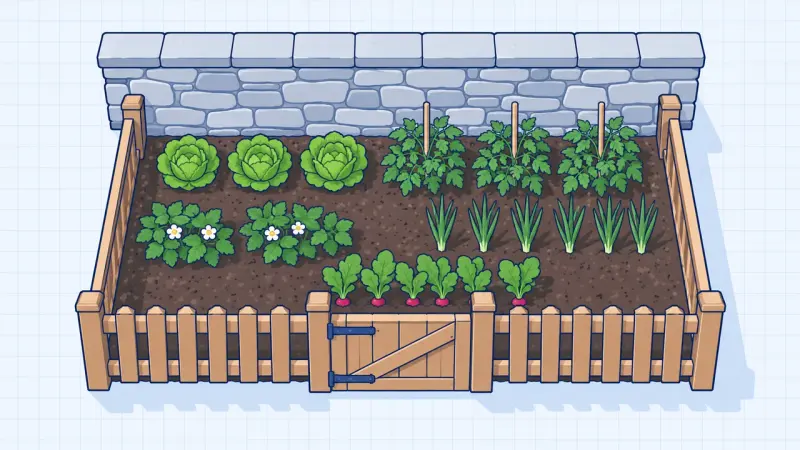
Which enclosure has the largest area? Picture and graph show the maximum, first by trying, then by exact calculation.
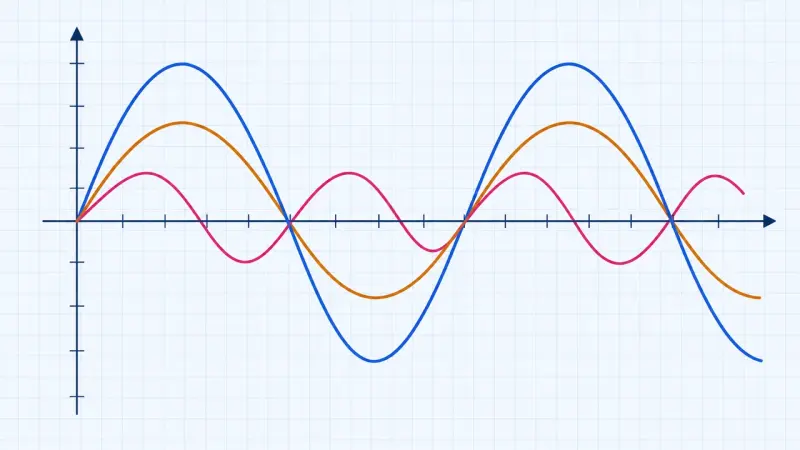
Up to three of your own functions at once, with a table of values, zeros and intersections. The tool for anything that can be a graph.

Shift, stretch, reflect: every move of the graph leaves its mark in the function's equation.
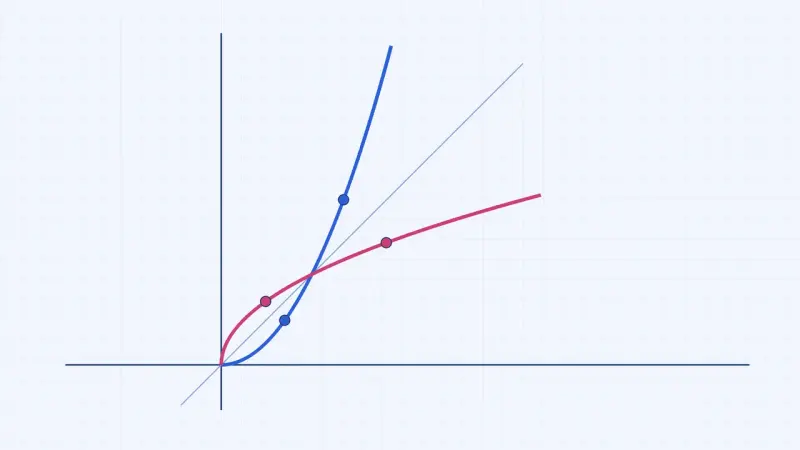
Reflect the graph in y = x and the inverse function appears. It only works if no function value occurs twice.
Describing graphs of power functions with natural and integer exponents by symmetry, monotonicity and asymptotes, f(x) = a(x + b)ᶻ + c (E); power equations (V).
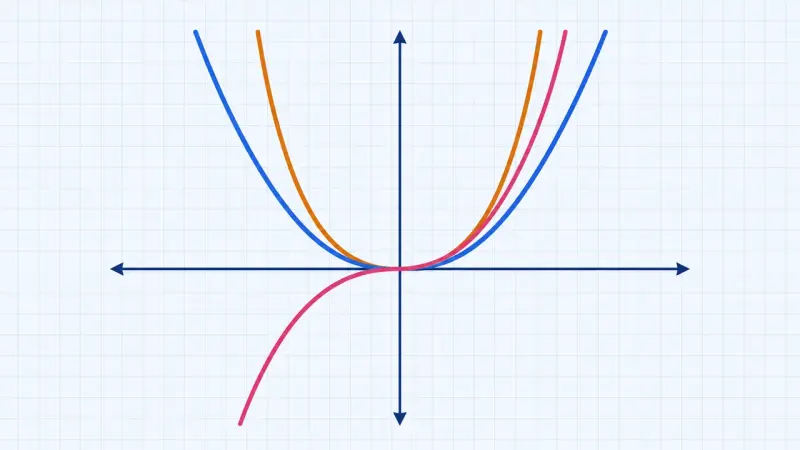
Even or odd, positive or negative: y = a · xⁿ changes with every exponent, and only a few points always stay the same.

The hyperbola gets ever closer to its asymptotes and yet never touches them. Shifting and stretching show what the parameters do.
Shift, stretch, reflect: every move of the graph leaves its mark in the function's equation.
Describing growth and decay with exponential functions, properties of the graphs, solving simple exponential equations (E); the logarithmic function as the inverse (V).
The logarithm answers the question: to what power do I raise the base to get this number? With graphs, rules and exponential equations.
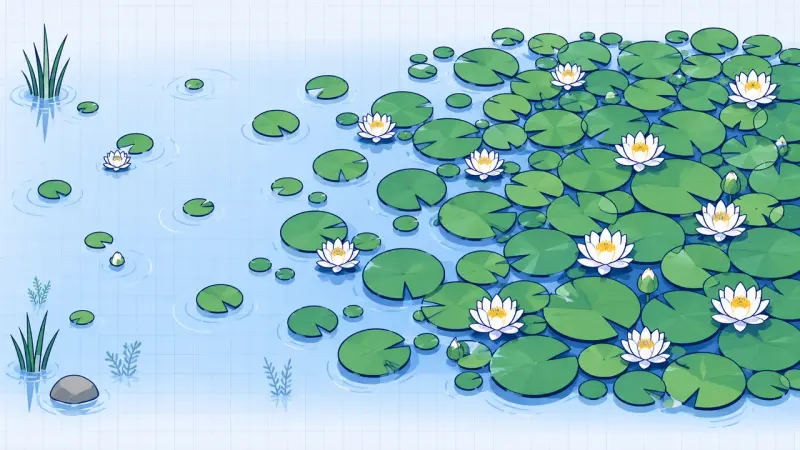
Water lilies on a pond, compound interest and decay: exponential growth compared with linear growth.
Reflect the graph in y = x and the inverse function appears. It only works if no function value occurs twice.
Recognising periodic processes, describing circular motion with sine and cosine on the unit circle, symmetry, zeros, period (E); in radians (V).
Sine, cosine and tangent on the unit circle, and how the sine curve grows out of it.

Change the amplitude, period and shift of a sine curve with sliders or by dragging.
Solving linear systems with two variables and quadratic equations graphically and algebraically and examining their solvability.
Solving systems of two equations in two variables graphically and algebraically, examining solvability, word problems (E); simple systems in three variables (V).

Two equations are two lines. Their point of intersection is the solution, which you can read off and check.

Drag three points and the matching parabola always passes through all of them. The equation is worked out step by step.
Solving quadratic equations graphically and with the quadratic formula, examining solvability with the discriminant (E); with a parameter (V).
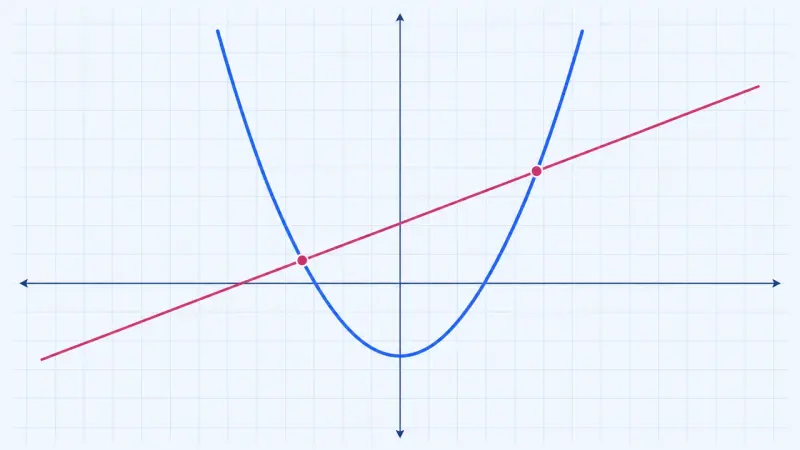
Draw both sides of an equation as graphs. The solutions are where the graphs cross.
Stretch, reflect and shift parabolas and read off the vertex and the zeros.
Showing statistical data in two-way tables, finding probabilities of two-stage experiments with tree diagrams and path rules, and simulating chance.
Taking statistical data from sources, displaying and interpreting it, also in two-way tables.

A two-way table, a Venn diagram and a tree diagram show the same data and are linked. Change one and the others follow.

Show the same data as bar, line and pie charts and more, and discover how charts can mislead.
Finding probabilities of two-stage random experiments with tree diagrams and path rules (E) and determining them by simulation, for example with the Monte Carlo method (V).

Draw balls from an urn, with or without replacement. The tree diagram and the path rules show how to calculate probabilities.

How likely is it that two people in a class share a birthday? From just 23 people on, it is more likely than not.

Random points fall on a square with a circle inside. From the share inside the circle you can estimate π.

Play yourself or simulate thousands of games: is it worth switching doors?
The summaries describe the curriculum in our own words. The original text is authoritative. Original text (German): Rahmenlehrplan und Lehrplan, Gymnasium, Mathematics, grade 9/10