

Place value and rounding
Ten counters make a ten, ten tens make a hundred. Once you have seen the bundling, reading millions and rounding them is no longer a mystery.
Visualising integers, fractions, decimals, percentages and roots.
Ten counters make a ten, ten tens make a hundred. Once you have seen the bundling, reading millions and rounding them is no longer a mystery.

A frog hops past zero into the negatives. Thermometers and bank balances show why minus 3 plus 5 makes exactly 2.

Break numbers down into prime factors, check divisibility rules and find primes with a sieve. This also gives you the gcd and the lcm.

From a grain of sand to the Earth in steps of ten. Along the way it becomes clear why 10⁶ is a million and how to write tiny numbers.
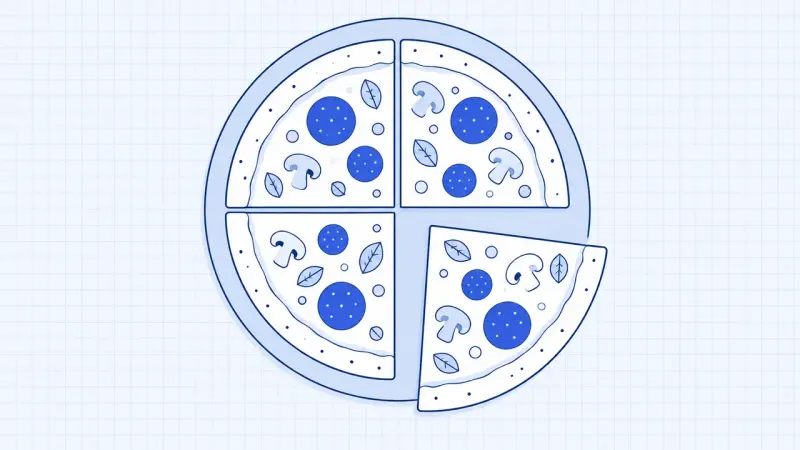
Pizza, cake or a line: share it out fairly first, then colour some pieces. That is exactly what a fraction means.

Compare two fractions as bars or circles. When you expand a fraction, the pieces get smaller but the amount stays the same.

Why does 1/4 end as a decimal but 1/3 never does? Long division gives it away as soon as a remainder repeats.

Two strips overlap in a rectangle: the shared area is the product of the fractions. Dividing by a fraction is shown visually as well.

Discounts, VAT, surveys: one single bar holds the base value, the percentage and the part, one above the other.

Step by step, a rectangle turns into a square with the same area. The method is almost 2000 years old and reaches √2 surprisingly quickly.