

Points, lines and circles: relative positions
Place and read points in a coordinate system, draw segments and lines and check whether they are parallel or perpendicular.
MathematicsGrade 5–10
Construct and investigate figures, symmetry, angles, triangles, similarity and trigonometry dynamically.
Place and read points in a coordinate system, draw segments and lines and check whether they are parallel or perpendicular.
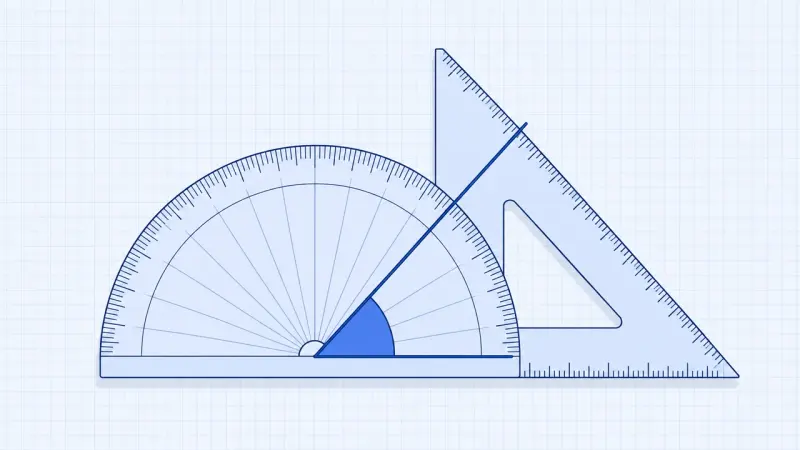
Line up the protractor, hit the zero point, read the right scale. The estimation game then shows how well your eye already measures.

Move one corner and the square becomes a kite. When does a quadrilateral get which name?

In a line or in a point: the shape flips over, and every construction step with the set square stays visible.

A point equally far from A and B never lies there by chance: the perpendicular bisector appears before you draw it with compasses.

Two lines cross and one of them turns. Which angles stay equal? At parallel lines they are called corresponding and alternate angles.

Tear off three corners, put them side by side, and you get a straight line: 180°, for every triangle. A quadrilateral gives 360°.

Construct triangles from three given parts with ruler and compass, step by step as in your exercise book. Sometimes there are no, one or two solutions.
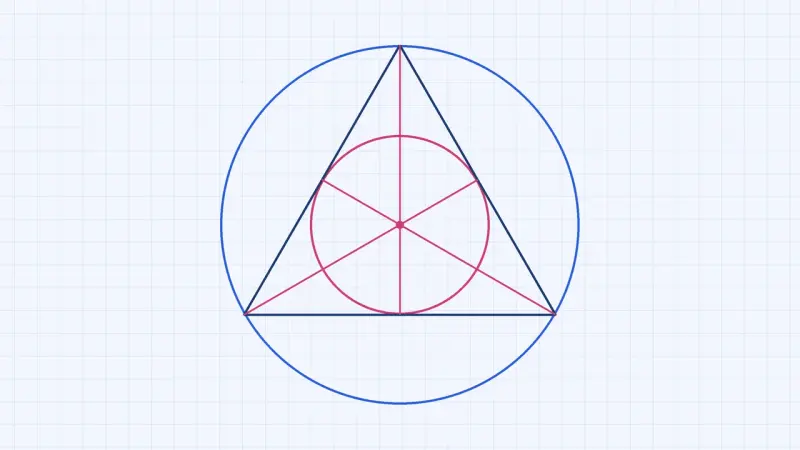
Construct the special lines in a triangle. Each set of three always meets in one point, for example at the centre of the circumcircle or the incircle.

Drag a point along the semicircle: the angle there is always a right angle.

Squares on the sides of a right triangle and a puzzle proof show: a² + b² = c².

How tall is the tree without climbing it? Two rays and a parallel line are enough, because the ratios stay the same.

Enlarge lengths, areas and solids. Doubling the length makes the area four times and the volume eight times as large.
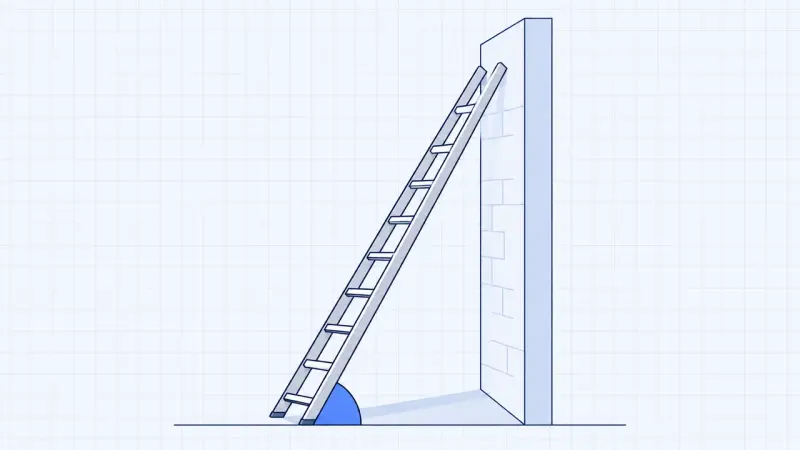
In a right triangle, the ratio of two sides depends only on the angle. This gives sine, cosine and tangent, with examples such as ramps and ladders.

Calculate sides and angles in any triangle with the law of sines and the law of cosines. A helper shows which law fits your problem.