

Light and shadow
One lamp casts a sharp shadow, two lamps a penumbra. Solar and lunar eclipses form in just the same way.
PhysicsBremen curriculum · Gymnasium
Grades 7 to 9: five framework topics in the order set by the curriculum, all listed for 7/8/9; the units are therefore the same for grades 7, 8 and 9 and are shown as one stage. In grades 5/6 physics is part of the subject science. The numbers are those of the curriculum.
The light-ray model, how we see, phases of the moon and eclipses, reflection and refraction, lenses and the lens equation, the eye, colours, thermal radiation and heat transfer in the particle model.
One lamp casts a sharp shadow, two lamps a penumbra. Solar and lunar eclipses form in just the same way.
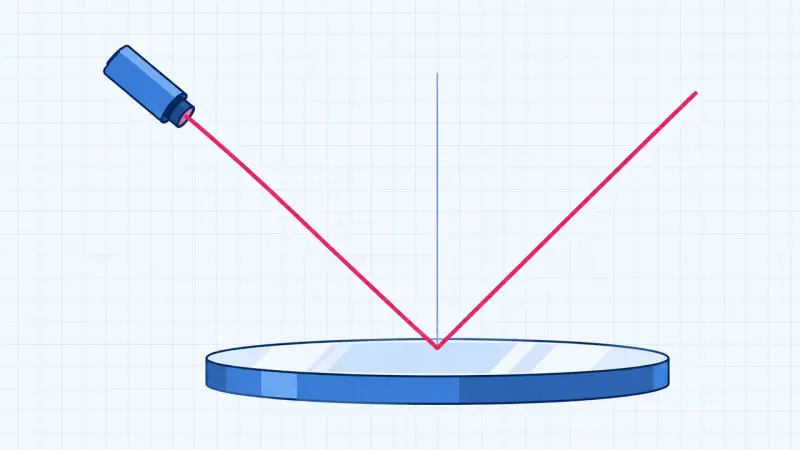
Laser at the mirror, measure the angles: angle of incidence equals angle of reflection, every time. And why does the candle appear just as far behind the mirror?

A light ray bends when it passes into glass or water. At a shallow angle it cannot get out at all: total internal reflection, as in an optical fibre.
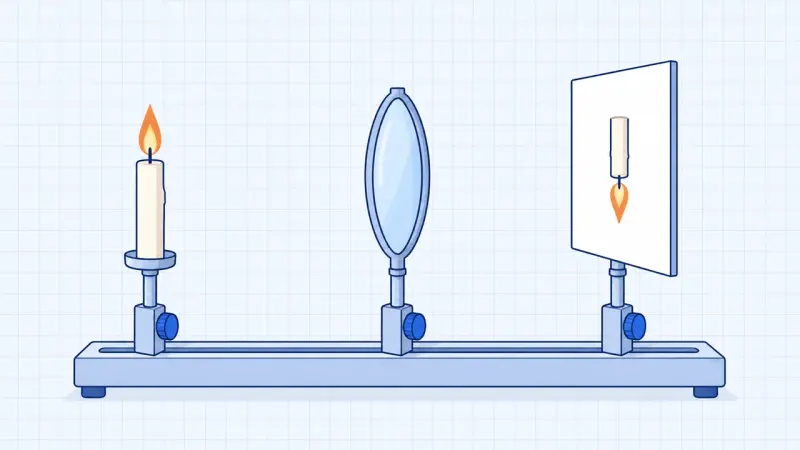
Move a candle in front of a lens and construct the image with three special rays. It becomes sharp on the screen.

Ice melts, water boils, and the temperature stops rising meanwhile. The particles show where the energy goes in between.
Velocity and distance–time graphs, mass and weight, forces as arrows, force as the cause of change in motion and deformation, inertia and friction, energy, work and power.

A car drives at a steady speed or speeds up. The graphs for distance, speed and acceleration are drawn live.

Hang weights on a spring and measure how far it stretches. Double the force means double the stretch.
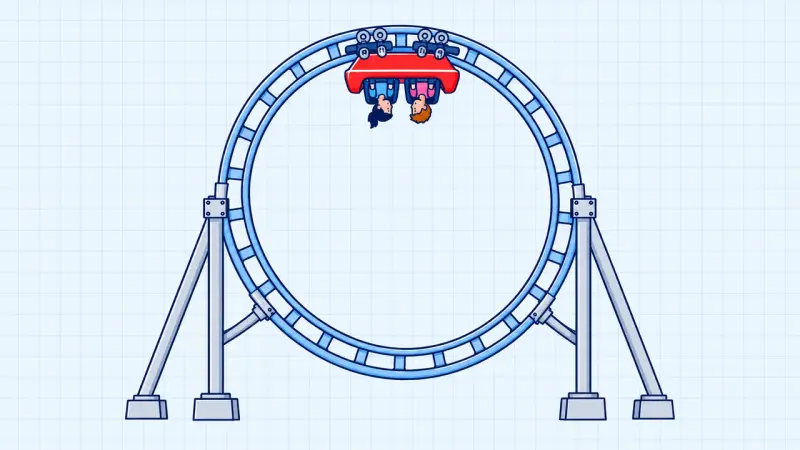
A car rides a roller coaster: energy bars show how potential and kinetic energy turn into each other.

Two forces pull on one point. Use the parallelogram of forces to find the total force or to split a force into two.
Basic electrostatic phenomena and charge, voltage, current and resistance, characteristic curves, series and parallel circuits, electrical power and energy, safety.
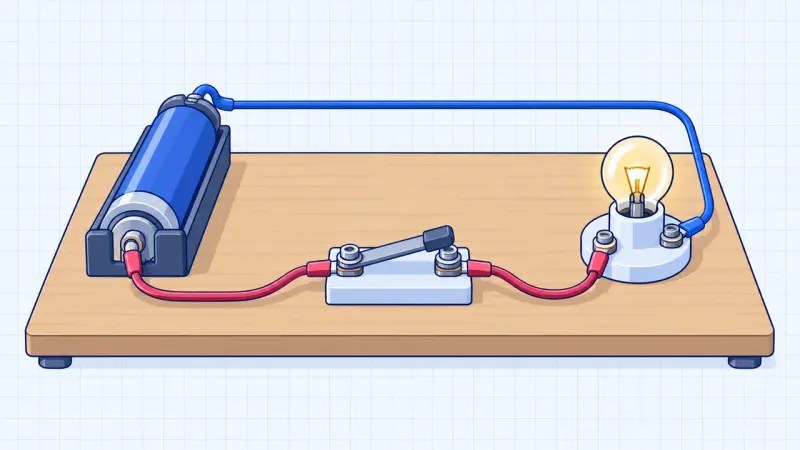
Build a circuit with a battery, a switch and a lamp, as a set-up and as a circuit diagram. When the circuit is closed, the lamp lights up.
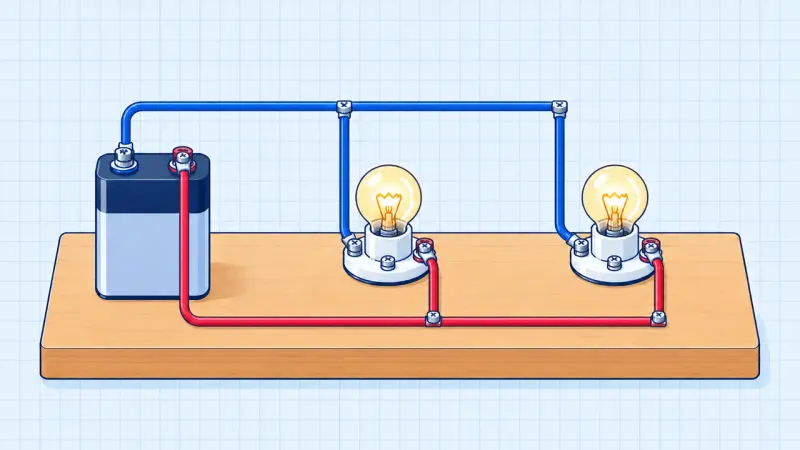
Connect lamps in series or in parallel and measure current and voltage at different points.
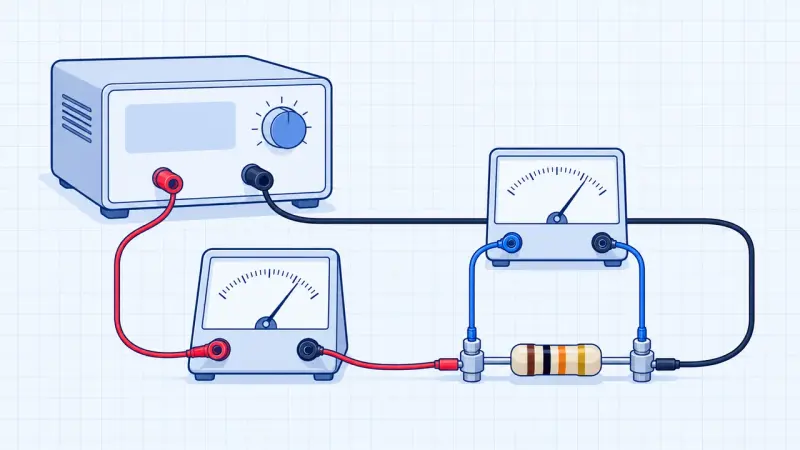
Turn up the voltage and the current rises, always in the same ratio. Point by point the characteristic curve appears, though not quite straight for a lamp.
Basic magnetic phenomena and elementary magnets, magnetic fields of magnets, the Earth and coils, the electromagnet and electric motor, induction, generator and transformer.

Magnet in, the needle swings. Magnet out, it swings the other way. Every generator works on the same principle.
The electromagnetic spectrum, the nucleus, radioactive decay and types of radiation, detection, half-life and activity, fission and fusion, radiation protection and nuclear energy.
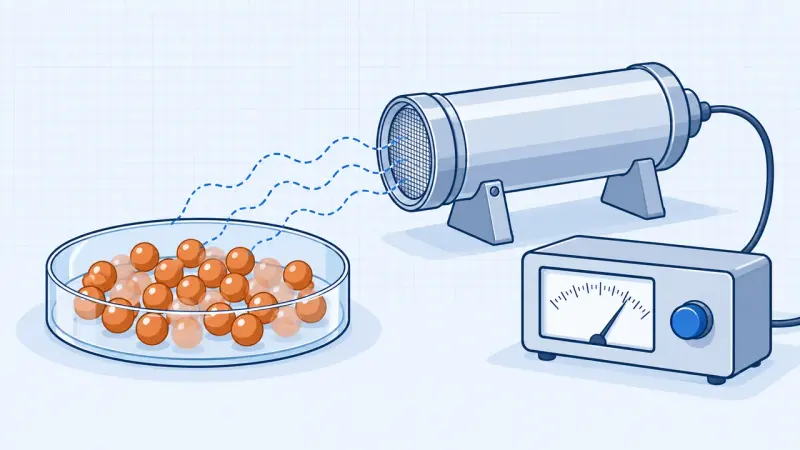
Many nuclei decay at random and a Geiger counter clicks. Even so, after each half-life almost exactly half are left.
The summaries describe the curriculum in our own words. The original text is authoritative. Original text (German): Bildungsplan, Gymnasium, Physics, grade 7–9